Showing posts with label mathiness. Show all posts
Showing posts with label mathiness. Show all posts
Saturday, March 14, 2009

Saturday, March 07, 2009
Assumptions: Quote of the Day
Godel says you have to assume shit; physicists just give an explanation for why it is brown and smelly.
Monday, October 22, 2007
Turning a Sphere Inside Out
Ever wanted to see what it looks like when a sphere gets turned inside out, or simply know what is meant when people talk about turning closed surfaces (like a sphere) inside out? Hat tip to Scott Aaronson for this video:
As it turns out, I actually recognize several of the intermediate steps (for a few of the algorithms they show) as neat-o sculptures that often show up near math departments.
Saturday, July 14, 2007
What is Math?
Apparently, math is within the purview of the Phiolosophia Naturalis blog carnival (*nudge, poke*, suggest articles!), which has got me thinking again of a discussion I had a couple of months ago with a group of MIT alum I didn't know very well. One of the guys in the group was trying to promote the view that math is a science, but the scientists at the table didn't like this idea very much. There are actually three distinct questions at play here. At the most fundamental level, what does "mathematics" mean and encompass, how do we approach and go about learning and discovering math, and how should math be marketed so as to not scare people away from it?
So, is math a science? Webster defines "mathematics" as "the science of numbers and their operations, interrelations, combinations, generalizations, and abstractions and of space configurations and their structure, measurement, transformations, and generalizations." But any real mathematician (except perhaps a number theorist?) would be quick to say that mathematics is about mere numbers. Keith Devlin claims that mathematics is "the science of patterns." I grimaced when I first heard this proposed definition, in part because it shifts the definition from "mathematics" to "science" and "patterns." I think what sets math and science apart is a certain degree of allowed imagination: for example, it is possible to create a self-consistent theory in which gravity goes like r-3 instead of like r-2, and the only problem with this theory would be that it doesn't describe the world we actually live in. One has to go and look at our universe to realize this, however. With math, however, one can theoretically sit in a closed room with a good brain and an endless supply for paper and pencils and derive and prove all of math—in math, something either is or is not true, and there is no way to even self-consistently describe the stuff that isn't true. That is, math is, at its core, universal truth.
From a marketing perspective, though, would it be better to treat math as a science? If the idea is that "numbers are scary" but "patterns are fun," then treating math like something to be explored and investigated instead of memorized might help fewer people get turned off by it. Such an educational approach, however, is the kind that is expensive and difficult to test the results of... though an approach that teaches how there are patterns in the multiplication table rather than insistance on memorization might have benefits. I can't really speak to this, however, since I've never been an educator, and moreso, I can't imagine what it's like to not grasp elementary level math as intuitive.
I had a friend who majored in the "philosophy of math" at Harvard. He said they didn't do math; they thought about doing math. When people actually "do math," i.e., prove new theorems and such, I think the process is rather scientific. You have some idea, a "hypothesis" perhaps, and you start with your assumptions and poke around until you prove or disprove the idea, or decide it's too difficult and the idea needs simplification. Science has a lot of trying new things to see what kinds of results can be produced; in this functional way, perhaps math is much more like an experimental science than a theoretical one, but where the "data" are trains of logical thought rather than measured values.
Of course, there are those who claim that math is a construct of the human mind, and, of course, we have no way of disproving this theory until we can communicate with other species. So you behavioral biologists and neuroscientists better get working on that.
Sunday, May 20, 2007
My Mother, the Math Teacher
The post a while back wherein I mentioned my dad's crazy doings was somewhat popular, so I figure I'll go with the flow and let y'all know about my non-stereotypical mother. Consider it a belated Mother's Day post. The actual impetus is Friday's xkcd comic: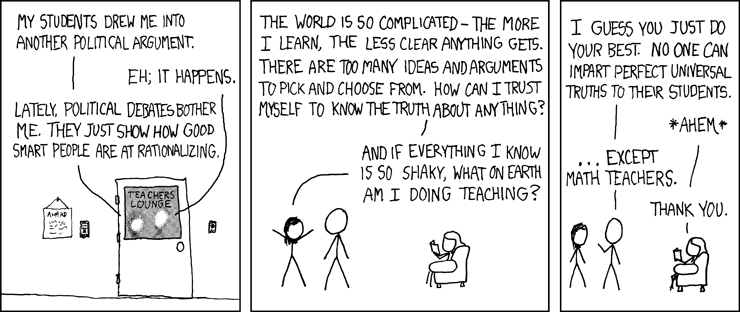 My mother is a chronic middle school math teacher. She half-heartedly tried retiring sometime when I was in high school, but continued to work full time. Then, about a year ago, we had a big retirement party for her because she was quitting for real. So then she worked part-time for most of the last year... and announced earlier this week that she will be teaching part-time next year. My brother and I keep reminding her of the definition of "retirement," but the message does not seem to stick. We think she is beginning to think of herself as a "free lance math teacher." This new job will not be at the school she's been at for the last 15ish years; instead, she will be teaching at a "gender magnet school," teaching 8th grade girls Algebra I and Geometry. This will be her 40th year of teaching.
The xkcd comic also rings true because my mother is not the kind of person who decided what she believes about the way the world should work decades ago, only to stop thinking about it now. She still talks about what she wants to be when she "grows up" ... perhaps she thinks retiring is the same as growing up? Regardless, it's going to be interesting hearing her perspectives on same-gender education over the next year. She says she hasn't given it much thought yet; she took the job because it's a good job, not because it involves teaching in a gender-separated environment. The more I think about it, the more morally opposed I am to gender separation in an academic environment; but then, it's something I've never had to actually experience myself. The teachers and the students are the ones who can attest to how bad or good of an idea it is, and how it does or does not "work." I'm yet to meet a student who has had both co-ed and gender-separated education and believed the gender-separated to be superior.
And, sadly, this is certainly one way to "politicize" math. Jerks.
UPDATE: Comments were disabled for unkown reasons. Everything should be working fine now, though.
Thursday, January 04, 2007
A Googol of Particles?
A few weeks ago, some friends asked me whether or not there are a googol particles in the universe. I copped out at the time, pleading hunger, but it's an interesting question, so I found myself trying to answer it yesterday.
First off, a googol is defined as 10100, or a 1 followed by 100 zeros. It's a big number, which is why the Google people wanted to name their company after it; unfortunately one of their first buyers wasn't very good at spelling... I'm also going to define "in the universe" to mean "in the known, observable universe." Obviously, if the actual universe is infinitely large, then there will be more than a googol particles in it. Second is the question of what we mean by "particle." I'll start by assuming that particle means "atom," specifically hydrogen or helium atoms, since there are relatively few other atoms around. I'm also going to take "known universe" to mean "observable universe," and for both of these terms to refer to the entire observable universe at an age of 13.7 billion years old. This isn't actually how the universe is observed; because it takes time for light to travel to us, the farthest away we can see in the universe corresponds to when the universe was very young. Taking this into account would needlessly complicate the question and the calculations.
To get a feel for numbers of particles in big, massive things: how many particles are there in the Sun? The mass of the Sun is roughly 2 x 1057 times that of the mass of the proton, and since about one out of every four atoms in the Sun is a helium atom (which has the same mass as four protons), there are roughly 1057 particles in the Sun.
So how many particles are there in our galaxy, the Milky Way? The mass of the Milky Way is difficult to define, and we have to be careful to only talk about the baryonic mass for now—that is, the mass that is in the atoms we are trying to count. Let's say it is 1011 solar masses; the number of particles in the Milky Way is therefore 1011 x 1057 = 1068.
From here, we can estimate how many particles are in the known universe if we have a good estimate for how many galaxies are in the known universe. This is a tricky number to estimate, because we can't actually see all of these other galaxies. We are also assuming that the Milky Way is a typical galaxy of typical mass. The internet gives a lot of different numbers for the "total number of galaxies in the universe." NASA's "ask an astronomer" page claims 125 billion, which is the same as 1.25 x 10¹¹; other sources give similar answers, so I'll use 1011. Under these assumptions, we calculate that there are on the order of 1079 "particles" (specifically, atoms) in the known universe.
Another way to do this calculation is to first figure out the number density of atoms for the universe, and then multiply by the total volume of the known universe to obtain a total number of atoms. I don't really feel like going into cosmology right now, but essentially, the density of the universe is inexorably linked with its geometry. We know that that universe is pretty damn flat, so we know what the density is fairly well. ("Flat" here means just what it sounds like; you can think of it as meaning that the three angles of a triangle have to add up to 180°.) This "critical" density is approximately 10-29 g/cm3. This is really really tiny: for comparison, the density of water is 1 g/cm3, the density of air at sea level is roughly 10-3 g/cm3, and the density of air in the best vacuum that can be made on earth is 10-20 g/cm3. Cosmologists tell us that only 4% of the universe is made up of atoms, so the density of atoms is more like 4 x 10-31 kg/m3. The mass of a typical atom is still about the mass of two protons, so this corresponds to about 1 x 10⁻⁷ atoms per cubic centimeter. (If you don't like fractional atoms, you can think of this as about 1 atom in every ten cubic meters instead.) The volume of the observable universe is determined by its radius. Even though the universe is 13.7 billion years old, its radius is not 13.7 billion lightyears; it's actually more like 93 billion lightyears, or about 9 x 1026 m. This gives us a volume of 3 x 1081 m3, and a total number of atoms in the observable universe of about 1077. I put a lot of assumptions and simplifications into these calculations, so it isn't too surprising that they give slightly different results. When I was doing the calculations yesterday, I was getting more like 1080 for both methods.
So we have determined that there are fewer than a googol atoms in the observable universe. This number won't increase by much if we expand the definition of "particle" to mean all electrons and quarks, the most fundamental particles of matter. But what if we include photons and neutrinos? The ground-up way to do this calculation is to start with a number density of photons (approximately 400 per cubic centimeter) and a number density of neutrinos (approximately 200 per cubic centimeter). Multiplying by the same volume as above, we now get a total of 2 x 1089 particles. There are therefore fewer than a googol known particles in the known universe. An easy check this number—as well as an alternate way of doing the calculation—involves using the known baryon-to-photon ratio of roughly 10-10. ("Baryon" being the word used in cosmology for "stuff that turns into atoms.") This is in fact approximately the ratio between the two total number of atoms and the total number of photons (and neutrinos) we calculated.
I said above that there this means that there are fewer than a googol known particles in the known universe. I have already mentioned that once we no longer restrict ourselves to the observable universe then there can clearly be more particles, but the distinction of known particles is important as well. I said earlier that about 4% of the universe by mass is made up of atomic-like particles; about 20% of the universe is made up of some other kind of mass that we don't really know what is, known as dark matter. A popular assumption is that the dark matter is some kind of as-yet unknown, un-detected particle—with some currently unkown mass. Using the calculation above, if there are going to be a googol dark matter particles in the observable universe, then the dark matter particle would need to be about 10-20 as massive as a proton—that's tiny—so stupidly small that it is in fact ruled out by the fact that we observe the universe to have structure. Such a small mass for the dark matter particle would lead to what is known as the "Hot Dark Matter" scenario; essentially, if the dark matter particle has very little mass, then regular matter won't get cold enough to condense and form nice things like stars and galaxies.
In conclusion, a googol is in fact a very very large number.
Subscribe to:
Posts (Atom)