Friday, September 29, 2006

Journal Club Talk: Star Formation Rates

One of the "neat" things done here to help graduate students become accostomed to talking in front of a group of people is a weekly journal club. The idea is that every Friday at 12:30 (usually people bring their lunch) a grad student gives a half hour talk (assuming no interruptions, of which there are always plenty, so it's usually more like forty-five mintues or an hour) on some recent paper. Usually, this paper is completely unrelated to their own research, so that instead of the student "defending" their own work, they are learning new science.

Journal club is one of the aspects of the program here that I gladly tell prospective students about, but personally try to weasel my way out of. In principle, it's a great thing to force grad students to learn how to make effective slides, to become comfortable standing in front of a room full of people, to be able to easily field unsolicited questions. In practice, it's fantastic, as long as I'm not the student in question. I succeeded in not giving a talk last year, but when, on our way to the conference in Japan in June, Paul (who is in charge of scheduling and running journal club this year) found out I hadn't yet given one, I found myself first up on the list for this year, unable to sneak out.

Thus I found myself standing in front of the department today talking about "Radial variation of attenuation and star formation in the largest late-type disks observed with GALEX." I had resolved to not be one of those students who waits until the last minute to prepare, but well, there's this paper I've been procrastinating on for a while, and I didn't get around to mailing it out to the co-authors until Wednesday night... which meant that I didn't start, uhm, reading the paper until yesterday morning.

I felt like I was in Junior Lab all over again, only I actually found the material interesting, wasn't being graded (per se), and didn't have a lab partner to ask questions of. It took me all day to actually read the paper, and I didn't start even making slides until about 5p.m., when I realized that I haven't actually given a talk in over two years. Everyone these days seems to be using PowerPoint... which I haven't used since, I think, 1997? So I dallied for about half an hour, finally deciding that, in fact, LaTeX would be easier.

I finished the slides this morning, and then Paul suggested that I might want to practice. That was about when I started trying to crawl out of my skin. Normally, I don't get the slightest bit nervous when talking in front of a group, but then, normally, I actually know what the hell I'm talking about. This... this, I couldn't have given you a solid definition of "attenuation" or told you how astronomers ("we") estimate star formation rates 48 hours ago. So, I tried practicing, and it was disastrous: I couldn't stand still, I couldn't find any words not etymogically related to "uhm," and I definitely couldn't remember half of what I actually wanted to say.

But the talk wound up going fine, I think. Have you ever been so tired you can't fall asleep? It was like that: I think I was so nervous I forgot to be nervous. There was a plethora of interuptions (before I could even get off the title slide!), which, as I discovered, actually helped. If your audience keeps interupting you, it makes the "talk" more like a conversation than an information dump. Some people get really nervous and upset if their audience can't keep quiet, asks really difficult questions ("But isn't that just bogus?"), or talks amongst themselves. I find that not only do I not mind, but I actually kind of like it: it takes the pressure off me. Furthermore, if need be, I know I can always regain control of the room (since I am standing in front of it).

The paper itself is fairly interesting, and, from what I can tell, important. The most compelling result "concerns the notion of a threshold" of star formation. The rate at which galaxies, or more specifically, regions within galaxies, make stars has lots of implications for galaxy evolution and other areas of astronomy. Unfortunately, we can't just take a yearly (or million-years-ly) census of a galaxy and count up how many new stars we see. Instead, people model what the spectra of stars of different mass look like (how much light they put out at different wavelengths) and the relative numbers and ages of stars of different masses, which can then be turned into "we expect to see this much of this kind of light when stars are forming at this rate." One star formation tracer is quite popular because it involves looking at an emission line from hydrogen, called Hα, which is a very strong feature in red light, which we can see from the ground. People have noticed that in most galaxies, at some large radius, Hα just quits being seen. Since this radius corresponds to a surface mass density, people have also talked about a critical "threshold" density below which no star formation can occur. The star formation tracer used in this paper, on the other hand, is ultraviolet (UV) light, which cannot be seen from the ground (at least while we still have an ozone layer in the atmosphere!). So, the data are from a satellite, GALEX. The main problem with the notion of a star formation threshold is that it's not actually a star formation threshold; it's an Hα threshold. This paper shows pretty convincingly that UV radiation is still seen beyond the threshold at which Hα is observed, which, presumably, means that star formation is occuring. They argue that no more Hα is seen at large radii because really massive stars (more than about ten solar masses) are needed in order to have Hα, and these stars are very rare and die very quickly. When it becomes very improbable to have even one of these massive stars within a large region, then no more Hα will be seen. The UV light, on the other hand, is sensitive to slightly less massive (and therefore more common) stars, and can therefore be seen at larger radii.

Tuesday, September 26, 2006

AstroVino #1: Intro and Component Tasting

Tonight was the first class of the wine tasting class I'm taking this quarter. Offered by and at the home of one of the professors here, Rick, it's a ten week course covering over sixty wines from four continents. We've got a fun astronomy-filled group of graduate students, postdocs, professors, and a spouse or two. The basic goal of the course is for us to learn the language of wine, the kinds of wine we do and do not like, and how to pick which wines might go well with which dishes. (Given some of my past experiences with wines, this is probably a good thing.) Mostly for my own personal edification, I'm going to try to post my impressions of each week's class before I forget all the nice details.

This week we started off with a bit of a history lesson. I personally really like the idea of the first person to taste wine: grapes are stored in a jar, they ferment, some sad soul comes along and decides to fix everything by poisoning themselves, they take a drink, and hey!, everything seems a little bit better...

The first food of the evening was a handful of concord grapes. This was a real eye-opener for me. They tasted like artificial grape flavoring tastes... but in grape form!! Where have I been all these years?! Amazing, simply amazing. We examined how the juice tastes compared to the pulp (which is actually white), how the juice from the dark purple skin tastes compared to the skin and the pulp. And how bitter the stem is. The grape tasting was complemented by an Ohioan wine made from concord grapes.

The bulk of the class was dedicated to "component tasting." Did you ever do that thing in elementary school where you have to make a map of your tongue based on dipping cuetips into sugar water and salt water and bitter water and swabbing it in your mouth? It was like that, but with wine and no little kids going, ewwwwww. We were given a simple base wine (Almaden Mountain Chablis, a white box wine) which had been enhanced with six different flavors. The components were acidity (citric acid), sugar (sucrose), sweetness (glycerine), tannin (... grape tannin), oak (soaked oak chips in the wine), and simulated oxidation (adding dry Fino sherry). Most of the tastes were fairly subtle, but the tannin and the oak were quite strong. Apparently, by the way, if a wine smells like sherry (and thus not like "wine"), it is probably due to an overabundance of acetaldehyde, and means the wine has "gone bad."

The class finished off with an assignment: taste six different wines (three whites and three reds) and try to identify the components in each. The whites were an NV Gazela Vinho Verde (Portugal), a 2005 Reisling Piesporter Michelsberg Spatlese (Germany), and a 2004 Clos du Bois North Coast Chardonnay (California). The reds were a 2004 Milton Park Syrah (Australia), a 2004 Santa Rita Riserva Cabernet Sauvignon (Chile), and a 2004 Louis Drouhin La Foret Pinot Noir. Normally, I shy away from white wines as I have never really liked them, and I usually find even cheap red wines quite potable. I'm also not exactly known for trying new things, but I figure if I'm going to be doing this class, I should try everything.

And so I did. The Vinho Verde, a light fizzy chilled wine, was quite tart; it's main goal in life is to be a refreshing summer wine. The Riesling was sweet and fruity; apparently, wines from colder climates are usually more acidic, but 2005 was an unusually hot season (according to the German sitting across the table from me), which probably explains why this bottle was so sweet. And the Chardonnay ... tasted like oak. And so did the next one. And the one after that. Even after I had some goat cheese on bread, they all tasted like oak. Have you ever been in a wood-panelled sauna? This taste of oak is like that, but consuming your entire head. Even the wines that wouldn't recognize the inside of an oak barrel if they saw it were reeking of oak after the Chardonnay. It's hours later now and I've had ice cream and brushed my teeth multiple times and my nose and sinuses are still asking me what the hell I just put them through.

But at least I know now to shy away from Chardonnays and anything claiming to be oak-intensive ....

Sunday, September 24, 2006

Adventures with arXiv.org

Apparently, I'm a rampaging robot.

I wanted to look something up in a paper I've written, and obviously, finding it on astro-ph is easier than going to a terminal opening it from *gasp* the hard drive, or even worse, standing up and trying to find a paper copy on my desk. At least, this was indisputably clear to me, until I clicked on the convenient PDF button, and instead of being given the PDF, I was told:

Access Denied

Sadly, you do not currently appear to have permission to access http://arxiv.org/pdf/astro-ph/0606460


Mm. So this is amusing. It's also not the same error message you get if you're trying to access a paper that hasn't yet been made public. The page does include a link to their explanation of Access Denied, though:

Access Denied

Accesses from your site have triggered our automatic robot detection system. (Sometimes a block is caused by another user from behind the same proxy.) Blocks are usually removed automatically after about a week.

I sent them an email in response. I said,

I'm not a robot. I am a graduate student.
The meat of their automated reply was—and I paraphrase here—"blah blah blah orange elephants blah blah." They closed with—and this part is a direct quote—:
Message joins 79 other compelling messages current in queue.
Have a pure day.
Hopefully they'll be able to discern the stubtle different between the two worker classes, and I won't be forced to use a mirror site for a week.

Friday, September 22, 2006

The Undergrads Are Back

Well, Wednesday was the first day of classes (quarter system, hence, oddness, but that's another post). The most noticeable change between this week and last week is that the undergrads are back. The only upside of this I can see is that now the restaurants near campus will once again have reasonable operating hours; on the other hand, now there will be hordes of people at them as well ...

The astronomy department here is situated on the top floor of one of the chemistry buildings. One the first floor is a little coffee stand that also serves cold sandwiches and pastries. There are 40,000 goddamn undergrads at this school, and I swear, at certain times of day (like noon) they are all on the first floor, milling around the elevator. And then they look confused when the elevator doors open and people want to, you know, get out?

Most of them manage being lost and confused without actually moving, but some of them need a little nudge. These are the ones you find on the stairwell between the second and third floors looking for the basement (it's completely irrelevant that there are no classrooms above the 2nd floor, by the way). Or they wander into an office on the fourth floor (that no one can find if they are looking for it) trying to find a room in a different building.

Then there's the girl who visited our theoretical spectroscopy class this week. It's about one minute before the bell rings (yes, we have bells; yes, this is a "real college"; yes, it's demeaning; yes, I jump about ten feet every time it goes off and I'm standing near it; apparently a past president was a former high school principal and the university has never quite recovered). The professor is standing there at the front of the room, you know, in front of the chalkboard, talking about the densities and temperatures of tokamaks and the broad line regions of active galactic nuclei. And this girl, the type with the long hair that she probably spent an hour that morning trying to make look "natural," with the jeans that ride just a little too low and the shirt that's just a little too tight, walks in, completely oblivious to the fact that there's this man talking. "Hi guys," she says, smacking her gum. And she sits down on the far side of the room ... and right around then, the professor is done speaking (he had successfully completely ignored her entrance), and so we all get up and leave. She looks flabbergasted, like she can't figure out why we're all getting up and leaving ...

Then there are the ones who want me to join their clubs or sign their petitions or whatever the hell else it is they're trying to do. And I can't help but laugh when I'm just walking along, minding my own business, and someone comes up to me and asks if I want to enter to win $25,000 for grad school...

Tuesday, September 19, 2006

McArthur Fellowships

The McArthur Fellowships were announced today. One of the winners, Josiah McElheny, made a sculpture of the Universe entitled "An End to Modernity," with a good deal of scientific coaching from a professor here, David Weinberg. Art and cosmology simply aren't combined in an intelligent and beautiful way often enough.

Monday, September 18, 2006

Overdue Supernovae

We're overdue a supernova or two. (A supernova is the violently explosive death of a (usually) massive star.) The Milky Way is believed to have a supernova rate of one or two per century, and yet, there has not been a supernova observed in our home galaxy since the advent of the modern telescope (in round numbers, let's say that was 100 years ago).

There isn't really a problem here, other than the fact that this is kind of annoying and we astronomers will fall over ourselves in a melee of sheer giddiness while pointing every telescope known to mankind at the thing when it finally happens. The reason it's not a problem is thanks to "small number statistics"; there have been about half a dozen supernovae in our Galaxy in the last millenium. We've simply been unlucky.

The supernova rate for a given galaxy is usually based on a measurement of the star formation rate. This may seem a little counterintuitive, but supernovae precursors are (usually!) massive stars. Massive stars have a much shorter lifetime than lighter ones; the lifetime of our own Sun is about 10 billion years, while the lifetime of a star ten times heavier is more like 10 million years. If we see a young star die, we know that it was born recently. Turning this around, if we can measure the rate of star formation, we can estimate a supernovae rate.

Star formation rate measurements are usually based on measurements of the density of ionized gas, since star formation and young hot stars will ionize the gas they are sitting in. More locally (and more simply, and more sexily) we can watch radioactive isotopes decay. Aluminum-26, which has a half-life of 746,000 years, emits a gamma ray with an energy of 1.81keV when it decays. So, by looking at the strength of this emission in the Milky Way, an estimate can be made of the Galactic star formation, and thus supernovae rate. This has been done, estimating a supernovae rate of about two per century.

So we know we're due. It will happen; we just have to be ready. And while we're pretty damn sure we'll notice it by the fact that it'll signal thousands of events in sitting happy neutrino detectors,* it's an interesting question as to whether or not we'll actually be able to get all of the information feasible from it. As I see it, there are two basic problems. The first is noticing it. The Milky Way takes up a rather large fraction of the sky, but there are all-sky monitoring surveys either already in place or on the drawing board. For many of these, however, "all-sky" really means "all of the sky we can see without looking in the plane of the Galaxy because it's really messy down there." Unless the supernova goes off nearly opposite the other side of the center of the galaxy from where we are situated and we can't see it becaues there's just so much other junk between us and it, I doubt that detection will be a problem. Historical supernovae are just that: they were bright and noticeable enough to sometimes even be noted by the casual observer.

No, no, what is much more likely to be the real kicker is the fact that telescopes and instrumentation have been designed for observing really faint objects, or really far away objects. Not incredibly bright nearby ones, which is exactly what a Galactic supernova would be. If it goes off while we've still got working space telescopes, will any of them even be able to take a snapshot of it without it saturating the detector or worse? The large telescopes that the majority of the astronomy community is gravitating towards are not ideally suited for studying bright nearby stars. If our nearest neighbor, Andromeda (also known as M31), gets around to having a supernova (Andromeda is also stalling on killing off stars lately, it seems), though, we might be better prepared to stare at it with all of our lids open.


* On the other hand, apparently dropping a wrench near the big neutrino detecting water tank can cause thousands of events as well...

Wednesday, September 13, 2006

Today's Headaches

I've seen this blog advertised as "a good insight into life as a grad student." With that in mind, think of this post as more of a delicate description of day-to-day educational hazards than as the wry whining it is more likely to actually be.

So, my summer vacationing officially over, I came upon the surprising discovery today that September arrived without my noticing or approval. Unfortunately, I have a lot to do before the final day of September rolls around: I need to register for classes and sign up for health insurance, prepare and give a journal club talk (which is required to be on a paper or set of papers unrelated to my own research, which is to say, on a topic about which I am currently ignorant), and write up a conference proceedings. I would also really really like to be done and finished with this paper I have been stalling on for almost a month now. Clearly, the easiest-to-accomplish of these options is registering for classes.

Or so the naive would believe. I am starting my fifth quarter here, and as of yet, I have not managed to get through a quarter without some kind of registration snafu. First quarter, there was the issue of Ohio State deciding to issue me a completely random social security number (which, unfortunately, doubles as a student ID here). I, of course, did not have knowledge of this random set of nine digits, and therefore registering for classes with my own SSN was... tricky at best. This was easy enough to resolve, though.

Second quarter, I easily registered for classes, but about halfway through the term I started getting angry letters from the Bursar's office telling me they would kick me out of school if I didn't pay my tuition. Now, this was interesting, as I am not responsible for paying my tuition—my department is. Around this same time, I got a bill for one of my student loans, including a late fee. Uhm. I'm a student. My student loans aren't supposed to have payments due while I'm still in school. Turns out, one office had come to a full realization concerning my actual social security number, but some other office hadn't exactly gotten the message, and so my tuition had in fact not been paid, causing other offices to inform my lenders that I was no longer a fulltime student.

The problems involving registration for third quarter were actually all my fault, if I remember correctly. I was busy: I was observing in Arizona for over a week, and then there was spring break, and I just kind of forgot to register for classes. Whoops. And I was still trying to convince my lenders that I was a fulltime student, but I ... wasn't registered for any classes. So I got to spend a few hours running around a maze-like building writing checks of various amounts and calling my officemates for various passwords until I could actually register for classes.

Fourth quarter (summer quarter), I didn't register for "classes" until the very last day possible to do so without paying a fee. In the summer, we are still supposed to be fulltime students, and so we register for a full load of research with our current advisors; I waited until I knew who my new advisor would be before registering. No problem. Except I accidentally typed in "1" instead of "15" in the "number of hours" slot. It told me so; I went back and changed it, leaving the country thinking everything was hunky-dory. In Japan I got an email asking me why I had registered for only one hour, but that it would all be taken care of.

About a week ago, the graduate studies director for our department stopped by my office with a piece of paper, asking me why I was registered for no hours, and why I am a Master's student instead of a PhD candidate. Other than constant ill-luck with these sorts of things, I honestly didn't know, and said as much. I was, though, greatly amused at having yet another thing to add to my litany of registration snafus.

The amusement stopped abruptly around 11:26 this morning, when I tried to register for classes, and more importantly, sign up for student health insurance. The webpage claimed I am not eligible for health insurance because I am not a full-time student. This is unfortunate, as I would really like to have health insurance. After some increased back and forth with various parties, I learned that someone somewhere forgot to fill out some form, and everything should be taken care of shortly...

Tired, hungry, and grumpy, I then went to AGN lunch. AGN lunch is usually quite fun, not least because one selfless grad student takes Chipotle orders from people in the department beforehand, goes to Chipolte and brings back lunch for everyone. The burritos and burrito bowls are all numbered and laid out sequentially on the back table in the conference room. Today, however, my burrito was missing. The neatly ordered numbers simply skipped that everso important second odd prime. Tired, very hungry, and very grumpy, I went and fetched my own lunch instead.

The rest of the afternoon dragged on as I stared at the computer screen, each sentence I wrote looking suspiciously similar and as content-less as the one I had just deleted. At some point, the selfless Chipotle grad student brought me a bag of Werther's in apology for the lack of burrito, which cheered me up for maybe half an hour. A deep headache set in, the kind where anything hard and sharp (such as the edge of a desk) eyes me as if everything would be better if it rammed into my forehead at a high velocity. Coffee didn't work. Tylenol didn't work. Water didn't work. And worst of all, I was still wishing the weekend hadn't yet ended.

Now, I am a moody person. Those who know me will laugh at the understatement of this fact. The relevant aspect of said moodiness to this story is that many of my decisions are made based on my mood: what to wear, what music to listen to—and what to eat. And this particular mood dictated that a bag of Doritos was in order.

With barely enough change, I went over to the next building and put my quarters into the snack machine. A-7. The satisfying spiraling of the coils holding the bag—aaaand it just hung there, just barely, but most securely hanging there. In a heavy machine I could try with all my might to rattle, and never succeed.

About an hour and negative two sentences later, I mustered up the composure to borrow a dollar from someone, and tried my luck again at vending machine roulette.

I won.

I spent the next half hour or so happily downing half a bottle of Coke and one of the bags of Doritos, and even managed to squeak out three sentences or so of this paper. By then, of course, it was definitely time to go home.

Hopefully tomorrow will have less of a headache and more productivity.

Saturday, September 09, 2006

Free Wireless

I learn something every day. Apparently, the clustrmaps website is offensive, sexual, illegal, or harmful to my computer system. I know this because the Columbus airport blocks such sites, and said site is indeed blocked.

Driving here this morning, I also learned why a rear windshield wiper is useful. I then learned that US Airways apparently charges a $25 standby fee, though this fee doesn't apply to tickets "purchased" with frequent flyer miles.

Hopefully after this short sojourn, I'll be in the mood to learn about more... universally applicable sorts of things.

Thursday, September 07, 2006

BMV

I spent four hours and six hundred dollars at the Bureau of Motor Vehicles today, leaving with a piece of colorful paper, some painted metal, and a driver's licence that expires not only before I plan on moving out of Ohio, but also four years earlier than the licence I posessed when I woke up this morning. "I feel like I just made out with a meteor shower." And there's nothing like that look after the eye exam (taken after I've confirmed that I have to wear corrective lenses) and the lady asks, that was without corrective lenses? No, no no, I'm wearing contacts. Oh. Yes, that's the look, that one right there—worth every penny.

I am also now a registered voter of Franklin County, Ohio—the only free of charge accomplishment of the day.

Saturday, September 02, 2006

Vietnam's National Day

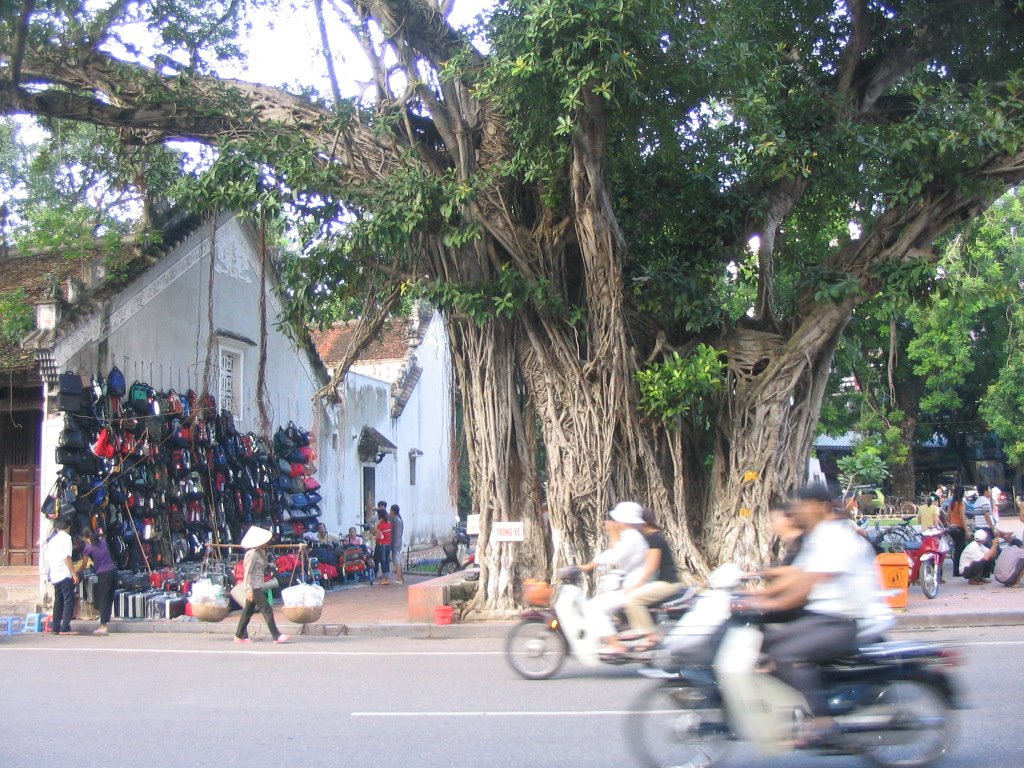
My father and I left Hanoi for the States a year ago today, after a full month touring southeast Asia. Coincidentally, September 2 is also Vietnam's National Day. We had managed to miss the Queen's Birthday in Thailand by a day, Malaysia's National Day by a few weeks, and Singapore's National Day by two days. But for Vietnam's National Day, we were in the capital, trying to get out, and staying within near spitting distance of the Vietnamese equivalent of the Esplanade on the Fourth of July. Both of us were in a horrendous mood; my father's wallet and glasses had been stolen as we squeezed through half a mile of ass-to-stomach thick crowd the night before, and I didn't know whether I more wanted American food or to walk down a hassle-free Walmart aisle.

Our flight out was shortly before midnight, so we took our last dinner at the cozy backpacker's place we had already frequented on a number of occasions. While my dad was shooting off a final email to my mother, I had a few drinks and made a final purchase of a 750mL bottle of Da Lat red wine. I hadn't actually had any on the trip, and we hadn't actually made it to Da Lat, which is in the mountains north of Ho Chi Minh City (also known as Saigon). Next time I'm in Vietnam, I'll definitely try to get there; we simply didn't have time on this trip.

We trudged back to the hotel, going well out of our way to this time avoid the burgeoning masses of people around the lake, getting back around 7:30 or so. The roads around our hotel were completely blocked off, and it only took about ten minutes to realize that "we ordered a taxi for you" really meant "I have no idea what you said, but I don't want you mad at me." So we walked away from the commotion for a few blocks, looking for someone to give us a ride to the airport.

Now, for those of you who haven't had the distinct pleasure of travelling somewhere where they can tell you're a foreigner by the color of your skin (please note that this is not an issue in the U. S. of A.) and where everyone knows that you can take advantage of a foreigner because they are endless fountains of money, let me explain something. One of the main reasons I was so ready for this slightly-too long trip to be over was that I had begun to cultivate an intense desire to be able to walk down the street without every other person yelling at me, Hey lady, want a taxi? Considering this, there is a strong level of irony to the fact that we had a hell of a hard time finding someone willing to give us a ride to somewhere else for the exchange of a few colorful pieces of paper.

We eventually found two guys on motorcycles, and realizing this was the best we were going to get, decided on a slightly too high price, and set off. There had been a bit of discussion over the word "airport," and then some arguing between the two of them as to, presumably, the best way to get there, but it was good to be on our way.

We arrived only about twenty minutes later. At the (closed) Vietnam Airlines head office. I honestly do not think that either of these gentlemen really knew what an airplane or an airport is. But they wanted their money. And explaining to them that they hadn't taken us where they told us they would didn't really work. And we really really needed to get to the airport.

At this point, the streets were completely packed, we were out a decent bit of cash (wallet stolen and all, we had a finite amount, see), and now no earthly clue as to our location, except that there probably wasn't a plane headed to Seoul within a mile.

One advantage to the street being at a standstill is it wasn't too difficult to find a cab. We agreed on a definitely too high price, and climbed in. And just sat there. And moved a little bit. And then sat there some more. Sometime between getting off of the motorcycles and into the cab and the cab not really going anywhere, the fireworks had started. Now, in the U.S., if you're in a car, and you're on the road, even if it is July 4th, if fireworks start going off, ... you keep driving, right? Right? You don't stop the car, get out, and watch the fireworks, even if you're in the middle of making a left-hand turn. This is probably because most people in the United States have actually seen fireworks before... as one kind woman about my age explained to us as we were trying to get the Red Traffic Sea to part, "But it's our National Day! Everyone is so excited!"

The only car that made any perceptible progress for the next half hour was the taxi (originally) next to us, with six people in it, most of whom were hanging out of the windows yelling and motioning at everyone else in the traffic jam. I think they were everso calmly explaining, "We've got a lady giving birth in the back seat, so please move over so we can get through."

Once the (rather brief, even if you are worried about missing an international flight) fireworks display was over, and we were definitively on our way, I recognized a familiar tune in the instrumental music on the radio. It was a forty-five minute ride out to the airport, we didn't miss the flight, and I was only mildly scolded by the immigration agent because my visa expired on the first of September. As I was moving shortly after returning, I even had the joy of going to Walmart almost daily for a week.

And now I've been here for almost a year. When my parents visited a couple of weeks ago, I marinated some steaks for them, and my dad opened up the bottle of Da Lat wine I had been saving for a special occasion. We toasted and sipped. Only one sip each. It was... earthy, in that thick muddy black dirt under your toenails kind of way. At least it'll make for good cooking wine...

Friday, September 01, 2006

Weak Lensing

All of the (physics) research I did as an undergrad related in some way to gravitational lensing. As papers with long author lists often take a while to go through the do-the-work-then-do-more-work-then-someone-writes-it-up-then-argue-over-what-got-written-up-then-try-to-publish-it process, it's no big surprise that a paper on "high precision weak lensing analyses" based in part on work I haven't touched in two years now showed up on astro-ph this week.

Gravitational lensing refers to the bending of the path of light due to gravity. If there is mass between us and some faraway source (which for something sufficiently far away, there always is) then that mass will act as a lens and distort how the source appears to us. If the source is very close to directly behind the lens, the source's image can be so distorted that a single galaxy is stretched out into an arc, or even have multiple images. This is known as strong lensing. In weak lensing, the background image is only slightly distorted; for instance, a perfect circle might be sheared to appear slightly elliptical. The neat—and useful—thing about gravitational lensing is that it is only susceptible to where the mass is—and that's it. Even if we can't "see" the mass. The other incredibly alluring aspect to graviational lensing is its (albeit, somewhat superficial) simplicity: all we need is a working theory of gravity. That's it. One theory. No chemistry, no convection modelling, no particle physics, no theory of galaxy evolution or anything else of the like.

We define the "ellipticity" of an object to be (1 - b/a), where b/a is the axis ratio. (If it's a circle, for instance, then the long axis and the short axis are the same length (the diameter), so a circle has zero ellipticity. A straight line, on the other hand, has an ellipticity of 1.) The effects of weak lensing are very very small—only on the order of a few percent—and since a typical galaxy has an ellipticity of tens of percent, it's impossible to measure distortions due to weak lensing for a single galaxy.

This doesn't stop us, however, from measuring the effects of weak lensing on lots of galaxies. Specifically, lensing doesn't happen haphazardly; the direction along which a galaxy is sheared tells us about where the mass is that is doing the lensing. The idea is that if you have some field of un-lensed galaxies, then they should be randomly oriented, and have an average shear of zero. On the other hand, say we have some lensing mass (like a cluster of galaxies) then the average shear of the background galaxies is not zero, and we can figure out how the mass is distributed in the cluster.

Now, this sounds all fine and dandy, but there are two very difficult steps. The obvious one is that "measuring the shear" of a galaxy isn't exactly the most straightforward procedure. Sure, you can just measure the axis ratio, but unfortunately, it's not nearly that simple. Galaxies are very complicated creatures, and deconvolving the galaxy's inherent properties from the changes due to lensing is... tricky. Is it better to directly measure the shape moments of the galaxy, or do you take an idealized model of a galaxy and stretch and squish it until it looks like the one in question? We don't really know.

The much more subtle problem is that of the PSF, or point spread function. See, data have this unfortunate feature of not being ideal. The PSF is one of the descriptions of how data can be annoying; it describes how a single point of light is spread out into a blob. When you see spikes on images, for instance, they are due to the PSF. The irritating part is that the PSF often has an ellipticity on the order of a few percent (just like the shear signal we want to measure!), varies with time (so not all of your images have the same PSF), and can vary across the detector itself (so that the PSF on the left-hand side of the image is different from on the right-hand side). The PSF must be accounted for before the shear can be measured, and a mis-estimation in the PSF's properties can lead to a mis-measurement of the shear signal. And then, assuming the PSF is perfectly modelled (unlikely), is it better to just subtract the PSF's ellipticity from that of the galaxies, or should we attempt to deconvolve the galaxy and the PSF? Again, there are arguments both ways, but no clear answer.

This recent work is part of a courageous attempt to try to determine which measurement methods work, which don't, and, more importantly, why. This is perhaps more effective than the scientific equivalent of lots of people saying, "mine's better than yours because I like mine and I don't like yours." What we have done is to make a set of simulated images, with realistic PSFs, realistic galaxies, and realistic noise, like what one would get from data taken at a large ground-based telescope. Most importantly, a shear was applied to each image which could then be measured. (My contribution to this work, by the way, was in making the simulated images.) Different people threw their weak lensing analysis pipelines at the images just like they would real data, and from their results, we can now quantitatively talk about why a certain method is more effective at correcting for the PSF than another method, or in what situations certain methods are more or less effective at measuring the shear. Other factors potentially affecting shear measurment, such as how galaxy evolution and—get this—pixel size, are also becoming clearer. The cautionary bit is that anyone doing or planning on doing a weak lensing survey should strongly test their measurements methods on simulated data. The good news, though, is that "high precision" weak lensing is in fact possible.

Wednesday, August 30, 2006

The Red Car, update

The Red Car! Here this morning, but now, gone! Yay!!

... the parking lot looks so empty now.

Sunday, August 27, 2006

Renmin Square, Shanghai

This afternoon I used the department Windows box to upload some photos and try my hand at making panoramas using Autostitch. The program was remarkably easy to use, but unfortunately is only available for Windows. Here's the panorama from Shanghai:
This is outside of the entrance to the People's Museum, in Renmin Square (People's Square). I don't know what's up with the green part in the middle-left, but not bad for a first try, eh? It wasy very cloudy and horribly smoggy the entire time I was there; let's put it this way: there was apparently a full moon while I was there, but I have no memory of ever being able to see any moon at all. I took the pictures that comprise this panorama my first day in the city (after having spent a week on the Fudan campus). It was nice to see a real city ... the Fudan campus was rural enough (which is to say, not terribly, but still) that the cicadas were deafening. I like all of the crazy looking buildings... Shanghai is still in the middle of a huge construction boom, but apparently (and I have no way of knowing if this is true or not) many of these new buildings are fairly empty... but they look pretty and China can tout about how progressive they are.

Tuesday, August 22, 2006

The Red Car

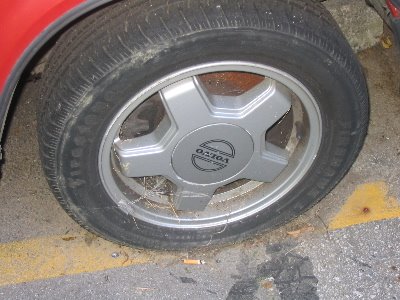
There's this red car that has been parked—badly—outside of my apartment since the day I moved in nearly a year ago. I've watched dead leaves gather around its ever-flattening tires, snow and ice take longer to melt under its bumper than elsewhere, and more recently, spider-webs grow on its front grill and wheels. I used to be mildly annoyed that I have to walk around it every morning and every night, but now, I want it gone. It is no longer a mild amusement: now, it's in my way. You see, now I have a car, and I want that parking spot. But no, no no, it has a parking sticker saying that not only does it belong to one of my everso delightful neighbors, but also that it can legally keep its rotting ass right there.

Some people would try to draw an analogy here, something about how people with great talents and skills never seem to fully appreciate or use what they have while the "rest of us" have to work for what we get. Or something about having cake? Or is it ice cream? Mmm... ice cream...

Thursday, August 17, 2006

Obligatory Planet Post

I have this vague memory of kindergarten, or elementary school, or sometime, when all the other kids were really into the planets. Me? I really couldn't care less. They seemed so... boring. I simply didn't care which order they came in, or when they were discovered, or what color they were, or whatever other nonsense people could come up with to talk about regarding these spheres with funny names.

It naturally follows that fifteen or so years later I decided to become an astronomer.

Now when I hear about "planets," I don't normally think first of our own Solar System. About 200 planets orbiting stars not our own have been discovered to date. As much has been speculated, but very little is actually known, about planet formation, it is very interesting indeed to think we might someday be able know what distributions of mass, distance from the parent star, brightness of planet star, etc. etc. planets take on. But our own Solar System? It's essentially one data point. Granted, it's the data point we know (and care) the most about, and since it's the one we can study the most about, we certainly should.

And so this week I have been getting a bit of a deja vu: "do you think Pluto should be a planet?" Well, the thing is... I don't really care. Neither, really, does any other astronomer. It's a definition. Nomenclature. Convention. Perhaps if we knew exactly how bodies orbiting stars formed then we could discover there is an obvious way of defining a "planet," but, well, we don't.

Personally, I think I like the current IAU proposal (I've posted the text of the actual proposed definition below). Like most people, my reaction went something like: "Ceres? ... Charon?!" But after reading the proposal, it mostly makes sense now. I think I can see what they were thinking, which is... good.

The reason I like the proposal is two-fold. First of all, I like that it acknowledges the eight "classical" planets. The terrestrials (Mercury, Venus, Earth, and Mars) and the gas giants (Jupiter, Saturn, Uranus, Neptune) just seem like the should be considered separately from the other minor bodies in the solar system. My real attraction to the phrase "classical planets," however, is that these are not the classical-in-the-real-historical-as-in-Greek sense: the word "planet" originally meant "wandering star" and referred, understandably, to the objects that moved across the sky in a detached manner from the background stars. The original seven planets were the Sun, the Moon, Mars, Mercury, Jupiter, Venus, and Saturn. Why else would there be seven days in the week?

My second reason for liking the proposed definition is that it appears to be physically motivated. Even if the proposal is not approved, people around the world are not merely aruging over "oh no! they're demoting Pluto!! poor pluto!" but actually being forced to think about the physical differences between different kinds of objects. Why is our Moon not a planet, but Charon is? (Hint: the center of mass for the Earth-Moon system is beneath the Earth's crust, while the center of mass for the Pluto-Charon system is not located inside either rock.) And, of course, it amuses me to no end to think of all the hapless souls in the non-scientific general public who, for whatever reason, have "always been interested in astronomy" and are now actually being forced to think a little bit about the conventions and panoramas they were taught in third grade.

Now, I didn't go through the "dinosaur stage" when I was six years old, either, but at least no one can count the current number of dinosaurs on their fingers. On the other hand, not everyone openly acknowledges that the dinosaurs actually existed ...

Current proposed definition of planet from the IAU:
Draft Resolution 5 for GA-XXVI: Definition of a Planet

Contemporary observations are changing our understanding of the Solar System, and it is important that our nomenclature for objects reflect our current understanding. This applies, in particular, to the designation "planets". The word "planet" originally described "wanderers" that were known only as moving lights in the sky. Recent discoveries force us to create a new definition, which we can make using currently available scientific information. (Here we are not concerned with the upper boundary between "planet" and "star".)

The IAU therefore resolves that planets and other Solar System bodies be defined in the following way:

(1) A planet is a celestial body that (a) has sufficient mass for its self-gravity to overcome rigid body forces so that it assumes a hydrostatic equilibrium (nearly round) shape[1], and (b) is in orbit around a star, and is neither a star nor a satellite of a planet.[2]

(2) We distinguish between the eight classical planets discovered before 1900, which move in nearly circular orbits close to the ecliptic plane, and other planetary objects in orbit around the Sun. All of these other objects are smaller than Mercury. We recognize that Ceres is a planet by the above scientific definition. For historical reasons, one may choose to distinguish Ceres from the classical planets by referring to it as a "dwarf planet."[3]

(3) We recognize Pluto to be a planet by the above scientific definition, as are one or more recently discovered large Trans-Neptunian
Objects. In contrast to the classical planets, these objects typically have highly inclined orbits with large eccentricities and orbital periods in excess of 200 years. We designate this category of planetary objects, of which Pluto is the prototype, as a new class that we call "plutons".

(4) All non-planet objects orbiting the Sun shall be referred to collectively as "Small Solar System Bodies".[4]


Notes:

1 This generally applies to objects with mass above 5 x 10²⁰ kg and diameter greater than 800 km. An IAU process will be established to evaluate planet candidates near this boundary.

2 For two or more objects comprising a multiple object system, the primary object is designated a planet if it independently satisfies the conditions above. A secondary object satisfying these conditions is also designated a planet if the system barycentre resides outside the primary. Secondary objects not satisfying these criteria are "satellites". Under this definition, Pluto's companion Charon is a planet, making Pluto-Charon a double planet.

3 If Pallas, Vesta, and/or Hygeia are found to be in hydrostatic equilibrium, they are also planets, and may be referred to as "dwarf planets".

4 This class currently includes most of the Solar System asteroids, near-Earth objects (NEOs), Mars-, Jupiter- and Neptune-Trojan asteroids, most Centaurs, most Trans-Neptunian Objects (TNOs), and comets. In the new nomenclature the concept "minor planet" is not used.

Sunday, August 13, 2006

Mind and Body

As my parents are coming into town on Tuesday, and spending the night at my place, I clearly need to clean up my apartment so I don't hear about how much of a slob I am for the next 47 years. And as I didn't particularly have any other plans today, the idea was nominally to do laundry while turning my apartment upside down and shaking it, perhaps with some bleach, so that it is as spotless as possible.

Needless to say, I stumbled upon the brilliant idea this afternoon (when faced with the choice of Doing Stuff or sitting on my couch watching Babylon 5 or The Twilight Zone) that my purposes would be much better served if I waited until tomorrow to go on a cleaning rampage. So I watched a DVD, wasn't in the mood to have my laptop on my lap for another two hours, and yet still had to come up with something to put off the impending doom.

So I exercised. I lifted weights, I went for a run (nearly ten whole minutes!), and I even stretched. Now, you have to realize, this never happens. Every few weeks, I resolve to "get in shape" or to "go running every other day" or to "at least lift weights to work on alleviating RSI." But it never happens. Even when I do get the occaisonal whim to try to do something physical, it's not strong enough to, you know, actually get off the couch and do something about it.

Today the random though got took control of me when I started off by trying to meditate for ten minutes. I really like the idea of meditation, of solidifying the connection between the mind and the body. This is a connection that is often ignored, even eschewed, in western culture. It's got a bad reputation. To concentrate on or care about such an intangible is what hippies do (and no one actually takes hippies seriously). Even simply caring about the capabilities and explorations of the mind is thought of as weird, or linked with drugs (and, as we all know, drugs are bad). The whole language surrounding how the mind and the body are linked reeks in fou-fou nonsense (e.g., "energy flow") that can't actually be backed up by, you know, science. Nevermind that that's because science just hasn't gotten there yet.

I first became interested in the idea of "meditation" (the term I'll loosely use for the idea of exploring the mind-body connection, though they are clearly distinct) when in Thailand for the first time, in January 2004. My father and I were motorcycle riding around the mountains in northern Thailand for about two weeks, and since this was a vacation after all, we had an hour-long massage each afternoon. Sometimes two. I got hooked on the Thai massage; it's an interactive experience, full-body (starting at the feet and moving up to the head and face), complete with various stretches. "Normal" (i.e., "Swedish") massage often focuses on relaxation, on having you be as calm and peaceful and out-of-it as possible by the end. Thai massage is entirely different; at the end of a good Thai massage, I feel indescribably alive, ready and able to do anything and everything, envigorated and enthused about life itself. This result, to me, is the desired outcome of a deep meditation. I want to learn how to funnel what energy I have into action, into thought.

The basic idea is simple: if I can become a happier, more productive, more energetic person by focussing on not merely what my mind is doing, but also my body, then, well, I should give it a try. I might even become healthier in the process.

Obviously, it's unreasonably, on a whole host of levels, for me to have a daily Thai massage while in Columbus, Ohio and trying to change the prefix adhered to my name. I know I am, in general, guilty of completely ignoring my body until it starts complaing that it wants something or doesn't like something else. Most of the time, it's just this thing I use to take my senses from one place to another, and, most of the time, said senses are merely used as information gatherers. Not exactly a two-way channel. Sure, there's comfort food, which isn't exactly healthy per se, but it's amazing how much better a bag of Doritos can make me feel (let alone a Coke or a nice cup of coffee, but caffiene is a whole other matter for consideration). And it's true, like most people, I get a mild euphoria after running for even five minutes (but it's very difficult to use that as a motivating factor before-hand). Similarly, I have also considered taking up dancing; the summer I spent at Caltech, I went swing dancing several times, though I can't definitively say that was a source of my high productivity and energy levels that summer.

So... what about meditation? How does it work? Everything I can find on the internet is about "relaxing" and "letting it all go" and "de-stressing." Uhm, no thanks. While sitting Indian-style with good posture does feel good for a little while, it doesn't exactly make me want to go figure out how the universe works. Is there a type of "meditation" that energizes instead of puts to sleep?

More along the lines of (mentally) concentrating on physical movement, there's qi gong, which I have mostly heard about from a friend for whom it has been most effective. I have had trouble with RSI (repetitive stress injury) for several years; while it's not as bad now as it used to be (at one point I was unable to open plastic bottles or doors with circular knobs) I still have to be careful not to hurt myself. I don't know much about qi gong, but I am interested in learing more. Apparently, all this would require is getting up early on Wednesdays, as the OSU medical center has recently started offering free weekly classes on qi gong.

But all of these ideas require actually doing something in order to, you know, do. And garnering the motivation to do stuff isn't exactly one of my fortes lately ...

Wednesday, August 09, 2006

Hubble "Constant"

I went through this stage once where I didn't read the news, at all, for about three years. The entire list of reasons is enough for a whole other post, but one contributing factor was certainly that every news article I have ever read about something (or someone) I actually know something about has made me want to scream due to mistakes ranging from raw factual errors or subtle misinterpretations.

The latest hubbub about oh-no-the-universe-is-15%-bigger-than-previously-thought proves to be no exception. Sigh. The article has it all right, far as I can tell, but it's the twist, the buzz, the headline-producing propoganda that has me annoyed.

In a nutshell, the Hubble constant, H0, relates how fast, v, an object (say, a galaxy) is moving away from us to its distance, d, from us in a simple way: v = H0d. The neat part is that, with very few other assumptions thrown in, the Hubble constant also tells us the age of the universe. So, we want to know this constant pretty badly. Velocities are fairly easy to measure, but distances... distances are hard. Relative distances aren't all that bad (e.g., "this galaxy is about twice as far away as that galaxy") but absolute distances are very difficult (e.g., "that galaxy is 50 kiloparsecs away").

For a long time, people have been anchoring their distance scales to the Large Magellenic Cloud, or the LMC. (For those of you who, like me until a year ago, never realized that the southern and northern hemispheres really do see different parts of the sky, the Large and Small Magellenic Clouds are two small dwarf galaxies orbitting our own Milky Way. They are so named because when Magellen's crew went sailing through the southern hemisphere, they were kind of confused as to why these two clouds always seemed to move with the sky, see...) The LMC kind of makes sense: it's close, and therefore easy to see, so it should be fairly easy to get a distance to. Right? Wrong.

So as I don't want to get into a whole discussion of how distances are measured, suffice it to say, for now, that people are always looking for new, independent measurements. The exciting thing about the M33 distance is that it's just that: a direct measurement of the distance to M33, independent of this fuzzy object in the southern sky. Working backwards, they are able to estimate the Hubble constant, which, sure, while 15% lower than what the HST Key Project got, is actually not unreasonable if you take into account the errorbars.

What all of this buzz has been forgetting, though, is that a "new" calculation of the Hubble constant ... isn't that exciting. I mean, it is, because it's the Hubble constant, which is exciting in and of itself, but the fact that people are getting all worked up over it (whereby "people," I clearly mean the media, which doesn't really count, but anyhow) just goes to show how remarkable it is that there has been a fairly agreed upon value for the last five-ish years.

And here you have it: published values of the Hubble constant over the last thirty-ish years. References can be found here. The big dot there on the right is the M33 value; its errorbars should be roughly the same as the HST ones (70% of which are due to systematics from not knowing the distance to the LMC, by the way). The supernovae paper listed several values, only one of which I've plotted, and they specifically state that their errors do not account for systematics. The WMAP results should be taken skeptically, as they fit for many cosmological parameters, and it's rather tricky to sort out all of their priors and other assumptions that go into H0 in particular.

Bottom line: the "new" value of the Hubble constant isn't exactly new, per se; it's just another step that's being taken in figuring out exactly how to measure distances to far away objects.

Tuesday, August 08, 2006

Age of Universe

I'm in the middle of composing a blog post—mostly in my head at this point—on the infamous Hubble constant and how distances are measured in astronomy and the implications said distances have on cosmology, but as that takes work, and work takes time and effort and focus, I'll instead let you know about some other fun stuff...

For example, the age of the universe is apparently increasing exponentially. First, it was thousands of years old because we could trace back the geneologies in the Bible and add up the years. But that first week is rather tricky, and then we started being able to date fossils, and, later, rock formations, which were milions of years old, and the age of the universe has to be at least as old as the age of the Earth. And then came Hubble and galaxies moving away from us and all sorts of things like that, and now the universe is billions of years old.

For your viewing convenience, I've replotted their data on a log plot:

Friday, August 04, 2006

Motivation

I think one reason I might be used to coming in on the weekends is because I don't always seem to get things done during the week. All of today, as well as most of yesterday afternoon, I've been trying to convince myself to write a script/code/thing that goes through our data and removes lines from the files corresponding to data which just isn't there (e.g., if we're missing for a year for a given object). This is really not a difficult task. And yet, as I've only sort of written a few lines of it, I'll probably come in tomorrow to do it. And then to start reducing the other set of data (the same stuff, but taken in a different wavelength).

It's funny, cuz I feel rather motivated right now, just not to, you know, do anything. Then I made the mistake of eating lunch, and all of that murky substance called "motivation" I had found in multiple cups of morning coffee and good conversation was instantly and irrevocably lost. How annoying. On the other hand, I remembered to bring both my camera and my USB stick to campus today, and my Chinese officemate who chews with his tongue instead of with his teeth and is therefore one of the reasons I tend to get homicidal if I am in my office around mealtimes remembered to bring his MacBook. See, my old decripid version of iPhoto doesn't realize that movies are a perfectly acceptable thing to download off of a camera, and therefore I have quite a number of movies that have just been biding their time on the camera instead of on the internet, which is where they really want to live. So here's one for you, complete with motivational communist music (such as was being piped into the train from Hue to Ha Noi, Viet Nam), so be sure to turn your volume up!

Today's other highly motivating event was the thesis defense of Rik, in that I got to think, "Ooh, I wanna change my name!!" and to consider the fact that sometime in the next four years I should figure out exactly how one transitions from being a student to an independent scientist. On the other hand, lots of sugar and a touch of champagne aren't exactly the most motivating factors of a lazy Friday afternoon.

In any case, it's now time for AstroMovie, so ... I 'll finish writing that code ... later?

Tuesday, August 01, 2006

Dots

I can't remember the last time I felt like everything in my life was simply going well. It's a strange and wonderful feeling. I highly recommend it.

Anyhow, seeing as how my paper was accepted by ApJ (the Astrophysical Journal) last night, I might as well start babbling about my next project with Kris Stanek.

The main goal of this project is to have something short, sweet, and fun, from which I can learn a lot and publish a paper. There are some near-infrared data lying around from 2000 through 2002 that some guys in our department took in order to look at one object, but they never got around to analyzing the rest of the data. So, we've got a bunch of images of the center of the Milky Way, and now we can look for variable sources, such as binary stars or pulsating stars or other crazy things. One of the exciting things about the cluster of stars at the center of the Galaxy is that there are both old and young stars (which is unusual---usually all of the stars in a cluster are the same age) and so there can be a lot of crazy stuff going on.

The way we are looking for variable stars is with a method called image subtraction. It's totally nuts that this works; we can often get fairly good light curves (graphs of how the brightness changes with time) of stars in regions so crowded that we can't even resolve the individual stars. To do this, we first make a reference image from some of the really good looking images in the set, and then subtract all of the other images from the reference (hence image subtraction). Stars that don't change in brightness ("vary") as time passes from image to image don't show up in the subtracted images, but ones whose brightnesses change do show up. We then, with the help of some black magic and code, can plot the light curves of the stars in the field.

Then comes the fun part. Lots of variable stars vary with some period; for instance, an eclipsing binary varies according to how long it takes for the two stars to go around one another. So, we just plop the data into a program and fiddle with it. This is what I spent this afternoon playing with. It's like connect-the-dots on steroids. The really fun part of it is playing with the phase-modulator, which folds the lightcurve up according to some phase, which I then get to futz around with.

The current plan is to have lightcurves for all of the sources in the field by tomorrow, or maybe Thursday. Not bad considering we started yesterday morning ...

And then I get to spend a month tweaking all sorts of parameters and redoing everything many many times and looking at lightcurves all squinty-eyed until I don't know left from right (I already don't know up from down) and we have everything all set. And much to Kris's chagrin, I don't think we'll actually have the paper finished by next Friday ...

Thursday, July 27, 2006

These United States

California, Nevada, Utah, Colorado, Kansas, Missouri, ... and home. Finally finally home, after over a month of travelling, the latest being driving from San Francisco to Columbus with Oliver (with a whole two days reverie in Columbus between Shanghai and San Francisco). As much as I would like to, I don't have anything all that coherent to say, so I'm going to have to try to the bullet-format blog post ...

  • There is a lot more traffic on I-70 in St. Louis and Indianapolis than there is in Utah.
  • Hotels west of Denver are expensive.
  • The Mojave River looks pretty much like you'd expect.
  • Hoover Dam: Expect Delays, 2003--2008
  • What's in Kansas isn't all that bad; there just isn't much. Also, the slogan on the tourbook: "Kansas: As Big As You Think." And here we were hoping we were wrong ...
  • There are lots of ADULT SUPERSTOREs in Kansas and Missouri. The ones I wanted to visit were usually coupled with "JESUS SAVES Pornography Destroys" signs. Isn't free speech grand?
  • Limon, CO: Left In the Middle Of Nowhere
  • If the TripTik suggests going around Kansas City instead of straight through on I-70, you should take the suggestion.
  • Illinois and Indiana are really similar, except Indiana has worse construction delays.
  • There is a lot of empty space in this country. I hear all of this stuff about how the population is rising exponentially, but we really do have places to put them all, and it can't be that big of a problem, as long as we can feed them all and someone fixes the energy problem. Oh, and global warming, that's another thing we should fix. Not that I think people should be having so many babies per se, but I'm just saying, the US of A is still fairly large. I have also become much more aware of how little I know that I would like to: exactly how much land is unused in this country that could be used? How much is used for farming, how much for animal raising? How much would it cost to make trucking a purely local venture and make long distance transportation of goods be left on the trains? Would that really help the environment? Just how much of a water problem is there? I want to know numbers, and I am just now figuring out which questions to ask.
  • The new cool thing for cars to have is fans on their rear bumpers. They are shiny and spinny and very distracting.
  • Lanya has a kitty who likes to meow. And who bit my nose.
  • Delilah is incredibly easy to find on the radio, regardless of location.
  • Las Vegas is shiny. In more ways than one.
  • Bailey's Chocolate Bar in St. Louis is totally my kind of place, especially since it was Lanya's treat.
  • The City Museum, also in St. Louis, would be an excellent place to have some sort of event, like a wedding reception or a ring premiere.
  • The Glenwood Hot Springs in Colorado seems like it would be a fun place to go ... at night ... in the fall or spring when it's cheaper and there aren't kids around ....
  • Check the hotel room before you leave. Really.
  • Despite all of the talk about how different we all are, the United States is amazingly homogenous. We just need to communicate better is all. "I'm right; you're wrong," isn't exactly effective.
  • It's very strange to be exclusively with one other person for a week and then to all of a sudden have them not be around.
But now I'm home, and there is work to do. I currently have no trips scheduled. It's quite a relaxing feeling.

Monday, July 17, 2006

For Security Reasons

July 8, 2006; Fudan University, Shanghai, China
Backdated for reasons which will become obvious ...


Other background: I was in China for RSI (just like the one typically held at MIT, but in Shanghai, with Shanghainese students, instead), teaching useful science communcation skills, also known as LaTeX and how to give a presentation ...

Well, I'm stuck in the computer lab tonight until 10p.m. (it is currently half past three, but I'm expected to start answering more questions around five), so I figured I'd try to actually write up a blog post. Of course, there are all sorts of problems with this idea. First of all blogger.com and blogspot.com are blocked in China. So... yeah. Other various problems I have mostly circumvented by giving in and bring my laptop, wisteria, into the lab today. Now let me explain this lab. Dell, being one of the corporate sponsors for RSI-Fudan, gave us 35 "state of the art" computers for the kids to do their projects on. Please ignore the fact that anything with a cathode ray tube quit being state-of-the-art around the turn of the century. On the other hand, the Dell guy who came to opening convocation brought with him a bag full of fifty 256Mb USB sticks, which has turned out to save our asses quite a bit as far as giving the kids a place to store their work. And, hey, I get one too! The other immensely interesting thing about this particular lab is that it is configured to only access websites that originate within China. In case you were wondering, there aren't many particularly useful English-language sites originating in China. So, after a lot of hoo-haa, we got a proxy server set up. But lots of sites are still blocked from this room. It's not a site, but ssh is also blocked, which is more than just mildly annoying. AIM is blocked, but jabber is not. Some sites are blocked only every now and then. Examples include such things as google.com and gmail.com. Not that anyone would want to use those anyhow. Besides, if it's not working now, just keep trying, and it might work again in a little bit.

There are about ten computers in the RSI office which don't have these issues. The only things blocked on them are the things that are blocked throughout China, e.g., wikipedia.com. (Interestingly enough, answers.com is not blocked, and contains much of the same information as wikipedia... and googling ofte brings up a wikipedia result, but I'm just now allowed to actually view it. Or the cached page.) On the other hand, ... they all have viruses, which have already claimed at least one staff member's pictures from five weeks in India. That, and I'm stuck here, not there.

UPDATE: ooooh yeeeeah

Wednesday, June 28, 2006

Birthday Candy

One of the nice little touches at this conference has been the availability of small snacks and candies during the coffee breaks between talks. As this is in fact a conference about galaxies, and one of the more popular galaxies is the Milky Way, it should come to no surprise that I have found myself craving a bit of chocolate. You see, astronomy, aside from the science of sugar, I suppose, is the field after which the most candy has been named. We've got the Milky Way, the Mars Bar, and, of course, the Starburst. But apparently Americans are confused about candy. I didn't even realize it, even after I had a clearly-labelled Milky Way bar this morning, with its soft nougat-y center. Apparently, what we Americans call a Three Musketeers is actually a Milky Way, and what we call a Milky Way is actually a Three Musketeers. Think about it. Milky center? That would be the stuff in a Three Musketeers. Three components? That would be the Milky Way's nice chocolate, caramel, and nougat. Somehow, this managed to blow my mind more than the influence of the bulge on the rotation curves of spiral galaxies.

Other adventures in eating include Tuesday night (birthday!); I went to dinner with roughly the same group of people I had gone out with Monday night (when I was terribly jetlagged and could have fallen asleep in my chair quite easily). This whole Japanese food thing is growing on me ... some of the raw fish is quite delicious, while some of it makes me think, "Why is this so chewy? Shouldn't it be cooked some?" Tuesday night I had raw beef for the first time, and it struck me how yummy it was. Not too chewy, and not to, well, raw-seeming. Afterwards, we went out for "dessert," or shaved ice with flavored syrup and possible beans. I passed, but it was still a fun place and I enjoyed the company and watching people investigate their dishes. We then went to the same bar we had gone to the night before .... their menu was primarily in Japanese, but some of the headings (e.g., Sake or Beer) were in English. One such heading was "Birthday Cocktails," and there were twelve pictures of colorful drinks in martini glasses. Obviously, this had to be investigated. As expected, my drink, a "Moonstone," was free, and I even had to show ID for it (in order to prove that it was indeed my birthday). It was one of the... weirder drinks I've ever had. It was milky white, and apparently yogurt-based. Aside from the fact that it was definitely alcoholic, that is all I know about its ingredients. It had this odd citrus-y flavor to it, like it was confused about what it wanted to be when it grew up. I won't mention that I think I was at least five years younger than everyone else at the table. While I may feel as if I have wasted the last twenty-two years of my life, it was definitely a young birthday.

Monday, June 26, 2006

Galaxies, background

I've finally arrived in Ishigaki. There is time set aside for a poster session today, and since I got bored on the plane yesterday and already wrote this up, I think I'll just give you some background on the research I've spent the last 9 months doing. Results to come later! The paper is at astro-ph/0606460.

First, a bit of background. To fully appreciate this project, you have to understand that galaxies are cool. Like, sexy cool. Like, really really pretty. Specifically, spiral galaxies are just to die for. Just look at any of the pictures I have here and you'll understand what I mean. One reason galaxies are so awesome is that they have a lot of stuff in them: stars, large groups of stars (called star clusters), gas (like H2, CO, etc.), and dust (tiny grains of stuff, like dust on Earth, but without all of the dead skin cells). There is a lot more gas than dust, but usually where there is dust, there is gas, and as dust absorbs and scatters more light than the gas, it is easier to observe where the dust is and infer that there's a bunch of gas there as well. It's interesting to know where the gas is because if you get a bunch of gas into a small region, then stars begin to form. Oh, and it's pretty.

Now that that's out of the way, you should also know that most galaxies are barred. This means that instead of just a mess of spiral arms, there is some straight feature in the middle, such as is seen in NGC1300 or NGC1530. Bars are believed to funnel gas and dust from the outer regions of galaxies to the centers. It has been observed that, in general, barred galaxies have a higher concentration of gas at their centers than unbarred galaxies do, which is a bit of evidence that the bar is responsible for transporting the gas to the center. What we tried to investigate in this project is exactly what happens to the structure or morphology of the gas (or, more specifically, the dust) when it gets near the center.

We made these things called "structure maps" in order to look at where the dust is (all of the grayscale images in the paper and on the poster are structure maps). The dark regions are due to dust, while the bright regions are due to emission (which usually indicates star formation). These were made from archival HST (Hubble Space Telescope) data. HST is really good about making data publicly available after a short time; anyone can easily search their archive and download the data. There were a few papers published which had measured barstrengths for a bunch of nearby galaxies, and using this list I searched for which galaxies have available HST data including the galaxy center. I then downloaded these, ran some code on the files, and created the structure maps.

Once all of the structure maps were made, we finally got to look at all of the galaxies. We classified the central regions into six different categories. It's been known for a while that spiral galaxies often have nuclear spirals. Large-scale spirals are usually made of young, blue stars, and are essentially the size of the galaxy---on the scale of ten parsecs, say. (One parsec is the distance at which one AU (the distance from the Earth to the Sun) subtends one arcsecond on the sky. It's a little over 3 lightyears.) Nuclear spirals are completely distinct from these large-scale spirals; they are regions of slightly higher gas and dust density, are typically less than one kiloparsec in size. Our nuclear morphology classification scheme has four categories for nuclear spirals: grand design (GD), loosely wound (LW), tightly wound (TW), and chaotic spiral (CS). The grand design class is based on large-scale grand design spirals: there are two prominent symmetric arms which, for our definition, are seen to extend into the galaxy nucleus. This is an interesting class because it has been observed (and theorized) that GD structure should be found primarily in barred galaxies; dust lanes along the bar are seen to spiral towards the nucleus once they reach the central regions. LW and TW spirals are basically just coherent spirals, but the tightly wound ones are, well, more tightly wound. (The prototypes figure has a good visual example of the difference between these two classes.) How tight the spiral is can tell us a lot about the environment in which the spiral was formed and exists. Chaotic spirals are nuclear spirals that, while still having a unique sense of chirality, are relatively incoherent. The other two classes, chaotic (C) and no structure (N) are for nuclear regions with no clearly discernible spiral structure.

Sunday, June 25, 2006

arrived in Osaka

Arrived in Osaka. Will miss first half day of conference, but will get there. Tired, but but free internet!

Apparently the really-awesome camera (ACS, the Advanced Camera for Surveys) on HST isn't working. This is Not Good.

The mirror in the bathroom here has this nifty feature that part of it majikle-y doesn't fog up. There's no noticeable border to the area, either.

More later ...

Friday, June 23, 2006

Disconnected

The illusion of world connectivity, shattered.

Have you ever had the feeling that what you're experiencing just can't be real? That you will soon wake up and it will actually be a few minutes or hours earlier? I like acronyms, so let's call this sensation the feeling of This Must-be A Dream, or TMAD for short. While I sometimes get TMAD when something really good is happening (e.g., oh my god, hejustkissedme), I more often feel TMAD when something really horrible is happening.

As a random example, let's take Friday afternoon, shortly after noon (Dallas time), as I was standing at the American Airlines Admiral's Club in Dallas being told that I would have to spend the night in Dallas. As all good travelling-on-planes-sucks stories are long and convoluted, and I'm currently sitting in a Hyatt Regency hotel room without internet access, I might as well start at the beginning. So, there's the conference in Japan entitled "Mapping the Galaxy and Nearby Galaxies." I'm supposed to present a poster there on Tuesday, and my advisor, Paul, is supposed to give a talk there, also on Tuesday. Of course, we would both like to be there for, you know, the entire conference. The conference is in Ishigaki, a tiny Japanese island off the coast of Taiwan. It's really hard to get to. Our itinerary had us flying from Columbus to Dallas (at 8:43am on Friday), and then from Dallas to Osaka (leaving at 11:45am). We were then to spend the night in Osaka. The next morning, then, we had a flight leaving at 12:20 p.m. to Naha, and then on to Ishigaki. This was going to be excellent---I could explore a random Japanese city for a night, and we'd be able to get over the jetlag before arriving at the conference. Alas.

We're sitting at the gate, and they come over the PA system to tell us to start boarding. We stand up. They come over the PA again: "We're sorry, but we just found out there is a ground stop in Dallas due to thunderstorms. We'll have a decision on a flight time by 10." Uhm. It's a two and a half hour flight to Dallas, and our next flight was supposed to leave at 11:45. This would be pushing it close. Paul, who has Platinum status and is therefore special, calls up American Airlines and asks them if our next flight is also delayed. This part is kind of boring and not very exciting, unless you include the bit about my laptop deciding that 60% battery means 0% battery and shutting down randomly. Anyhow, when we finally got on the plane shortly before ten, it looked like we might be able to make the connecting flight. If we missed it, we might be able to get on a flight to Narita-Tokyo at 12:05; the people on the phone assured us there were plenty of open seats on this flight, and that we had nothing to worry about. We decide we'd rather be stuck in Columbus for a night than Dallas, but that it's worth the risk. Oh, and, apparently, they do not delay international flights, even if all of the incoming domestic flights (you know, the ones with the people on them) are delayed. Paul had a seat towards the front of the plane, but I was stuck in the next-to-last row, with no hope at all of getting off the plane quickly.

The flight landed right at 11:45. From my delightful seat in the back (next to the girl with lots of mascara, badly dyed hair, and a red and black tattoo that covered her entire back), I could see Paul jumping up quickly. He was probably one of the first ones off the plane. When I finally get off the plane, he wasn't at the gate anymore, so I check the screen. Flight to Osaka delayed to 11:55, but in another terminal. I start running, assuming that if Paul got there in time he'd try to have them hold the plane. Oh boy. So, the Dallas airport has five terminals, connected by a tram thing. I was in C terminal, and had to go to D. Of course, this requires going through E. At the second E stop, the doors don't reclose. We wait and wait, and eventually someone comes over the PA and tells us to get off the train and to take the one going the other way, as it will service all of the stations. Never listen to the big brother voices. Get on the other train; the doors start closing on the first one. Run over to the first one. Wait. Wait some more. I was mildly anxious at this point, by the way. It was probably at this point that I realized Paul and I should have exchanged cell phone numbers. Then another one coming the wrong way comes along, and, once again, we're told to get on that one. So I do, and it goes, and when we're almost to the stop I started at, we see the first tram leaving the E station. I freak out a little bit, switch trains at the next station, turn on my cell phone, go all the way back to D, finally, and run to the ticket counter.

There's no one there. At all.

So this would be when I start freaking out, a lot. There is a huge departures screen right by the gate, so I look at it, and ... the Osaka flight is no longer listed. See, this is bad. I look, and ... the Narita flight is also no longer listed. This is also less than ideal. Some poor guide lady asks me if she can help. I figure she's not with American Airlines, so, no. I am probably hyperventilating at this point. If I had been thinking clearly at all, I would have totally been having TMAD---this was just not possible. I go to the next gate and ask the lady there if Paul was on the Osaka flight. No, but he was on the Narita flight. Which has already departed.

So, this wasn't good. I'd like to think I'm a fairly self-sufficient person, but at this point, I was falling apart in every which-a-way. It's also at times like these that I all skill I might have at maintaining composure is quickly converted into skill at cursing.

"So, wait, he's on the flight? And the flight left?" "Yes, ma'am."

Right then, my phone rings. It's a 617 number, but it's gotta be a good sign. It's Paul. That's weird. He's three gates away and had called the department to get my phone number. Relieved does not begin to express what was going through my mind at that moment. He had apparently been booked on stand-by on the Narita flight, which, though half-full two hours earlier, had been filled up due to some other flight dumping passengers. Anyhow, with his special-person status, we go to the nearby Admiral's Club and they start trying to get us to Japan.

Apparently, all flights to Japan from the lower 48 leave between 11 a.m. and 1 p.m. All of them. So, if you miss one, you miss all of them. They found an itinerary that would have us flying from Dallas to Frankfurt. Yes, Frankfurt, you know, the one in Germany. And, yes, the other direction. From there we could have a flight to Osaka and arrive in Osaka in time for our next skip and hop to Ishigaki. Sure, we wouldn't exactly be rested, but at least we'd arrive on time and not miss our next flights. The problem with the flights from Osaka is that they are part of a (rather sketchy seeming) package deal, which includes our hotel rooms at the conference. We've only corresponded with these people via email, it's unclear that they work on the weekends, and it's also unclear that they actually speak English.

As exciting as it might have been, it turns out that the airline with the flight from Frankfurt to Osaka is "not booking" on that flight right now. Not that they don't have seats available---no, no, they just aren't booking them right now. Even with all of the special powers of the Admiral's Club, we couldn't get seats on that flight. And we'd already missed all of the flights out of the US to Japan for the day. Why is it so hard to get half-way around the world in 48 hours?? Aren't we living in a highly-connected world these days? As we are apparently not, we are currently booked on the same flight we had today, but for tomorrow. Now, the problem with this is that it puts us into Osaka at 3 p.m. on Sunday. But .... our flight leaves at 12:20 p.m. And it's mid-summer and Ishigaki is a resort island. All of this was running through my mind as I was standing there listening to the kind man with the nice suit, and I just didn't feel like it was real. It's past being funny; I want to get to this conference. I don't want to miss any of it. But right here, right now, that's just not going to happen. I don't see a happy ending for this story yet, but at least I'm not the one on the phone trying to take care of it.

Meanwhile, they gave us vouchers for lunch, dinner, and breakfast, as well as rooms at the Hyatt Regency for the night. The beds look like they are to die for. There are four channels of ESPN, but I'd have to pay for internet. I have vouchers for three drinks from the Admiral's Club, including alcohol, in my pocket, but that's on the other side of security. I may or may not try going tonight. It's almost 4 p.m., ... now what?

(Posted at 10 p.m. ... we have reservations for Sunday night in Osaka, but it's currently unclear how or if we'll be able to get to Ishigaki from there. As it is simply inconceivable that I would have to spend my birthday travelling back to the States after failing to get to a conference ... at worst, we'll arrive a day late. Right??)

Wednesday, June 14, 2006

Soccer and Such

Well, I've been meaning to write a post on this since opening day, but for whatever reason I'm just now getting around to it.  And, for equally unknown reasons, I'm writing this up now instead of either working or watching Germany v. Poland.  I've been assured, however, that Germany never loses to Poland, and so far the match is scoreless anyhow.

So... I've gotten sucked into the world of soccer in the last week.  Friday I was slightly burnt out and fairly intent on doing anything but working on my paper, and so I was gladly dragged along to watch the opening games of the World Cup.  Our department has a decent representation of non-Americans, as well as Americans who actually care about this international sport, and so the company during these matches has been quite knowledgeable.  I must say, though, that I am really sick of all the people---Americans and non-Americans alike---who keep talking about how, in general, Americans don't care about soccer.  (And, yes, I realize that by complaining about it, I too am talking about it.)  They talk about how 2.2 billion people were watching the World Cup finals last time (they're every four years, so that would have been in 2002, when Brazil won and I had a room on Mass. Ave. ...).  That's one third of the world population.  Here's one for you:  did you know that the World Cup was held in the United States in 1994?  Apparently, that is when and why Major League Soccer was formed in the US; to host the World Cup, you have to have a national soccer league.  Also, apparently, 50% of Americans were unaware that the World Cup was being held here.  I was certainly one of them.

The ones that really get under my skin are the Americans who talk as if America is inferior because we don't care about this sport.  Seriously, what the hell?  It's not like we don't care about sports or rivalries.  The difference is, the United States is a large country without any natural rivals a la England v. France, and Americans already believe they are better than any other country.  We create national pride by invading other countries, not by beating them on a game field.  (Sure, the morality etc. et.c of this can be debated, but hang with me here ...)  And, yes, we have our sports.  We care deeply about them (I was in Boston when the Red Sox won the World Series---ah, yeah, we care about sports).  The way I imagine soccer in the rest of the world is like this.  Take Boston and New York.  Let New York only have one baseball team. which we all know is really the Yankees.  Now, give both Boston and New York a lot of guns, don't let them trade players, but do let them invade each other if they feel they have sufficient reason.  Think I'm kidding?

I will concede one point, though:  people say Americans are wussy because the celebrated sports in the great U. S. of A. all have time-outs.  Baseball, you take turns.  Football, you go for a few minutes, max, and then stop and try again---and you only get a certain number of tries.  Basketball even has time-outs instead of letting the clock run continuously.  In soccer, on the other hand, the clock runs continuously for forty-five minutes, while one of the referees keeps track of how much time should have been taken for time-outs, and tacks it on to the end fo the half (which is known as "stoppage time.")  So, okay, sure, it's less atheletic.  But giving us fans only 15 minutes to go to the bathroom or get another snack??  Haven't you people ever heard of "commercial breaks"???

Oh, let's see.... other fun stuff....  well, when trying to learn all the rules, I asked about what happens if a player accidentally knocks the ball into their own goal.  Apparently it counts as a point for the other team anyhow, unlike the safety in football.  And, apparently, people can get really pissed off ... in 1994, a Colombian player scored against his own team in the World Cup, and could never show his face in public again.

We went down to the Drexel Theater yesterday to watch the Brazil v. Croatia game, which was being shown for free in one of the theaters.  While the game itself was rather entertaining, to be sure, I was fairly amused when a fan ran onto the field.  The commentators kept talking about how the cameramen were being very good for not showing him and therefore not condoning the behavior, but we finally go to see him being carried off of the field.  He was wearing a Croatian red-and-white checkered jersey, "but the blue-jeans gave him away."  The commentators then commented that "this doesn't bode well for security ... and neither does this," as they show multiple places in the stands where Croatian fans had red blazes going with nice thick red smoke.  Absolutely awesome.