Showing posts with label food and drink. Show all posts

Sunday, April 06, 2008

Brunch Review: Spagio's in Columbus, OH

My brother was in town last weekend, and being inspired by my previous two brunch reviews, decided that some "Is it breakfast, or is it lunch?"-y goodness was in order. So last Sunday morning we went over to Spagio's in Grandview, the closest thing I have to a "default" brunch place in Columbus, and this Sunday morning (after visiting for a second weekend in a row!) he has reminded me that I never got around to writing up what I think of brunch at Spagio's.

First off, Spagio's is one of my favorite restaurants in Columbus. It is one of the default places several people in the astronomy department take visitors (colloquium speakers, prospective graduate students, and the like); I unequivocally recommend it for dinner. The restaurant is attached to a decent wine store, so the wine selection is understandably good (and unlike many restaurants, they have a decent list of wines they serve by the glass). The decor is kind of random: there are hammocks hanging from the ceiling (which certainly hundreds of people who have dined there never noticed), random art hanging on the walls (including a weird wooden sculpture of a pig's head and a napkin one of the restaurant's owner's [or the chef's?] friends spilled some wine on and then went to town on turning into Art), and generally just an eclectic collection of decorations which somehow jive together into a neat atmosphere. Pretty much everything I've tried there for dinner I've enjoyed, so it was a natural choice for a first attempt at brunch in Columbus.

So, brunch. Spagio's is a few doors down from Columbus's Stauf's Coffee, and so that is what they serve. Delicious. Unfortunately, this is Ohio, and so no alcohol can be served before 1pm. So much for a bloody Mary for my brother. My normal fare is the croissant French toast with maple cream cheese; oh gods it's so good. Last week I decided to try to jump out of my comfort zone, and I tried the steak and eggs. The steak was fine, but the eggs were kind of flaky and weird and I didn't end up eating them. My brother at least enjoyed his eggs a la maison ("it was food"), but generally I was unimpressed last week. But hey, if someone else is willing to pay for it, I wouldn't turn it down. Just stick to the French toast.

Sunday, March 23, 2008

Brunch Review: L'Antibes in Columbus, OH

This morning we tried out brunch at the fairly new French restaurant, L'Antibes, in the Short North. We were clever and realized yesterday that today is apparently a holiday on which lots of people like to have brunch out, so we even had reservations this morning. The restaurante is on the small side, but the atmosphere was pleasant and comfortable. The brunch menu price is fixed at $18 per person; this includes drinks (I recommend the orange juice even though it was very pulpy and I do not usually care for pulp; the coffee was also delicious). The meal itself consists for two courses; for the first course the choices are toast with fresh cream, butter, and jam (what I got), a cheese sampler, and a small salad (what the significant other got). For the second course, you have a choice of poached eggs, quiche (my selection), lobster potato gratin (what the SO got), and stuffed French toast. I was pleasantly surprised with the quiche, mostly because I don't think I've ever actually had quiche before; people have the tendancy to fill it up with ingredients I consider nasty. This was just eggs, cheese (asiago and goat), and boar bacon; simple yet light and fluffy and filling. The lobster potato gratin (a soupy mixture with a sunnyside up egg on top) was apparently a disappointment, unremarkable and "not that good" (but the entire thing was eaten).


The CMH Gourmand has also weighed in (despite a sore lack of brunch reviews over there), if you would like a more professional sounding review. The pictures are from a review by the Restaurant Widow; we cleverly forgot to snap some photos ourselves.

Sunday, February 24, 2008

Brunch Review: Mahogany Grill in Ithaca, NY

Brunch is arguably the best meal ever invented: more filling and alcoholic than your typical breakfast, more eggy and bacony than your typical lunch, and so slow and lazy you need all the time normally allotted to both. The question then becomes: it's Sunday morning (or afternoon) and you want to settle in for a nice long meal over coffee, omelettes, crab cakes, waffles, Bloody Marys and mimosas.

Whenever I am in Ithaca, the Significant Other and I always go to The Mahagony Grill for Sunday brunch. The Mahogany Grill definitely tops my list of favorite places to go for brunch. It's elegant, yet casual enough that I don't feel odd showing up in jeans. The prices are reasonable, at less than $25 including tax and tip for two people. The food is always good; I almost always get the brandied french toast with cinnamon and nutmeg, but the specials are always delicious as well. The significant other usually gets an omelette or eggs benedict, or perhaps the crab cakes, and today I had one of the specials: a Belgian waffle with Bailey's cream sauce and bananas. And to top it all off is a little-known secret: all entrees served after 12 noon come with complimentary mimosas or champagne.

In other news, I wrote this entire post without functioning 0, ), p, :, ;, or / keys.

Thursday, November 22, 2007

A Day to be Thankful For

My new idea is to send people to and for whom I am thankful Thank You cards for Thanksgiving. I didn't think of this until today, but maybe it will happen next year. I love the Thanksgiving holiday because it is so unpretentious: get together with loved ones (or at least, people with whom you can vaguely get along during a meal) and eat lots of food. And, of course, the undercurrent of "being thankful" is perhaps a good one, only normally people take "being thankful" to mean "remembering there are a bunch of things taken for granted that perhaps should not be." This happens even when there is a person who should be the receiver of the thanks: why is it, "I am thankful you are here today" instead of "Thank you for coming today"? Any other time of year, it would be the latter, so why the passive voice when we are actively trying to "give thanks"?

Off the soapbox and back to the food. This year, the significant other came to Ohio and we are spending the weekend alone and away from family. We had a duck and sausage stuffing for dinner; even though neither of us had ever cooked a whole bird before, preparing the duck turned out to be even easier than this ostensibly simple duck roast recipe we found online. Staying true to the spirit of the holiday, we made enough food four four or five people even though it is just the two of us. We also bought a bottle of gerwurztraminer, and discovered that wine bottles can be easier to open with a corkscrew than without, and that most of the people in the grocery store on Thanksgiving can be observed talking on the phone asking if there isn't "just one more thing" needed. There was also bread and goat cheese, hot spiced apple cider, and pumpkin pie. We're halfway through a puzzle bought yesterday, and so far, Carina has only tried to eat one of the pieces. I think she's still got a bit of food coma from the bit of duck she had. The next project will be to see what she thinks of the bucket of Legos once its opened and we try to build a Lego castle...

Monday, May 28, 2007

Day 0 at the 210th AAS: Honolulu!!

I flew in yesterday afternoon via Chicago on American Airlines. It was a 9 hour flight, and yet they didn't have any food resembling a meal back in steerage class, just things like overpriced chips and overpriced cookies and sodas. I guess I've been spoiled by the only four hours longer trans-Pacific flights where they have two real meals, as well as snacks. So when I arrived at the hotel yesterday afternoon, I didn't know if I was more hungry or more tired.

I've never been to Hawaii. It's 7 a.m. here, six hours behind the east coast of the continental US. This kind of jet lag isn't so bad, as I can both sleep for a long time (still recovering from a cold) and feel like I'm getting ujp early. From my hotel room (which comes with a nice balcony!), I can see two moutains with either really thick fog or rain between them. From what I've seen so far (airport, mall, convention center), this is a really indoor-outdoor place; I like it. I like how I can not realize that I'm outside until the ceiling above me disappears.

Last night there was a small reception on the roof of the convention center. This is another way of saying, there was a small amount of food, but enough to make me not want to go foraging for a real meal. I only keep mentioning the food because I really haven't eaten since like Saturday, but I'm not a breakfast person, so I still don't feel like eating now. Anyhow, I met a group of people from the University of Texas, a girl who plans on conquering the infamous eigenvector 1. In the increasing darkness over dumplings and fresh fruit, we discussed said eigenvector and other AGNy things like the broad-line region, FeII, FeVII, and NeV, with Greg Shields and Richard Green. I sometimes wonder what's going through people's minds when they ask me the simple question of what I work on, and I stammer a little, explaining that I am presenting here on variable stars at the Galactic center,
but now I'm working on the Lyman-α forest. Do I seem well-rounded, or indecisive and noncommittal?

Today is the first day of talks and posters. The posters will be up in two batches; the first batch today and tomorrow, and the second batch Wednesday and Thursday. Mine is in the second batch. There are several simultaneous talks I know I will want to go to, and I haven't decided which I'll actually go to yet. One thing people always complain about with the AAS meetings is that they are so big; talks are limited to 5 minutes each (and, of course, people routinely go over, which mostly serves to annoy the audience and the moderators). The irony is that since the meetings are so big, no one comes. They say it's good for undergrads and graduate students (and, to an extent, postdocs) to go and meet people, but if no one who "matters" goes, then who is there to schmooze with?

A much more relevant question, though, is whether I give this post an EST or an HST timestamp.

Wednesday, February 28, 2007

Terra Bite

I think I need to go visit Kirkland, WA now. They've got this new coffee shop, see, and I like coffee. First of all, the place is owned by a Google developer and is named "Terra Bite," which is hilarious enough for me to want to stop by. But the completely cool and completely crazy part is that they apparently work on a "voluntary" payment system. As in, you decide how much you feel like paying, and then you pay that much. No prices on the menu, no cash register, no tip jar. And they have free wireless! What more could I possibly want?

Tuesday, December 26, 2006

Egg Nog

My father said I could share our super-secret family recipe for egg nog, as long as you all promise not to tell it to anyone. It's real egg nog, none of this wussy nasty syrupy stuff they sell in grocery stores these days. It's also about 40 proof and so fluffy and soft you don't even notice as it slides on down.

6 eggs (you want these to be fresh, so don't buy them a week before making the egg nog!)
3/4 cups sugar
1 pint whipping cream
1 pint half & half
1 1/2 cups Jack Daniel's
1 oz rum (though when my father and I are in charge, we usually assume "1 oz" means "1/4 cup")

About a day before you plan on actually having the egg nog, separate the eggs. Beat the yolks with 1/2 cups sugar until lemon colored and thick. Add the whisky, rum, and half & half. Separately, beat the egg whites with 1/4 cups sugar until stiff. Fold this into the yolk mixture.

Age this mixture in the refrigerator overnight. This is so that the alcohol can "cook" the eggs, making the final product completely safe to drink. The next day, whip the whipping cream (with a dash of vanilla). Fold the whipped cream into the refrigerated mixture; you don't want to mix them too much. The final mixture will be somewhat heterogenous at first, but after sitting for a bit will be light and fluffy and delicious. It is also quite yummy with a touch of nutmeg.

Here's to a happy rest-of 2006 and a delightful 2007!

Sunday, November 26, 2006

AstroVino #9: Pinot Noir (& Beaujolais)

This past Monday we had the final night of wine-tasting in the class I have been taking this quarter. Focussing on the wines of Burgandy ("Borgogne" in French), we primarily had Pinot Noir, with one bonus bottle of Beaujolais at the end. Burgandies are apparently fairly fickle wines; to shamelessly quote from our notes, "... like the Cubs or Red Sox, it more often than not disappoints its ardent fans." The Pinot Noirs we tried lived up to the analogy: a few were delicious, while a few were simply not very good.

We started the evening with a 2003 Joseph Drouhin Côte de Beaune from Borgogne, France. (Côte de Beaune here is the coast being made fun of in the "Côte du Bone" from a few weeks ago.) An earthy wine (it "smells like dirt"), it seemed to become oakier as the night went on. Some people claimed to find hints of "chocolate and cherries" in it, but I didn't.

The 2005 Sebastiani Pinot Noir from the Sonoma Coast, CA was incredibly tannic and oaky; if you can get past this, it apparently is rather "fruit forward." We had a rather strange 2005 Parker Station Pinot Noir from Santa Maria, CA which was incredibly difficult to place ... it smelled something like fruit-scented Clorox, which is to say, like pineapples, pears, or candied apples, but kind of off. The 2004 Argyle Pinot Noir from Willamette Valley, Oregon was much clearer and paler than the others, and also somewhat more acidic. While some people claimed to taste cloves in it, it was really just "kind of yick." The 2005 Saint Clair Vicar's Choice Pinot Noir from Marlborough, New Zealand was one of the evening's spicier choices, giving off airs of black pepper and cinnamon.

One of the grad students taking the class donated a 2004 Laetitia Estate Pinot Noir from Arroyo Grande Valley, CA, which started off rather oaky, but got tastier and tastier as time drew on. I could actually believe claims of "chocolate and cherries" with this one, and also perhaps a lot of fruitiness.

My favorite wine of the evening, though, was not a Pinot Noir. Our bonus wine, a 2005 Morgon Beaujoulais from Romanèche-Thorins, France, is the only one on the list earning a smiley face. Beaujoulais wines are designed to be incredibly fresh and fruity, and are meant to be drunk in the year they are made. The grapes are fermented via carbonic maceration; the entire grape, stem, everything is thrown in the tank for the fermentation process. The Morgon we tasted was a dark purple color, smelled "perfumy," and tasted incredibly jammy, almost like blackberry jam.

We visited Charleston, South Carolina on Friday, and I saw a sign advertising an upcoming Beaujolais tasting. I was terribly excited by the fact that I know what that means! It's taken a few months, but the words associated with wine are no longer just nice sounding words: they actually have some meaning behind them ...

Sunday, November 19, 2006

AstroVino #8: Chardonnay

Last week's wine of choice was Chardonnay, the wine people generally get when they just ask for a "white wine" and the wine people request if they want to sound like connoisseurs but aren't sure what to order. In other words, the Chardonnay grape is either incredibly versatile or rather bland, depending on who you ask. Chardonnay wines are often aged in oak barrels, giving them a distinct flavor: from my experience the first evening of the wine class, I was afraid I wouldn't be able to survive this week, but evidently the Chardonnay the other evening was chosen as to "make a point." Most of the wines (aside from obvious exceptions) this week were fairly uninsulting, but none made my list of favorites.

We began the evening with two French Chardonnays: a 2004 Pouilly-Fuissé Propriété Marie-Antoinette Vincent from Fuissé, France and a 2005 Les Sétilles Chardonnay from Bourgogne, France. French Chardonnay is referred to as "white Burgandy." The Fuissé was described as "crisp" by others, and the Les Sétilles* was slightly spritzy, with a tart, almost lime-like flavor.

We then moved over to California, with a 2005 Rodney Strong Chardonnay from Sonoma County and a 2005 Kali Hart Chardonnay from Monterey County. The Rodney Strong was "aged in small oak barrels" and according to my notes, "smells oakier than smells." Erm ... perhaps I mean "smells oakier than tastes"? The oakiness did come out more strongly after the wine sat for a while, though. The Kali Hart was slightly sweeter and more "robust," with "fairly tropical" and "butterscotch" flavors. Californian Chardonnays are supposed to be good as sipping wines, independent of any food.

The interesting wines of the evening definitely came from South Australia. It is a bit too expensive for Australia to get genuine oak barrels for aging wine in, so generally wine is stored in large steel tanks, and wood chips are tossed in if an oaky flavor is desired. This distinction, though, did not play into the ... interestingness of our Australian wines. We tried a 2005 Hugo Unwooded Chardonnay from McLaren Vale and a 2003 Yalumba Eden Valley Wild Ferment Chardonnay. The Hugo, as it was "Unwooded," was not aged in oak at all, and served mostly to bring out just how oaky the other Chardonnays were (such as the Rodney Strong). Now, the Yalumba was quite an adventure. We have a group of 12 people, and the wine bottles are passed around one at a time, so more often than not, you get to hear what everyone else has to say about a certain wine before you get a chance to taste it. "Weird," is always an amusing comment to watch circulate the table, trailing after a certain bottle. You see, the Yalumba was a "Wild Ferment," which means that instead of letting cultivated yeasts do the work of fermenting the wine, the winemakers at Eden Valley chose to let wild yeasts native to the grapes themselves have at it. This proved to make the wine taste ... interesting. It smelled like a construction site, like tar perhaps?, or like "model airplane glue." It didn't taste quite as off as it smelled, but let's just say, it's more of a conversation piece than a nice sipping wine.


* Yes, it does make my spine twitch a little to refer to something as "the Les ..." but I do my best to ignore it.

Tuesday, November 14, 2006

AstroVino #7: Cabernet Sauvignon and Merlot

Last week's wine tasting focussed on the red wine of the Bordeaux region of France, specifically Cabernet Sauvignon and Merlot. These are the wines around which much wine lore has developped: that there are legendarily "good" years (like 1945 and 1961) and that wine has to be stored and such&such temperature for exactly so long before drinking. Cabernet Sauvignon is usually expected to age at least 5 years, if not 10 or more. These are also the wines that can get really really expensive. French wine labels are also notoriously difficult to understand (for example, in 2005 a survey was taken of the French population, and 72% of them couldn't parse the label on a typical wine bottle), so I won't really go into all of the descriptions here and now ... except for one little tidbit. Back in the day (mid 1800s), Napoleon III decided, for whatever reason, to have the winemakers of the Bordeaux region ranked. These rankings are still in use today, so a Premier Cru (1er Cru) is going to be among the most expensive and rarest wines around, on down to the 5ème Cru and the "Cru Bourgeois." Our first wine of the evening, a 2003 Château Potensac from Médoc, France was a Cru Bourgeois and right at the top of our price range; apparently any of the actually ranked 1–5 Crus are worth buying a wine cellar and holding on to for a while ... and if anyone ever offers you one, stop what you're doing, say "thank you," and listen to whatever it is they have to say.

We also had three other Cabernet Sauivignons: a 2001 Oberon Cabernet Sauvignon from Napa Valley, California; a 2004 Jim Berry The Cover Drive Cabernet Sauvignon from Clare Valley, South Australia; and a 2004 Montes Alpha Cabernet Sauvignon Apalta Vineyard from Colchagua Valley, Chile. Others at the tasting claimed that the Jim Berry was "jammy," like berries, and that the Montes Alpha had hints of "vanilla and chocolate," but all four tasted quite the same to me. Quite good and very tasty, but quite the same. Cabernet Sauvignons are apparently quite good with steak, but do not hold up well against fatty or spicy foods.

Our other two wines of the evening were Merlots, which have been grown and marketted so that they are easier to deal with than the complex store-in-the-cellar-for-a-decade Cabernet Sauvignon: a Merlot is a much safer and easier option for "I want something to drink tonight." We tried two: a 2002 Sebastiani Merlot from Sonoma County, California (which is actually 79.0% from the Merlot grape, plus a smattering of Cabernet Sauvignon, Zinfandel, Syrah, Cabernet Franc, and "other reds") and a 2004 Wolf Blass Yellow Label (100%) Merlot from South Australia. My only smiley face for the evening went to the Wolf Blass; it was slightly spritzy and very fruity. The Sebastiani was a tad too tannic for my tastes, but still yummy. Supposedly these Merlots are more "velvetty" and "softer" than their Cabernet Sauvignon cousins, but even after being told so, I found the reverse to be true.

All said, I very much enjoyed all of these wines (it was only the second week I have finished all of my portions), but perhaps all of the fuss made over French wines and their dauntiness—while perhaps having some validity—isn't quite all it's made itself out to be.

Sunday, November 05, 2006

AstroVino #6: The Whites of the Rhone Valley

This past week we tasted white wines from and similar to those from the Rhône Valley in France. The wines were divided into two varietals: Viognier and Marsanne & Roussanne. The three Viogniers we tried were: a 2005 Domaine Miguel Viognier, Vin de Paus d'Oc, from Languedoc, France; a 2004 Jewel Collection Viognier, from Woodbridge, CA; and a 2004 Yalumbua Eden Valley Viognier from South Australia. I could talk about these for a while, but there isn't really anything all that interesting to say: the French wine was apparently rather "austere" while the Woodbridge was fruitier and the Yulambua was somewhat stony. Viogniers are apparently tasty with chicken and fish, but all we had was (very yummy) cheese and bread, which aren't quite the same.

I greatly preferred the three Marsanne/Roussannes we tried: a 2004 Côtes-du-Rhône "Parallèle 45", Paul Jaboulet Aîné from the Southern Rhône; a 2005 Marsanne "Santa Ynez Valley", Qupé from Santa Maria, CA; and a 2004 Rosenblum Cellars Château La Paws Côte Du Bone Blanc, CA. Oh, yes, that's right: because bad puns and wine belong together. The Côte Du Bone turned out to be my favorite of the evening: my first comment was a simple, Wow. Then it got a big smiley face next to it on the handout, which is all a good wine could ever hope for. It smelled very flowery and somewhat citrusy, but the taste was indescribably interesting and fascinating, in a good way. Apparently it is so-called because the guy who runs the winery is interested in animals or is a veternarian or something. The Qupé was also delicious, right up until someone mentioned that it smelled like buttered popcorn, and then I couldn't convince myself that it smelled like anything other than buttered popcorn.

Saturday, October 28, 2006

AstroVino #5: Syrah and Shiraz

This week was the first of a two week tour of France's Rhône River Valley. Red wines of the Rhône Valley are principally made from the Syrah wine grape. I personally was not captivated by any of the wines we tried, but most of them did improve as the night went on.

We had two French Syrahs: a 2003 Côtes-du-Rhône, E. Guigal, (S. Rhône, France) and a 2001 Crozes Hermitage, Les Jalets, Paul Jaboulet Aîné. Côtes-du-Rhône is supposed to be a "safe" French red wine, but I found it to be somewhat bland and uninteresting. The Hermitage was brown, it finished quickly (i.e., left no aftertaste), but it was better later in the evening than at the start.

The most memorable wine we tried was from South Africa, and had nothing to do with the taste, though apparently it was one of the top 100 wines on some wine list sometime recently. No no, it's memorable because of the name: Goats do Roam in Villages (2004), from Fairview Estate in Paarl, South Africa. It was quite purple and rather dry, but but Goats! The same winery also offers Bored Doe, Goat Door, and The Goatfather. Because bad puns and good wine belong together.

We had two Californian Syrahs as well: a 2004 Cline Cool Climate Syrah, from the Sonoma Coast and a 2004 Qupé Central Coast Syrah. These are supposed to be incredibly fruity "fruit bombs," but I was having to fend off the free association of the individual on my right who was insisiting that the Qupé had an undertone of play dough, so the fruitiness didn't really come through for me.

Now, just to be confusing, Syrah is known as Shiraz in Australia. The Syrah grape is native to France, but the French didn't know this until 1998, as the Syrah wine was introduced by a former crusader Guy De'Sterimberg, who claimed that he had found this fantastic exotic wine grape in Shiraz, Persia, when in fact he had found it in his backyard. But, hey, Australia can still get away with sounding exotic, so Shiraz it is. The one we tried was a 2002 Penfolds Bin 28 Kalimna Shiraz.

Speaking of goats, all of these wines kind of began to taste like one another after a while. This was partially, I think, because we didn't have very good cheese this week: if you're going to have goat cheese, have goat cheese, not the processed stuff from a canister. Really.

Tuesday, October 17, 2006

AstroVino #4: The German Whites, Riesling & Gewurztraminer

This week we tried out the German white wines, specifically, four Rieslings and two Gerwürztraminers. In general, while all of the wines were good, the ones from Germany were by far the best. I think I'm coming to the realization that it's not that I dislike white wine, but that I dislike the white wines I've had before this class.

German wine names are ... long. The four Rieslings we had were: a 2004 Joh. Jos. Christoffel Erben Urziger Würzgarten Rielsing Kabinet from Mosel-Saar-Ruwer, Germany; a 2005 Wente Riesling (made in the Kabinet style) from Monterey, CA; a 2004 Pikes Clare Valley Dry Riesling from South Australia; and a 2004 Willi Haag Brauneberger Juffer Riesling Spätlese, also from Mosel-Saar-Ruwer, Germany. With the two hailing from Germany itself, the long part before the word "Riesling" (a type of grape) is a name, probably of the winemaker, and the part after "Riesling" tells you about the style of wine. A Kabinet (from the winemaker's "cabinet") wine is a dry wine with less sugar than the Spätlese ("late vintage"). Other such adjectives include "Auslese," or "selected." The take-away message from the possible list of modifiers is that if anyone ever offers you a "Trockenbeerenauslese," take it and do whatever they say. A very rare, very expensive, deep golden wine, it's "the elixir of the gods."

All of the wines this week were slightly fizzy (or even spritzy!). The two wines from Mosel-Saar-Ruwer were quite excellent and somewhat sweet. The Australian one ... was fizzy, with a hint of rock. We tried all of the Rieslings with Granny Smith apples since the combination of sugar and malic acid often conjures up fruity connotations. If I had ever wondered what granite would taste like in liquid form, now I know it tastes exactly like the Pikes Clare Valley Dry Riesling after a bite of apple.

We also had two Gerwürztraminers: a 2005 Fetzer Valley Oaks Gerwürztraminer from Mendocino, CA and a 2003 Machmer Bechtheimer Stein Gerwürztraminer Spätlese from Rheinhessen, Germany. "Gerwürztraminer" literally means "spice from Tramin;" it forms a rich, spicy wine that apparently stands up well to food. (It definitely did a good job cutting through the heaps of goat cheese I was filling up on.) Especially recomended was Gerwürztraminer with fatty poultry, such as duck or turkey. As for the two we tried, again, while the Californian variety was quite potable, the German one was intensely interesting (in a good way). The Californian was an interesting example of achieving tartness without simultaneously screaming, acid!!

Bottom line: German wines are better when from Germany, even if you can't make heads from tails of the label.

Saturday, October 14, 2006

AstroVino #3: Zinfandel and the Italian Reds

I've been craving goat cheese all day. I don't have any goat cheese. Clearly, this means I should write up a little something about this week's wine tasting. Luckily, we are given comprehensive handouts with plenty of anecdotes, descriptions, and pictures, so I can manage to reconstruct the night five days later. We have bread and crackers and cheese (both hard and soft) to go with the wine, mild and unflavored to denumbify the tongue between successive tastes. I had volunteered to bring the bread and cheese this week, and I was quite pleased with the chèvre the cheese guy at North Market recommended. We also brought some sort of hard Spanish cheese, like manchego, but not, which also went over well.

This week was the first red wine week. We started with two Zinfandels: a 2004 Ravenswood Old Vines and a 2003 Ridge Vineyards Three Valleys, both from Sonoma, CA. Zinfandel wine primarily hails from California, and as such, the Zinfandel grape has often been referred to as "California's grape." The California Senate even went so far as to pass a bill declaring Zinfandel to be California's "historic wine," but the bill was terminated by the governor ...

There was long a question as to exactly from where the Zinfandel grape originates; it had to be imported from somewhere, back in the day. Zinfandel wine first appeared in California in the 1800s; an "old vine" wine is in fact made from grapes grown on re-grafted vines that survived Prohibition. Back in the 19th century, a shameless self-promoter by the auspicious name of "Count" Agoston Haraszthy claimed to have brought Zinfandel over from Hungary, specifically, vine stock of the Croatian Plavic Mali. Rumor had it that Haraszthy was eaten by alligators in Nicaragua; rumor also had it that Zinfandel was actually the Primitivo grape from Puglia, Italy. The first rumor grew up into a legend, as the Count was an ... interesting fellow, but the second rumor was generally disregarded, as wine made from the Primitivo is fairly disgusting.

Fast forward to the 1990s and the joys of genetic testing. Genetic type-matching for grapes was coincidentally developped at UC Davis by Carole Meredith and friends. Turns out, the Zinfandel and Primitivo grapes are genetically identical ... but that's not the end of the story. See, the Primitivo grape was actually introduced to the US after Zinfandel wines started popping up, which would imply that it didn't show up in the US at the same time as the Zinfandel grape. By 2001, Meredith had finally found the answer: Zinfandel is, in fact, the same as the Crljenak Kastelanski grape, which had nearly gone extinct along the Croatian coast of the Eastern Adriatic. And as for Haraszthy's Croatian Plavic Mali? It's actually the genetic child of Zinfandel, and it's still totally unclear as to how Zinfandel ever made it to the Golden State to begin with.

I enjoyed both of the Zinfandels we had. I still have a difficult time differentiating and describing the tastes, but I will remember that I liked the Zinfandels and that they apparently go quite well with food. We also had four Italian red wines: two Barberas, a 2002 Anté Barbera d'Asti (from Italy) and a 2004 Renwood Select Series Barbera (from the Lodi & Sierra Foothills in California); as well as two Chiantis, a 2001 Querceto Chianti Classico Riserva (from Italy) and a 2003 Tamas Estates Sangiovese (from Livermore Valley, CA). I have a smiley face next to the d'Asti, which I take to mean I liked it; the Renwood was a bit too tannic and had a bit too much of a bite for me, but I still found it drinkable. The Querceto was fun because the finish (a more polite word for "aftertaste") was decidably different from the initial taste, and I found the Sangiovese to be a bit fruitier.

But they were all quite good with chèvre.

Tuesday, October 03, 2006

AstroVino #2: Sauvignon Blanc & Chenin Blanc

Last night was the second class of the wine appreciation course-like thing I'm taking this fall. We're alternating red and and whites; this week was two of the classic whites: Sauvignon Blanc and Chenin Blanc. Both of these capitalized French names are kinds of grapes. One of the complicated things about wines is the naming conventions: in the Old World (i.e., Europe), wines are named after where they are made (e.g, Bordeaux or Burgandy). This is simply due to the fact that these places have been making wine for a long time, and for a long time, wine could not be transported well. The New World, being newer, takes the simpler route, with wines named after the grapes from which they are made.

We had three Sauvignon Blancs: a 2004 La Reine Blanche Sancerre from the Loire Valley in France, a 2005 Casa Lapostolle from the Rapel Valley in Chile, and a 2005 Villa Maria from the Malborough District in New Zealand. Likewise, we had three Chenin Blancs: a 2005 Vallee de Jardins Vouvray, also from the Loire Valley, a 2005 Bonny Doon Pacific Rim from somewhere in California, and a 2005 Coriole McLaren Vale from South Australia.

Now, I'm a scientist. I like trying to find patterns and using these patterns to try to predict the unknown. Luckily, this is a wine tasting course for scientists: what we may lack in taste differentiation, we try to make up in overanalyzing. The obvious comparison to be made with these wines is to compare and contrast the tastes of the two grapes. The much more interesting one, I find, is to examine how three wines made from genetically identical grapes can taste so drastically different... both climate and technique come into play. I found the difference the most obvious between the first two Sauvignon Blancs: the Loire Valley has a much cooler climate than the Rapel Valley, which is sunny, and this plays out in that the Lapostolle has a sweet, even fruity, taste contrasted against the much more acidic Sancerre. The Lapostolle was my favorite of the evening, actually; it was sweet, to be sure, but not overly so. The McLaren Vale was also fun, as the taste changed over the course of the evening. The real let down was the Bonny Doon Chenin Blanc, which just tasted blah (a Chenin Blank?).

All in all, it was another fun evening. I always enjoy watching how groups self-interact. While the bottles of wine were being passed around and everyone is tasting each for the first time, the room is silent except for the *click* of the precision pour. (Precision pours, incidentally, are incredibly ingenious.) But then all the wines are out, and people start discussing how each tastes, and soon the word "pineapple" is quite amusing. Eventually, more bread and cheese is brought out, people are discussing how long it will be until another ultraviolet sensitive satellite flies and the abundance of animals with different male and female names in English, and the glasses scattered about the table are becoming more and more empty. Good Monday night fun; ten points if you can guess why I'm writing this post on Tuesday.

If anyone knows how to take good notes on how something "tastes," by the way, please let me know. I could actually tell the difference between the wines (and, even, after I got the order of the glasses mixed up, I could identify which glass went with which wine), but when I tried to describe what it tasted like? "Uhm, so this one tastes like white wine, see." Even with all of the component tasting of last week, I'm at a loss of how to describe what I'm tasting.

Tuesday, September 26, 2006

AstroVino #1: Intro and Component Tasting

Tonight was the first class of the wine tasting class I'm taking this quarter. Offered by and at the home of one of the professors here, Rick, it's a ten week course covering over sixty wines from four continents. We've got a fun astronomy-filled group of graduate students, postdocs, professors, and a spouse or two. The basic goal of the course is for us to learn the language of wine, the kinds of wine we do and do not like, and how to pick which wines might go well with which dishes. (Given some of my past experiences with wines, this is probably a good thing.) Mostly for my own personal edification, I'm going to try to post my impressions of each week's class before I forget all the nice details.

This week we started off with a bit of a history lesson. I personally really like the idea of the first person to taste wine: grapes are stored in a jar, they ferment, some sad soul comes along and decides to fix everything by poisoning themselves, they take a drink, and hey!, everything seems a little bit better...

The first food of the evening was a handful of concord grapes. This was a real eye-opener for me. They tasted like artificial grape flavoring tastes... but in grape form!! Where have I been all these years?! Amazing, simply amazing. We examined how the juice tastes compared to the pulp (which is actually white), how the juice from the dark purple skin tastes compared to the skin and the pulp. And how bitter the stem is. The grape tasting was complemented by an Ohioan wine made from concord grapes.

The bulk of the class was dedicated to "component tasting." Did you ever do that thing in elementary school where you have to make a map of your tongue based on dipping cuetips into sugar water and salt water and bitter water and swabbing it in your mouth? It was like that, but with wine and no little kids going, ewwwwww. We were given a simple base wine (Almaden Mountain Chablis, a white box wine) which had been enhanced with six different flavors. The components were acidity (citric acid), sugar (sucrose), sweetness (glycerine), tannin (... grape tannin), oak (soaked oak chips in the wine), and simulated oxidation (adding dry Fino sherry). Most of the tastes were fairly subtle, but the tannin and the oak were quite strong. Apparently, by the way, if a wine smells like sherry (and thus not like "wine"), it is probably due to an overabundance of acetaldehyde, and means the wine has "gone bad."

The class finished off with an assignment: taste six different wines (three whites and three reds) and try to identify the components in each. The whites were an NV Gazela Vinho Verde (Portugal), a 2005 Reisling Piesporter Michelsberg Spatlese (Germany), and a 2004 Clos du Bois North Coast Chardonnay (California). The reds were a 2004 Milton Park Syrah (Australia), a 2004 Santa Rita Riserva Cabernet Sauvignon (Chile), and a 2004 Louis Drouhin La Foret Pinot Noir. Normally, I shy away from white wines as I have never really liked them, and I usually find even cheap red wines quite potable. I'm also not exactly known for trying new things, but I figure if I'm going to be doing this class, I should try everything.

And so I did. The Vinho Verde, a light fizzy chilled wine, was quite tart; it's main goal in life is to be a refreshing summer wine. The Riesling was sweet and fruity; apparently, wines from colder climates are usually more acidic, but 2005 was an unusually hot season (according to the German sitting across the table from me), which probably explains why this bottle was so sweet. And the Chardonnay ... tasted like oak. And so did the next one. And the one after that. Even after I had some goat cheese on bread, they all tasted like oak. Have you ever been in a wood-panelled sauna? This taste of oak is like that, but consuming your entire head. Even the wines that wouldn't recognize the inside of an oak barrel if they saw it were reeking of oak after the Chardonnay. It's hours later now and I've had ice cream and brushed my teeth multiple times and my nose and sinuses are still asking me what the hell I just put them through.

But at least I know now to shy away from Chardonnays and anything claiming to be oak-intensive ....

Saturday, September 02, 2006

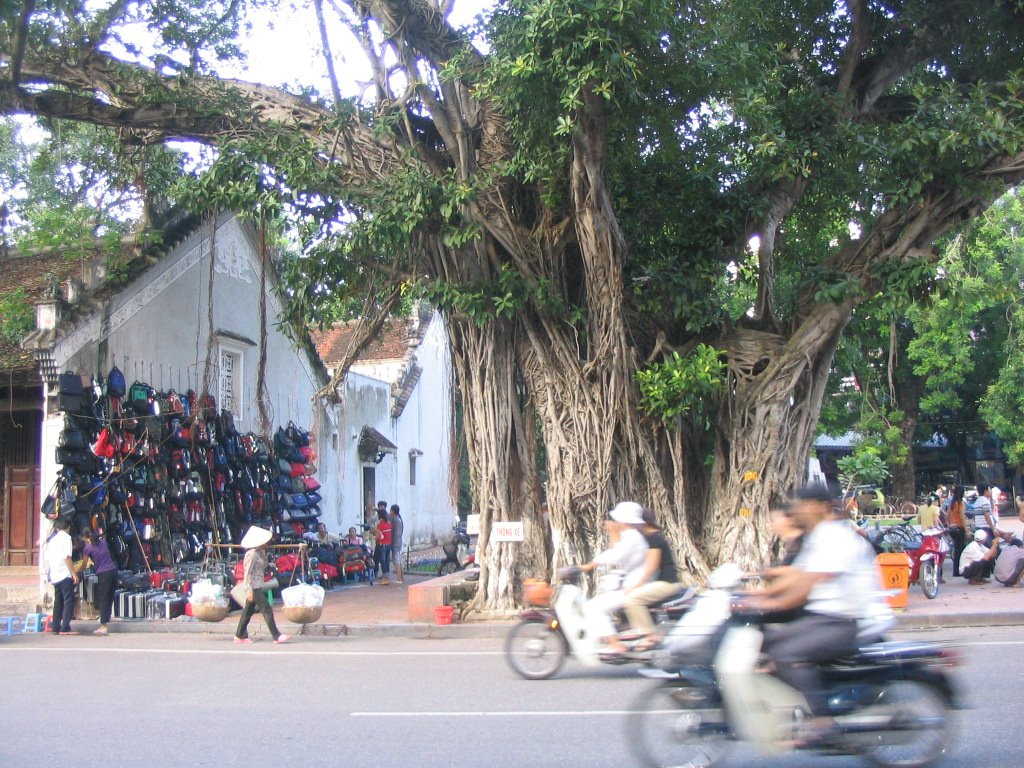
Vietnam's National Day

My father and I left Hanoi for the States a year ago today, after a full month touring southeast Asia. Coincidentally, September 2 is also Vietnam's National Day. We had managed to miss the Queen's Birthday in Thailand by a day, Malaysia's National Day by a few weeks, and Singapore's National Day by two days. But for Vietnam's National Day, we were in the capital, trying to get out, and staying within near spitting distance of the Vietnamese equivalent of the Esplanade on the Fourth of July. Both of us were in a horrendous mood; my father's wallet and glasses had been stolen as we squeezed through half a mile of ass-to-stomach thick crowd the night before, and I didn't know whether I more wanted American food or to walk down a hassle-free Walmart aisle.

Our flight out was shortly before midnight, so we took our last dinner at the cozy backpacker's place we had already frequented on a number of occasions. While my dad was shooting off a final email to my mother, I had a few drinks and made a final purchase of a 750mL bottle of Da Lat red wine. I hadn't actually had any on the trip, and we hadn't actually made it to Da Lat, which is in the mountains north of Ho Chi Minh City (also known as Saigon). Next time I'm in Vietnam, I'll definitely try to get there; we simply didn't have time on this trip.

We trudged back to the hotel, going well out of our way to this time avoid the burgeoning masses of people around the lake, getting back around 7:30 or so. The roads around our hotel were completely blocked off, and it only took about ten minutes to realize that "we ordered a taxi for you" really meant "I have no idea what you said, but I don't want you mad at me." So we walked away from the commotion for a few blocks, looking for someone to give us a ride to the airport.

Now, for those of you who haven't had the distinct pleasure of travelling somewhere where they can tell you're a foreigner by the color of your skin (please note that this is not an issue in the U. S. of A.) and where everyone knows that you can take advantage of a foreigner because they are endless fountains of money, let me explain something. One of the main reasons I was so ready for this slightly-too long trip to be over was that I had begun to cultivate an intense desire to be able to walk down the street without every other person yelling at me, Hey lady, want a taxi? Considering this, there is a strong level of irony to the fact that we had a hell of a hard time finding someone willing to give us a ride to somewhere else for the exchange of a few colorful pieces of paper.

We eventually found two guys on motorcycles, and realizing this was the best we were going to get, decided on a slightly too high price, and set off. There had been a bit of discussion over the word "airport," and then some arguing between the two of them as to, presumably, the best way to get there, but it was good to be on our way.

We arrived only about twenty minutes later. At the (closed) Vietnam Airlines head office. I honestly do not think that either of these gentlemen really knew what an airplane or an airport is. But they wanted their money. And explaining to them that they hadn't taken us where they told us they would didn't really work. And we really really needed to get to the airport.

At this point, the streets were completely packed, we were out a decent bit of cash (wallet stolen and all, we had a finite amount, see), and now no earthly clue as to our location, except that there probably wasn't a plane headed to Seoul within a mile.

One advantage to the street being at a standstill is it wasn't too difficult to find a cab. We agreed on a definitely too high price, and climbed in. And just sat there. And moved a little bit. And then sat there some more. Sometime between getting off of the motorcycles and into the cab and the cab not really going anywhere, the fireworks had started. Now, in the U.S., if you're in a car, and you're on the road, even if it is July 4th, if fireworks start going off, ... you keep driving, right? Right? You don't stop the car, get out, and watch the fireworks, even if you're in the middle of making a left-hand turn. This is probably because most people in the United States have actually seen fireworks before... as one kind woman about my age explained to us as we were trying to get the Red Traffic Sea to part, "But it's our National Day! Everyone is so excited!"

The only car that made any perceptible progress for the next half hour was the taxi (originally) next to us, with six people in it, most of whom were hanging out of the windows yelling and motioning at everyone else in the traffic jam. I think they were everso calmly explaining, "We've got a lady giving birth in the back seat, so please move over so we can get through."

Once the (rather brief, even if you are worried about missing an international flight) fireworks display was over, and we were definitively on our way, I recognized a familiar tune in the instrumental music on the radio. It was a forty-five minute ride out to the airport, we didn't miss the flight, and I was only mildly scolded by the immigration agent because my visa expired on the first of September. As I was moving shortly after returning, I even had the joy of going to Walmart almost daily for a week.

And now I've been here for almost a year. When my parents visited a couple of weeks ago, I marinated some steaks for them, and my dad opened up the bottle of Da Lat wine I had been saving for a special occasion. We toasted and sipped. Only one sip each. It was... earthy, in that thick muddy black dirt under your toenails kind of way. At least it'll make for good cooking wine...

Wednesday, June 28, 2006

Birthday Candy

One of the nice little touches at this conference has been the availability of small snacks and candies during the coffee breaks between talks. As this is in fact a conference about galaxies, and one of the more popular galaxies is the Milky Way, it should come to no surprise that I have found myself craving a bit of chocolate. You see, astronomy, aside from the science of sugar, I suppose, is the field after which the most candy has been named. We've got the Milky Way, the Mars Bar, and, of course, the Starburst. But apparently Americans are confused about candy. I didn't even realize it, even after I had a clearly-labelled Milky Way bar this morning, with its soft nougat-y center. Apparently, what we Americans call a Three Musketeers is actually a Milky Way, and what we call a Milky Way is actually a Three Musketeers. Think about it. Milky center? That would be the stuff in a Three Musketeers. Three components? That would be the Milky Way's nice chocolate, caramel, and nougat. Somehow, this managed to blow my mind more than the influence of the bulge on the rotation curves of spiral galaxies.

Other adventures in eating include Tuesday night (birthday!); I went to dinner with roughly the same group of people I had gone out with Monday night (when I was terribly jetlagged and could have fallen asleep in my chair quite easily). This whole Japanese food thing is growing on me ... some of the raw fish is quite delicious, while some of it makes me think, "Why is this so chewy? Shouldn't it be cooked some?" Tuesday night I had raw beef for the first time, and it struck me how yummy it was. Not too chewy, and not to, well, raw-seeming. Afterwards, we went out for "dessert," or shaved ice with flavored syrup and possible beans. I passed, but it was still a fun place and I enjoyed the company and watching people investigate their dishes. We then went to the same bar we had gone to the night before .... their menu was primarily in Japanese, but some of the headings (e.g., Sake or Beer) were in English. One such heading was "Birthday Cocktails," and there were twelve pictures of colorful drinks in martini glasses. Obviously, this had to be investigated. As expected, my drink, a "Moonstone," was free, and I even had to show ID for it (in order to prove that it was indeed my birthday). It was one of the... weirder drinks I've ever had. It was milky white, and apparently yogurt-based. Aside from the fact that it was definitely alcoholic, that is all I know about its ingredients. It had this odd citrus-y flavor to it, like it was confused about what it wanted to be when it grew up. I won't mention that I think I was at least five years younger than everyone else at the table. While I may feel as if I have wasted the last twenty-two years of my life, it was definitely a young birthday.