Showing posts with label not funny. Show all posts

Wednesday, October 01, 2008

Book Review: Autism's False Prophets by Paul Offit

I recently received and read Autism's False Prophets: Bad Science, Risky Medicine, and The Search for a Cure by Paul Offit through the ScienceBlogs Book Club. Offit first details the history of various attempts at defining the cause of and curing autism, focusing the most on first the MMR vaccine and then thiomersol (which contains mercury), which is contained in many vaccines (though not MMR).

In general I found this book interesting and educational (all I knew going in was that the "vaccines cause autism" nonsense was both quackery and dangerous), and I recommend it to anyone interested in the so-called controversy—there is no controversy as far as the science is concerned—as well as for the book's interesting discussion on the interaction between science and the public via the media. People distrust science and its authority figures all the time; usually this just leads to ignorance, but in the case of "let's not vaccinate our kids" it can lead to death. Which isn't cool.

Summary: Autism's False Prophets begins by offering a pre-vaccine history of autism and attempts to cure it. A pattern is established: people come up with some desperate theory, put a lot of time and effort and money in trying to "cure" their children, some of the "cures" wind up doing severe damage, parents move to next theory. Then enters the vaccine theory, which is actually two-fold. It begins in England with Andrew Wakefield announcing that the Measles, Mumps, and Rubella (MMR) vaccine increases rates of autism; he's even got an (unsupported) idea as to why this should be the case. (People seemed to not mind that he's had it out against MMR since the 1980s.) Meanwhile, as the MMR-autism link isn't able to be reproduced in independent studies and Wakefield is exposed as a fraud, a panel in the US realizes that the amount of ethylmercury in vaccines (used as a preservative, which makes the vaccine both cheaper and safer to use) is higher than the amount of recommend safe-levels of methylmercury. Spurred on by parents who have decided that their kids got autism after getting their vaccines (most austism symptoms become the most apparent about a year or so of age, right around when kids get many of their vaccines, so the emotional causal link isn't unsurprising), the panel figures that there isn't any harm in being cautious. So they announce that while there isn't any reason to be afraid, they will be looking into the situation. And all hell breaks loose.

Offit traces this aftermath right up to the Omnibus Autism Proceedings, a huge court case of thousands of parents claiming that vaccines caused autism in their children; the court's decision is due out early 2009. Offit then discusses how this controversy is a classic example of fear, scandal, and headlines driving the media narrative more than responsibly informing the public of the facts: the scientific case showing no linkage between vaccines and autism has actually been established for some years now. But, Offit argues, the public equates going online and reading what shows up on a Google search with scientific literacy, and our culture likes to buck authority, and so the result is kids dying of measles. The book closes with a short look into what actually does cause autism (it's genetic), and how a few parents of autistic children who know vaccines weren't the cause—and who don't like having their children referred to as "mad," "damaged," or "soulless"—have been responding to this whole fiasco.

Review: In general, I liked this book and found it easy to read. However, there were several stylistic points which were downright annoying. (I get the impression that while the author did his job, the editor did not.) First, there are several simultaneous storylines weaved throughout the text, yet as the story is not always told chronologically, it's difficult to keep any of the dates and the relative orderings of different "plots" straight. In this same vein, the book is written with the understanding that vaccines do not cause autism, but often the story is told like it is a story, a thriller: the case against vaccines-cause-autism isn't made strongly and irrevocably until well into the book, so someone could easily read halfway and think "zomg! conspiracy!!!" Also, as this is a book talking about how important believing the scientific consensus is, I would have appreciated it if the end notes listed at the back of the book were actually marked in the text itself. The organization of the book is also somewhat shaky, causing some interesting points get a bit buried in the text. For example: if vaccines-cause-autism really is this big conspiracy, then how come the scientists, etc. supposedly perpetuating this conspiracy vaccinate their own kids? Or that kids absorb more methylmercury from breast milk and baby formula than from vaccines in their first few months of life anyhow, a fact which is just mentioned in an off-hand kind of way in the middle of some chapter.

The two chapters towards the end of the book on science and the media and how the general public portrays science were both interesting and elucidating. I can't come up with solutions to these problems, but Offit at least lays out the issues well.

Monday, September 08, 2008

Book Review: Halima Bashir's Tears of the Desert

Over the weekend I read Tears of the Desert: A Memoir of Survival in Darfur by Halima Bashir.

Tears of the Desert details the life of Halima Bashir, a doctor who grew up in Darfur and now lives in the UK. Her story is told in a straightforward manner: how she grew up and how her family and village were important to her, how she went to school and enjoyed it and eventually went on the medical school, how war crept into her life until it became un-ignorable and eventually destroyed her life, her home, her family, and how she finally escaped from Sudan and managed to put together a new life in England. It most places—even the childhood stories—the story is riveting (which, unfortunately, also means that some of the explicit statements of foreboding come across and cheesy and unecessary). The storytelling is also often unexpectedly hilarious; I found myself laughing out loud quite a few times.

As a personal accounting of the history of the Darfur conflict, Tears of the Desert is a powerful story of how innocent lives are completely torn asunder. Bashir has lived through things that most of her readers cannot possibly imagine (yet, of course, as the book is written in the first person, we the readers know that, she at least, has survived). Her story thrusts raw emotion into the too easily glossed-over refugee and death statistics streaming out of the region. However, I found the book almost too insular at times; for example, the only year explicitly stated (aside from in the short epilogue), is the date of Bashir's birth: 1979. I was constantly adding and subtracting to determine approximate dates, and so as an actual history Tears of the Desert unfortunately falls a little short and does not serve well as an introduction to the Darfur crisis, and I fear that in ten to twenty years this fact will make it an even more difficult read. Likewise, no map is offered and only a brief description as to the underlying cause of the conflict and why the UN is doing little to stop it is given in the epilogue.

Regardless, a reader who first spends half an hour reading about the Darfur situation online should have plenty of context in which to set this book, and Tears of the Desert provides a far more personal and accessible accounting than anything the internet (or most anywhere else) has to provide.

Tears of the Desert will be on sale in the US on September 9, 2008.

Tuesday, January 22, 2008

Mystery Hunt 2008 Post Mortem

I spent this past weekend at MIT for Mystery Hunt, and like last year, I was planning on doing an "obligatory hunt post." But this year's hunt, to be blunt, was simply not fun. The puzzles were too hard, required too many leaps in logic to solve, relied too much on flavor text, and often came with a basketfull of extraneous information and red herrings. Hunt started at noon on Friday and by 7pm I was ready to stop ... and it just kept going until 9pm on Sunday (by the time the coin was found, our team was almost completely cleaned out of headquarters, in the middle of a team debriefing, and setting up a dinner mob). I could say more, but since the winning team is known to write a good Hunt (they wrote last year's, for example), and I'm actually not in the mood for a full-fledge rant, I'll share with you this Sesame Street gem that came up in the middle of an "oh my god I'm so sick of trying to solve impossible-to-solve puzzles" conversation Saturday night:

Friday, November 16, 2007

A Dose of Not the Daily Show

Miss the Daily Show? Here's what one of its writers has to say about the WGA strike:


Monday, May 07, 2007

Let's Play Good Idea, Bad Idea

Recently, a Chemistry professor at OSU had their house broken into. Among the stolen items were two laptops. Typically, when someone has their laptop stolen, it sucks for them, but that's the end of the story.

But this is Ohio. They do things differently here.

You see, the laptops were ones on which said professor stored class rosters. And, among other things, these class rosters included the social security numbers of approximately 3,500 current and former students. Which is bad. And so the university has had to find and contact these 3,500 some odd individuals and let them know their identity security has been breached. Some of these students were from many many years ago, and as such, private investigators and the like had to be hired. Which costs money. Apparently this has cost the chemistry department and the university something like $80,000 so far.

That was in February. In early April, some other computers on campus were hacked into and something like 14,000 SSNs were "exposed." These SSNs are a subset of everyone who receives a paycheck from OSU ... including various faculty and staff, which (it seems like) was enough to make people go from saying "this is a problem that should be fixed" to actually trying to, you know, fix it.

There is much specialness abounding in this situation. The most obvious one to me is that there is no reason why a professor should ever have students' SSNs. So why do they? Well, it's because at this prestigious university, SSNs have long been used as student ID numbers. (Yes, I have complained about this before.) What this means is that they are routinely included on all class rosters, grade lists, etc etc. Which means that someone somewhere along the way had to think that was a good idea. Sure, it might have been back before the days of identity theft when everyone was all good and moral ... but a lot of software (e.g., for grade submission) has been written since then that didn't need to include that information. And once it became obvious that this practice could cause problems, someone somewhere had to make the decision to "phase" in a solution (apparently they've been saying this for years) instead of doing a rapid change manouver.

Which is what they're trying to do now, but with a great deal more... panic. No one likes a lawsuit, so another brilliant decision that someone somewhere made was to hold individuals liable. Not just the poor sap who has SSNs stored in his mail from over a decade ago, but also the individual responsible for that computer, aka, your friendly local tech support guy who is really not enthused at the idea of policing a department's worth of computers for nine digit strings, but is rather motivated at the idea of keeping their job.

Best part is, someone has realized that all of this goes against FERPA regulations ... pesky laws. We're assured that it'll all be fixed by the start of Autumn quarter in September, and the Astronomy department is definitely being all pro-active in purging computers of these data records. Besides, it's not every day you learn that Professor X has found Famous Astronomers Y and Z's social security numbers on their computer ...

Friday, May 04, 2007

Jorge Cham at Ohio State

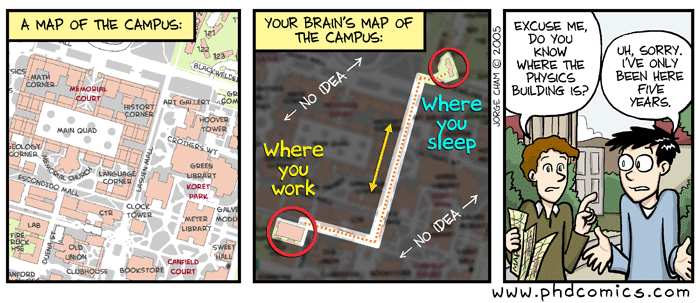
So I've not felt like blogging lately, apparently. According to Jorge Cham, this isn't a bad thing; "procrastination is when you're doing what you want to be doing." I heard him say so himself Tuesday night when he gave a talk here at OSU to an auditorium full of graduate students. (Is it bad that though I knew there was a coffee shop on the first floor of the building, I had no idea what its name was?)
Anyhow, the talk was entertaining, even for someone like me whose been reading the comics regularly for the last, uhm, six years. It started with a routine "I had to learn about Ohio State before coming here" bit ... talking about how the Wikipedia article for OSU is gushing about how big and great of a university it is ... and then we find out that Larry Sanger apparently is an OSU alum and it all begins to make sense.

So this part isn't going to be funny; I know, and I'm sorry, but deal with it. Apparently one of the main points of Cham's talks is that many graduate students are depressed. Apparently, for many people, graduate school is the first time when the ratio of what they think they know to what they think they don't know becomes very small, the first time they feel as if they are not "one of the best" at something. Uhm, so that would have been ... 11th grade for me, at the latest. And if it hadn't happened then, a few days at MIT would have cured that right up. And it goes without saying that my self-confidence is muuuch higher now than it was when I was an undergrad ... although that really isn't saying all that much. My view of stress as an undergrad v. as a grad student is somewhat skewed; while MIT is a high-stress environment, it's also true that my current department most certainly is not, relative to other places (or what's portrayed in the comics). And, seriously, if people are unhappy as graduate students because they don't like what they're doing, then, uhm, why are they in grad school to begin with? People should be doing what makes them happy.

Anyhow, the talk was pretty good and all around entertaining; the only thing that could have made it funnier would have been if he'd actually made a L'Hopital's Rule joke instead of just alluding to the possibility of one. More jokes about how annoying undergrads are would have also been appreciated. They were, unfortunately, not selling the new book (which ships, I think, tomorrow). I'd even brought money from one of my officemates (which I should return ...) to buy one. Instead, I was one of three people to win a raffle for a free (old) book, which is funny because I already own both books. Two years ago Cham gave a talk at MIT, and instead of going, I took a nap. (I was thesing, OK?) A friend bought both books for me—and got them autographed—as a graduate gift. So, I decided to give my free book to one of my officemates, who had decided to not come to the hour-long talk because he needed to work. No lie. Severe workaholic silliness I try very hard to not compare myself to.

Regardless, how come there aren't any couches in my department? My brother, a graduate student in history, maintains his office has one exactly like this:

Wednesday, April 25, 2007

American Idol, Landfills, and Juvenile Justice

Alright, I confess. I'm an American Idol fan. I'm all about the brainrot. It's pathetic, I know, but what's even more pathetic is that I don't even own a television and I watch a taped version of the Tuesday night show on Wednesday evenings. Last night's show revolved around "Idol Gives Back," this "big" war-against-poverty campaign they're doing. The big thing they kept mentioning is how for each vote, NewsCorp was going to donate $0.10, for up to five million dollars. They never really said where the money was going, except that it was to *gasp* Save Lives! Also nevermind that this is freaking NewsCorp and five million dollars is barely a drop in the bucket, if that. It probably did do some good and made a lot of people feel warm and fuzzy inside, so I can't complain too much.

So, last night, instead of forcing us to watch Bono "coach" the contestants (oh God thank you for sparing us that pain), we got to see a bunch of short segments of the host and the judges going around the US and Africa. The parts from Africa were ... familiar. (Nevermind that they never told us where in Africa they were; it's one big homogenous place, so it must not really matter anyhow. And while they did talk about how horrible of a disease malaria is, they didn't mention AIDS even once. American Idol is a family show, after all.) But, yes, the shots of people walking through landfills and of large groups of orphans happily eating in large bare rooms... it was a total deja vu, except the grinning kids in the video had darker skin that the ones in my memory.

In August 2005, in the middle of a month-long trip through southeast Asia, my father and I found ourselves in Phnom Penh, the capital of Cambodia. (If you don't know anything about Cambodia, quit being ignorant and go check out the wikipedia article or something. Especially the parts about the Khmer Rouge and Angkor.) We knew that Phnom Penh was going to be horrible, the worst combinations of a large dirty city and abject poverty in a country still recovering from large-scale genocide. Cambodia's tourist attractions are are elsewhere, and we were only in its capital out of necessity. My father's all-too-natural solution was to spend our one full day in town visiting the dump.

I'm not kidding. You just can't make this stuff up. We had met a couple in Siem Reap (the town near Angkor) who had spent a few days volunteering at the Centre for Children's Happiness in Phnom Penh. This organization actually runs two orphanages; the kids are separated by age and amount of time since they've lived in the landfill. Lived in the landfill. Like the girl in the picture on the left, these kids have all lived in the Phnom Penh dump as "garbage pickers" before coming to the orphanage. They go through the trash trying to find something, anything, they can sell for mere pennies in order to try to get enough money to buy food with. They literally live and sleep in the dump; the lucky ones might even live there with older siblings or even a parent. Most are orphans, or have parents in worse situations than them (e.g., missing a limb from the copious land mines scattered throughout the country). The CCH carefully picks children living in the dump to come live in the orphanage instead—and, importantly, the kids have to decide for themselves that this is a change they want in their lives. Usually the children coming straight from the dump have to spend about three months (if I remember correctly) in a hospital gaining strength and being treated for various diseases. (Actually, many only spend a few weeks, but some must spend many many months in recovery.) At the orphanages, they get a chance at having a "real childhood." They learn to read and write (in Khmer, English, and Japanese), they learn math, they learn job skills, they learn traditional Khmer dance and art, they learn how to care for one another and how society runs better if people treat each other with respect, have jobs, and take care of themselves. And, oh yes, they learn math. The walls of the courtyard in the main orphanage are covered with painted lessons: vocabulary, useful math formulas and ideas, proverbs, etc. I spent a while talking to one of the older students, a 16 year old boy who had been in the orphanage for three years. He said he really liked math, "especially trigonometry," and working on the computer. This is what we call a "motivated player." He said that when he turned 18, he wanted to work for the orphanage as a full-time employee; this was two years ago, and I do not know what he has wound up doing. The founder of CCH, Mech Sokha, is very open about the workings of the orphanage; the main office (where the computers live, and thus where many of the children spend much of their time) has a whiteboard dedicated to a breakdown of exactly how much it costs per child per day, and where all of that money both comes from and goes, as he is explaining to my father in the picture on the left. This is one of my favorite pictures (aside from all of the math!) from the orphanage because the kid you see standing next to Mech is so typical. For the first time in their lives, these children are somewhere safe, and it was so obvious just how safe they felt. Kids were running around, hugging each other, hugging Mech (like this one here), and generally just being happy. (I was the one with the camera, so many of them while I was there were taking turns having their picture taken, inspecting the preview on the screen on the back, informing me it wasn't good enough, and making me retake pictures. Oh, the cuteness.)

My dad actually got really excited by the entire experience. One thing we noted is that their computers were all really old and crappy; they had about ten, but only one or two would ever work at a time. My dad thought, "I have a lot of friends; we could easily get dozens of nice computers here." So he tried to help, to forge a bond, but apparently Mech just quit responding to his emails, the last I heard. I personally found the entire experience depressing rather than invigorating; it is difficult to see people making so much out of so little and not feel guilty for making so little out of so much opportunity in my own life. I'm still naive and idealistic; instead of seeing one potentially solvable situation, I see a whole helpless world full of Things That Should Not Be. In my head, I know what the world should be like, but the real world around me is so different that it's overwhelming to know how to go about fixing it. Well, there's that, and the fact that I'm incredibly cynical and impatient and people annoy me.

My father, you see, is different. (It takes a special kind of person to decide to visit the Phnom Penh dump on a tour of southeast Asia, yes?) He was a high school guidance counselor for almost 30 years, and somewhere along the way got involved with a volunteer organization associated with the state's Department for Juvenile Justice. Whereby "involved with," I really mean "founded," and whereby "Department for Juvenile Justice," I'm referring to "juvy," the prison where kids under 18 go. My strongest memories of Christmas morning when I was a kid don't center around getting up at the crack of dawn to run downstairs and see what presents I got; they revolve around getting up before the crack of dawn to drive out to DJJ to hand out bags of Christmas gifts to the teenage inmates there—gifts like pads of paper, pre-stamped envelopes, an orange, and a toothbrush. Since his retirement my senior year of high school, my father has poured himself into running this multimillion dollar philanthropic adventure. Explaining everything they do would require a whole other post, not to mention actually listening when he's going on about all of it on the phone.

My father's philosophy is that charity has its limitations; money can only go so far, and if you actually want to make a difference, then you need to actually do something. Charity is trying to treat symptoms ("we need to feed these hungry children!"), while philanthropy is trying to cure the cause ("we need to help these children's parents feed them!"). Charity makes people feel all warm and fuzzy inside; it has immediate gratification and results, and it's easier, but it the results aren't lasting. Philanthropy, on the other hand, is hard. Philanthropy requires thought, action, and inspiration in additon to mere money. It's one thing to give incarcerated kids prestamped envelopes, but it's something all together to try to change their lives and keep track of them so that when they get out of jail they don't go back to their old (criminal) habits upon returning home.

This is part of what has me cynical about the whole "Idol Gives Back" nonsense. I'm not saying it's bad; I'm saying it sounds like it isn't going to be as effective and useful as it could be. Money going to food doesn't solve problems; it merely postpones them until the next meal, while teaching people that they don't have to work for what they get. In Africa, wouldn't the money be better spent teaching safe sex and supplying condoms so fewer unwanted kids are born? Shouldn't we be trying to attack the problems instead of simply making ourselves feel better?

And, yes, I was glad to see Sanjaya go.

Saturday, February 10, 2007

Global Warming is Bad

Now that I've ranted about how cold it is, I'm going to rant about how warm it is. Whereby "rant," I mean something much much more than that, but you'll see.

On Monday we discussed in Coffee the recent IPCC (Intergovernmental Panel on Climate Change) report to policy makers. You can see the full thing here (in pdf form); all of the figures I'm showing are snatched directly from there.

The report is entitled "Climate Change 2007: The Physical Science Basis," and it essentially describes the unambiguous evidence that Earth's climate is going through rapid transitions, and this warming is unambiguously due to human action. The report also outlines several climate change models, and describes how even the most conservative and optimistic models predict drastic and nearly irreversible changes. What is even more terrifying is that, scientifically, their approach to the the entire thing is incredibly conservative and almost certainly underestimates the problems. For example, the report completely ignores "catastrophes," rapid events that could strongly alter sea levels and atmospheric content (like the Arctic ice cap melting, or all of the frozen peat in Siberia undergoing a phase transition [i.e., melting] and releasing a bunch of methane into the air all at once). They ignore possible catastrophes because, frankly, they can't be well modeled yet, and things that can't be well modeled have no business being in models.


The graph on the left shows the increase in carbon dioxide (CO2 10,000 years; the inset shows a blow-up of the last two hundred years. Clearly, something happened that made this trend go from slowly increasing to increasing really-really-fast. The report has similar graphs, showing disturbingly similar trends, for both methane and nitrous oxide. On the right-hand side of these graphs you can see the ") in the air in the lastradiative forcing" due to each of these gases. Basically, a certain amount of gas in the air can cause the atmosphere to either warm up or cool down. (The warming up is what is commonly referred to as the "greenhouse effect.") What I find painfully ironic about relative radiative forcing amounts is that apparently it wasn't until around the 1950s that people actually started noticing the increase in temperature of Earth's atmosphere due to gases like CO2. This is because the Earth's temperature wasn't actually increasing all that much until the 1950s. Why not? There were certainly pollutants in the air from cars and factories pre-1950. The reason is because the ickier pollutants—think nasty particulate smoke from Industrial Revolution era factories—acted as a coolant, effectively counterbalancing the warming effect from the other gases. Once people realized that "smog is bad" and started cleaning up cities, the greenhouse gases were able to start really doing their thing. On the right is a series of plots showing this increase in temperature and its affect on the average sea level and the amount of snow in the northern hemisphere (between March and April) since 1850 or so. The smooth black curves represent averages for a given decade, while the grey dots are actual yearly values. Note, especially for the snow and temperature plots, that just because the amount of snow is up or the temperature is down in Columbus, OH for a given week, month, or year does not mean that the average global temperature is decreasing.

The report then goes on to describe, and show, that these observed changes are not due to purely natural causes. "Natural" here essentially means solar activity and volcanos, whereas examples of anthropogenic (human) causes include pretty much everything that separates first world and third world countries. One of the neat things about this report is that it culls information from a variety of scientific reports; instead of the authors running their favorite model, they cite results averaged over 58 models.

Then comes the nightmarish predictions, as summarized by the graph to the left. The plot shows global surface warming as observed over the last century (the top panel of the previous plot, remember) and as predicted for the next century. The bottommost model curve, the yellow-orange one, is if we hold the as-is atmospheric content completely constant: not another engine turning on, not another cow pooping, just—statis. And, behold, the yellow curve is increasing, and a thousand years from now the changes we have caused to the atmosphere would still be noticeable. And look: the other curves (red, green, and blue), show even higher increases in temperature. The models take things like population and economic growth into account differently, and the report says there isn't any reason to favor one over the others. It is interesting, though, that all of the models have the global population peaking around 2050. The report also gives predictions for distributions of temperature change across the globe; those of us living in the northern hemisphere should realize that the predicted average change in temperature for where we live is about twice the global average shown on the above plot.

One of the scariest parts of these predictions is the increase in sea level. If in 2100 the average global temperature were to level out at the amount of the green line in the above plot, then the sea level would rise by about half a meter by 2300, due solely to the fact that water expands as it warms. That is, this prediction of half a meter completely neglects the fact that glaciers and ice caps will simultaneously be melting and increasing the amount of liquid water in the oceans. Think of your favorite seaside city (Boston? New York? San Francisco? Hong Kong? Singapore?), and then wonder what it will be like in a few hundred years.

So now the question is: what does humankind need to do in order to save the world and ourselves? The obvious is that if we are going to do this without simultaneously butchering the economy, then someone needs to conjure up an alternative fuel, and fast. Meanwhile, converting to soley nuclear fuel for electricity (and everything else from heat to cars being electric) would give us some time to figure all of this out without continuing to be so worsening the problem trying to solve it. But individuals on their own aren't going to make the requisite lifestyle changes; I for one know I care, but when I am cold I am going to turn my heat up. It's the classic prisoner's dilemma: it is better off for the group if no one drives big cars, but it is better for me if I drive a big car. And this is why God invented Big Government to help force people to make the right decisions, like chosing the correct lightbulb.

If I remember correctly, the IPCC will be releasing another report in April with suggestions for just what global and local changes should be made.

Monday, January 29, 2007

The LBT on the Discovery Channel

The LBT was recently featured on the Discovery Channel's show "Really Big Things." The LBT, or Large Binocular Telescope, is a, well, really big telescope Ohio State is helping build on Mount Graham in Arizona. It's got two 8.4-m (that's 9.1 yards) diameter primary mirrors—for perspective, in the picture below, the mirrors are the two round shiny things.

But this post isn't actually about the LBT at all. It's about the Discovery Channel's depiction of science while attempting to be "funny."

What really angers me about this episode is the attitude of the show's host/interviewer "Matt," and thus the editors, etc. of the entire show. Whenever the conversation would drift towards science—you know, the reason this telescope is being built—the host would start trying to crack jokes about how confusing it is and how he doesn't understand it. Yes, the LBT is an amazing feat of engineering, and, yes, it's really big, and yes, we (as astronomers) will be able to do mind-boggling awesome things with it. But that doesn't mean that the driving science behind building it can't be explained—in fact, I think the scientists and engineers they interviewed did a fantastic job of explaining why astronomers want large mirrors and high resolution ("like an HDTV").

What gets me is how the host was obviously pretending to be stupid/ignorant and then trying to make a joke out of it. For example, at some point he asks if the telescope will be able to be used to look "back in time"—obviously he knows the answer is yes, and I highly doubt that someone would be able to even get a job hosting a show like this without having some proclitivity towards scientific thinking. The fact that looking far out in space is like looking back in time because it takes a long time for the light from far away to reach us is a standard explanation for astronomers, and I think the astronomer doing the explaining explained it well given the time constraints. And then the host was like, whoa, I'm in a time machine, that's too much for me.

Seriously? I applaud the Discovery Channel for trying to reach a different demographic (i.e., not "nerds"), but are they now implicitly supporting the idea that "science is hard" and "normal people will never be able to understand science"? Let's get this straight once and for all: science is nothing to be afraid of. Sure, there are levels of understanding which the average person won't be able to reach after a brief explanation—there are reasons why people spend so many years in school studying this stuff, after all—but that doesn't mean there isn't some level at which they should be able to understand how their computer works or why we know the universe was once a hot, dense, goupy soup of fundamental particles. This is part of what it means to be an educated individual in today's society—or at least what it should mean. I'm not saying that everyone should already have such&such knowledge and understanding, but rather, have the willingness to learn more instead of being afraid of the everso slightly mathematical unknown.

At least the Discovery Channel has the "hey, this is really cool" aspect figured out... but I am disappointed that they are also playing around in the "let's make ignorance and stupidity look funny" field.

Friday, November 17, 2006

Guest Post: Why Mr. Cohen Isn't Funny

This post is a contribution from my brother, Reed, who is currently enrolled in the history Master's program at Clemson University. He will be reading and replying to comments here as well.

Within ten days of opening, Sacha Baron Cohen's comedy "Borat" made nearly 68 million dollars and confirmed the continued vitality of racist humor in the United States. In the movie, Mr. Cohen, misrepresenting himself as an obnoxious Kazakh reporter (this is called "lying"), travels around the United States putting Americans in awkward and uncomfortable social situations. Borat is misogynist. He hates Jews, Uzbeks and gypsies. His Kazakh home village is a picture of backwardness.

Actually, the village Mr. Cohen portrays in his film is not Kazakh. It is Romanian, and nobody there even knew Mr. Cohen until he arrived there purporting to make a documentary about the poor socioeconomic conditions. This is also lying. Mr. Cohen found many people in the village eager to participate in his film about their hardship and struggle. Very few people in the village spoke English, which allowed Mr. Cohen to fairly safely ridicule them. This is cowardice. An oblivious woman becomes Borat's prostitute sister and an elderly amputee becomes a pervert. This is all, apparently, hilarious.

For Mr. Cohen's character to be Kazakh made sense. Very few Kazakhs live in the United States or Great Britain. As a small, obscure minority we can all laugh at Kazakhs without risking the socially awkward possibility of actually encountering them. Nobody's secretary is Kazakh. A Kazakh family doesn't live two doors down the road. Your kid's coach isn't Kazakh.

But according to Mr. Cohen the joke isn't on Kazakhs, it's on Americans. In a recent interview in Rolling Stone magazine, he explains that "The joke is not on Kazakhstan. I think the joke is on people who can believe that the Kazakhstan that I describe can exist..." He chose the country because it was "...it was a country that no one had heard anything about, so we could essentially play on stereotypes they might have about this ex-Soviet backwater." Borat's anti-Semitism is designed to show "...the absurdity of holding any form of racial prejudice, whether it's hatred of African-Americans or of Jews." (Rolling Stone, Nov. 16) So Mr. Cohen is helping us by showing us how ignorant we are.

His defense is flawed and shameful. He deliberately chose a country of which many of us are ignorant. We certainly aren't ignorant of it now. Mr. Cohen's fictional Kazakhstan is backwards and ignorant, near-medieval. The Republic of Kazakhstan, the actual country that borders southern Russia and northwestern China, is a large, strategically important and socially dynamic country. In the movie, Mr. Cohen makes no effort to distinguish between the Republic of Kazakhstan and his bigoted creation. The few Kazakhs who live in the United States are now obliged to constantly explain that no, I do not drink horse urine and no, I do not in fact sleep with my sister and sorry, we actually do treat Kazakh women as human beings. They are angry and insulted, and it's easy to find their articles, letters and essays to this effect on the internet. When the Kazakh government very justifiably expressed anger and indignation at the film, Mr. Cohen, in character as Borat and flanked by Kazakh flags, held a press conference in front of the Kazakh embassy in Washington, DC and further lampooned the country. That Kazakhs are supposed to appreciate this subtle critique of American cultural intolarance is a stretch indeed.

While we're on the topic of intolerance, we need to discuss Borat's anti-Semitism in particular. Mr. Cohen is Jewish and he has family in Israel. He feels that his ethnic background gives him immunity from any serious charges of anti-Semitism. This logic does present a fairly convincing argument. I doubt Mr. Cohen hates Jews. What is not clear is his attitude towards Muslims. Kazakhstan is an overwhelmingly Muslim country. While Borat's religious affiliation is unclear, as an ethnic Kazakh he is by default ostensibly a Muslim. America has had a somewhat complex and troubled relationship with the Islamic world as of late. There is a tendency among many Americans to view Muslims as ignorant, oppressive and anti-intellectual. Borat personifies each of these flaws. By presenting no evidence to the contrary, Mr. Cohen reinforces religious stereotypes among Americans and further alienates the Muslim world.

And he's made a ton of money by doing so. The various lawsuits filed against Mr. Cohen and Fox will likely get nowhere, nor should they. The film will continue to show and Americans will continue to laugh. What we are laughing at is not American cultural peculiarities, but a grotesque racial characterization which we believe, which we buy into, far more than we would like to admit. Mr. Cohen has chosen to capitalize on this prejudice. He is a racist and a bigot. That is not funny.

Monday, October 30, 2006

An Evening with Jon Stewart and The Daily Show

A little less than a month ago, I felt glad for the first time* that I am living in Ohio instead of somewhere, you know, interesting.** There was this election or something two years ago that a lot of people cared about, and the general consensus is that since the votes in Ohio were the last ones to be counted that it matters more than other equally divided states with more efficient vote counting techniques. But whatever the cause, Jon Stewart is hosting the Daily Show in Columbus, OH (specifically on Ohio State's campus, maybe?) for the next two weeks. Indecision 2006! ... The Midwest Midterm Midtacular!!!!

Of course, by the time this was officially announced (i.e., when I first heard about it), tickets for the actual taping of the Daily Show itself were already sold out.*** So, instead, they decided to have "An Evening with Jon Stewart and The Daily Show" in the large basketball arena/colliseum on October 28, free and just for students. I've had my ticket in my desk drawer for weeks, totally stoked and completely convinced that it was going to be downright awesome.

It wasn't.

The basic format was "moderated." Jon Stewart did make fun of this a few times, granted. The dean of the College of the Arts asked some questions from the thousands that had been emailed in, and there seemed to be only two types of questions. There were the lame questions that just wasted everyone's time and weren't even funny, like "How do you think the world will end?" Then there were the really good questions that were mostly sidestepped by the cast because there was no good way to answer it in a short (moderated) format. The only decent question receiving a decent (i.e., actually funny) answer was: "Do you want to see Bush, Cheney, and Rumsfeld remain in the political scene so as to provide your show with more content?" After a curt "No," it was explained to the audience that everything Cheney has ever said publicly is simply ... wrong. And he shot a guy in the face for crying out loud.

The most annoying part was that acoustics in the building were horrible. Everyone kept asking each other, what'd he just say? What was that? Oh, and the dean doing the moderating clearly didn't know how to use a microphone. At some point handheld mics were finally brought out, but even then, it was very difficult to follow the conversation. And what's it say when the dean is introduced and there is a lot of booing from the crowd? And how come she got that gig anyhow, instead of someone who would have been more comfortable? There were large screens (... like you'd see at a basketball game ...), but the lighting was so poor that it wasn't any easier to see what was happening by looking at the screen than by looking directly at the very far away stage.

No, that actually wasn't the most annoying part. The most annoying part was that they clearly hadn't prepared anything of any value. Most of the entire hour and a half was filled by showing any clip pertaining to Ohio. Now, I'm a pretty big fan of Jon Stewart and the Daily Show, well, I like them, see, but I don't own a television and have never had access to cable, so I'm more of a fan who never watches the show per se, see, but at least the clips were new to me. But I could watch them on my computer at home and actually hear what was being said instead. And I'm certain that most of the people there had actually seen most of the clips before.

No, that's not true either. The most annoying part of the evening was the fact that I was in a very large room with thousands of Ohio State undergrads. And, oh yes, Saturday was also homecoming and *gasp* there was a home football game involving the Buckeyes slaughtering Minnesota 44-0. Now, there's this ... cheer? ... where someone will yell, "O! H!" and people will yell back, "I! O!" It's one thing during the game, but people will do it freaking walking down the street and then they'll give you nasty looks and accuse you of being from Michigan if you don't yell back. So put thousands of undergrads in a very large room still high from a wholly expected win, and they'll start doing this odd yelling thing. Jon Stewart commented, "I do not understand this ritual, but it seems comforting to you ..." Pretty much the entire evening, every answer to a question involved either saying the magic word, "Ohio," which would in turn elicit raucous cheers from the sharp-thinking crowd, or mistakeningly admitting that there are other states in the Union and getting lots of boos.

Ugh. I may be surrounded by cows and Ohioans, but at least my vote will count this year. And I'll still be watching the Comedy Central election day coverage with an odd pride about me.


* Not the first-first time, but just got along with the story, okay?
** Sure, the cost of living is extraordinarily less than anywhere Interesting, but isn't that the kind of thing you only actively notice if you're living in the expensive place with no residiual money to take advantage of the interesting stuff?
*** Seriously people, don't tell someone that if they email such&such address they can get tickets when there are already no more tickets left. It won't put anyone in a better mood.