Showing posts with label science and art. Show all posts

Monday, December 31, 2007

Clay Sculpture: a Bhuddhess

I mentioned in November that I took a clay sculpture class last summer (as in, I started this post on July 26, apparently), and now that the majikle day has passed, I can share the formerly Top Secret product (a Christmas present for my dad):
This is a Bhuddhess for my dad's massage parlor (formerly my bedroom). The inspiration was the weeks we spent touring Thailand (and other various places in southeast Asia), replete with daily Thai massages and many famous Bhuddhas. This Bhuddha is in the meditation position, which I figured was the most similar to the mental state achieved in a good massage. The base on which she is sitting is supposed to be a lotus flower, a la this picture from a lake near Battambang, Cambodia:
I'm also rather disturbed at how disturbingly similar this picture (which I took) is to one of the iPhone's (and, apparently, newer versions of Apple's OSX) default wallpapers.

Sunday, December 30, 2007

Hotel Mauna Kea

What is it like to observe on Mauna Kea, the tallest mountain in Hawaii? Hat tip to the Angry Astronomer:

Monday, December 24, 2007

Bismuth and Copper, on a Tree

(NB: I would have made this post earlier, but alas, my camera has broken. Santa?)

I have been taking a jewelry class for the last few months, and as those who know me in Real Life invariably ask upon hearing this tidbit: "Jewelry?!" Well, good point. But one of the projects I have spent the most time on was making bismuth crystal Christmas tree ornaments out of copper:

This particular crystal is one of the ones a friend gave me last year, shortly before I discussed making bismuth crystals here (see the crystal on the top-left in the first picture in that post). Next steps include getting better at making my own bismuth crystals (it's a lot of fun, but rather tricky as it turns out), and turning them into more pieces of art and jewelry: necklaces, earrings, pendants, and more ornaments.

Saturday, November 10, 2007

Science: Still Awesome

Just in case you were wondering, science is still awesome.

First up, synesthesia—the mixing of senses so that, for example, one associates or experiences certain colors with individual numbers and letters—is always cool. I have this to enough of an extent that I would totally love to have it even more. For example, in my mind Thursdays are a deep mustard color, but Tuesdays are a rich green and Wednesdays are a pale blue; I wouldn't be surprised if this association is one reason why I don't have to keep a calendar or datebook. The recent incredibly wonderful thing I've found out about synesthesia is that apparently colorblind synesthetes can experience colors via associations that their eyes are not actually capable of seeing. Brains are so fantastic.

I've been taking art classes at the local cultural arts center since June. Over the summer I took a clay sculpture class, and when I went back on my second week to look at what I had started, I was rather freaked to discover that the piece was partially covered in mold. Turns out, the more microorganisms there are living in clay, the more aerated the clay is, and thus the higher quality it has the potential to be for sculpting. Also in the art department, last week I was working with two pieces of sheet metal (I'm taking a jewelry class now) that I wanted to have have identical borders, so I superglued the two pieces together so they wouldn't move relative to one another as I filed the edges. But then I wanted to, you know, unsuperglue them. The most efficient way to do this, apparently, is to simply anneal the metal—that is, put it under a big torch until the superglue burns away and the pieces come apart. I was working with copper, which normally when annealed turns a nice deep red color, but with the superglue on it, turned a dark grody grey.

It's been all over the news, and I obviously didn't get around to writing this post yesterday, but the Auger collaboration has finally come out with their first big result: cosmic rays appear to not be isotropically distributed on the sky. They come just short of saying that comsic rays are produced by supermassive black holes (specifically, supermassive black holes actively accreting matter), but due to a liberal use of the subjunctive in the paper, this is essentially the take-home message. Chad has already done a detailed analysis of the paper and all that jazz, but he fails to mention the fact that the effective size of the Auger detector, located in Argentina, is roughly the same area as Rhode Island—and they're looking to expand. I'm not sure if this is just a statement of how large their detector is, or how small Rhode Island is, though.

Monday, October 22, 2007

Turning a Sphere Inside Out

Ever wanted to see what it looks like when a sphere gets turned inside out, or simply know what is meant when people talk about turning closed surfaces (like a sphere) inside out? Hat tip to Scott Aaronson for this video:

As it turns out, I actually recognize several of the intermediate steps (for a few of the algorithms they show) as neat-o sculptures that often show up near math departments.

Tuesday, October 16, 2007

“This is because taking the derivative of something makes it redder.”

Hat tip to Blake:


Also, I totally want a Derivative Machine now, especially if I can run it backwards!

Saturday, September 08, 2007

Scientists in Movies (and TV)

I saw Pi last week for the first time since about when it came out in 1998. Back then, I didn't really see what the big deal was, but then, I probably was unable to follow the "plot." This time around, I really don't understand what the big deal was: it's an artsy-fartsy film that is trying way too hard. Everyone knows that Contact (the book) does a better job of hinting at the mystique of number theory—even though it's nominally a book about astronomy and aliens and religion!—and even Kushiel's Avatar does a better job at trying to guess what it would be like to hold the supposedly unholdable Name of God in one's head.

But what really disappointed me about Pi—and thus made all of the number theory and religious mumbo jumbo just silly and contrived—was the utter stereotypical nature of the main character, Max. He's clearly supposed to be the troubled genius, an antisocial outcast rife with self-destructive hallucinations and unthinkable mathematical insight. No. Just, no. Even if mania/insanity/depression/whate-have-you and intelligence are linked or correlated, the movie still screams, "Ooooh, look at me! Isn't this disturrrrrrbing?" No. It's ridiculous. Now get over yourself.

Even most movies which clearly try to be realistic fall short. Take for example the play-based Proof. In it, Gwyneth Paltrow is supposed to have proven this really amazing theorem about "prime numbers," but she is also battling various mental issues. While the psychosis in this film still comes across as a bit off, I think it's a good effort; where the movie is utterly painful for me is whenever the characters attempt discussing math. This is the problem the writers face: they can either have the characters speak naturally like real scientists or mathematicians would—and thus have essentially no one in the audience understand any of the jargon-laden sentences, or they can have the characters repeat definitions to one another that they would have realisitically known since they were six years old and have the conversation come across and stilted and forced. Most movies I can think of choose the latter path; they'd rather hold the audience by the hand and let them feel like they can follow the conversation rather than have a realistic exchange in which the tone of what is spoken—the jokes, the tension, the insults, the interruptions and half sentences—are the drivers of the plot rather than the actual words.

The only two movies I can think of that take the latter route (and even then, still let the words be the plot driver) are Contact and Real Genius. The particular scene in Contact that doesn't try to painfully explain the details to the audience is the one in which they are taking the Vegan signal and converting it to a TV visual and audio output; the dialog exchanged is reasonably realistic, and the audience doesn't have to understand it all because it all makes sense when the TV is turned on—and part of the humor in the scene is that the nasty miltitary man doesn't understand the conversation either. Contact has its own shortcomings of course—you can seriously not convince anyone who has spent time trying to decipher puzzles lacking instructions that "we can only get three sides to fit together!" doesn't scream "I'm a cube, damn you!!!"—but it is still one of the best movies with scientists as characters I know of.

The other, of course, is Real Genius. The students and scientist-types in it are all obvious caricatures, but they are exagerations of something realistic and along the correct axes. Sure, many of the characters in the movie are the stereotypical "oh no I'm smart and can do math so I must be a total social dork!" but the main character, Chris Knight, is clearly well outside of this box. I couldn't even begin to list the number of movies and TV shows featuring a scientifically intelligent character who is white, male, with glasses, doesn't shower often enough, can't get a girlfriend, can't carry on a "normal" conversation, and is uncomfortable in big groups and pretty people. Of course, this is a travesty because it's through pervasive moves and television that most kids subconsciously learn the cultural stereotypes of many professions and different kinds of people. It is extremely difficult to fight stereotypes once they are planted.

Are there any movies, or even TV shows, out there that I'm missing which depict scientifically minded folk in a realistic—or at least non-condescending—fashion? Even the West Wing, which clearly respects characters with intelligence, treats mathematical intelligence as inferior to the ability to yield verbal rhetoric. I think the main problem is that (good) writers write what they know, and almost by definition very very few writers know what it is like to be or be around real scientists. This, combined with the fact I mentioned above about writers being scared to write conversations their audiences can't actually follow, is why even those writers who want realistic technically-minded characters on screen don't achieve them.

Tuesday, April 17, 2007

I'm a Published Photographer!


Check out page 34 of the current edition (Spring/Summer 2007) of the Harvard Design Magazine! The issue, subtitled "New Skyscrapers in Megacities on a Warming Globe," has several articles discussing the interplay of urbanization and high-rise buildings. It's an interesting dichotomy I've never considered: on the one hand, it's presumably better for the environment for people to move to the cities and get around on foot and via public transportation than to live in the suburbs and guzzle gallons of gas each day, but on the other hand, if moving to the city means building tall buildings, then the fact that tall buildings consumer enormous amounts of resources should also be considered. This being a "Design" magazine, the role tall buildings play in their cities is also discussed at length; essentially, no one has yet found a way to pleasantly incorporate skyscrapers into cities that isn't off-putting or mildly hostile. They go over the history of skyscrapers; in the 1960s it was all about maximum volume efficiency, but then not only was it discovered that people are unhappy working in cubicle farms, but also that these new-fangled "computers" need lots of wiring, which requires extra space between floors. Additionally, all these extra electronics means extra cooling is needed; extra cooling in turn means more energy consumption. And so on. After several articles of people talking about buildings generating their own energy and being "green," they have a nice article entitled, "No Building is an Island." It pleases me to know that there are people actually thinking about these kinds of impacts, both on local and global scales.

The other aspect discussed at length is the rapid increase in skyscrapers: apparently, as of June 2006, "40% of the world's 200 tallest buildings have been completed since 2000." Furthermore, many of these buildings are in countries essentially saying, "Look! Our *ahem* building is taller than yours; we must be important!!" I definitely found this to be the ambiance surrounding the Petronas Twin Towers in Kuala Lumpor (I took the picture above, which was featured in this issue, looking down from the skybridge connecting the two towers about halfway up). The Petronas Towers were basically bought in order to showcase Kuala Lumpor for the rest of the world: in 1998, people were like, "Kuala Lumpor? Where's that? They have the tallest building(s) in the world now??" They are situated in the middle of a large park, the Kuala Lumpor City Centre (commonly referred to as the KLCC). There are essentially no other tall buildings nearby; the Menera Maxis building is actually directly adjacent and connected underground to the Towers, but as it is more than half as tall as the Towers themselves, from ground level they are nigh indistinguishable. From the sidewalk, there is just no good perspective; sure, they're tall, but I for one couldn't tell they were all that tall. For comparison, in March 2001 I stayed for a few nights at the Marriott World Trade Center in New York, and, yes, the World Trade Towers seemed quite tall, in part because they were noticeably so much taller than their already tall surroundings.

Having never even considered picking up and reading an architecture magazine before, I'm finding this to be rather entertaining and educational. If you can, you should go pick up a copy and read it. And check out the most excellent photography on page 34.

Thursday, February 08, 2007

IT WORKS, BITCHES.

A slightly belated christmas present came in the mail today. I'm so psyched, but unfortunately, it's a short-sleeve t-shirt, and while I am wearing it, no one can tell. It'll be our little secret for now.

On the front:


And on the back ...


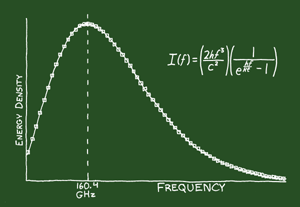
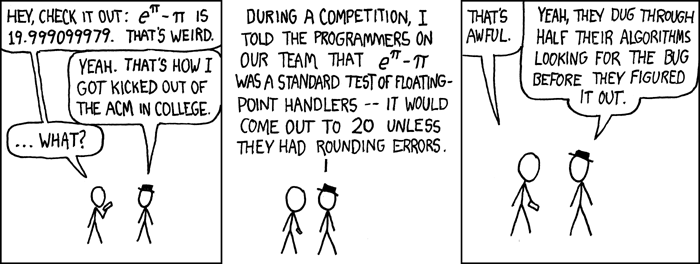
This is, of course, the Cosmic Microwave Background (CMB) spectrum, with the COBE data on top of the predicted model, where the errorbars/points are grossly oversized, and it is, of course, from xckd. Because where else would you see the ACM mentioned in a comic—let alone one that is also discussing the inherent hilarity of trancendental numbers disturbing cozy close to integers?
And now I must stop, lest I either link to or show every other comic on the site. Bitches.

Wednesday, January 31, 2007

Dark Matter, Rap, and Murder

Apparently one of the many things with Alfred P. Sloan's name (and some of his money) on it is the annual Alfred P. Sloan Prize at the Sundance Film Festival. The prize of $20,000 goes to a filmmaker whose film either focusses on science or technology, or has a scientist or mathematician as a main character. This year's winning film is "Dark Matter," a film by Chen Shi-Zheng based on the University of Iowa murders in 1991. Science? Murder? The general lore behind this sad story is that graduate Gang Lu was rather displeased that he was not awarded some prestigous prize for his dissertation work. In the movie setting, apparently they are all cosmologists instead of mere physicists. The fantastic aspect of this seemingly minor change is that one of the characters does the infamous "Dark Matter Rap" written by Ohio State's very own David Weinberg (lyrics here, and! mp3 here). Unfortunately, the rapper is one of the ones who is murdered ... but I still can't wait to see the film. And with Meryl Streep as one of the "stars," how much better can it get??

Wednesday, January 17, 2007

Bismuth Crystals

I have a friend living in Cambridge who has recently gotten into Bismuth crystal making. Unlike lead, bismuth is a surprisingly non-toxic (real) heavy element—in fact, it's the reason for the "Bism" in Pepto-Bismol. You can buy it for about $20 a pound. It melts at about 520°F, which is cool enough that you can melt it on the stove. To form a crystal, melt some bismuth on the stove (my friend uses some stainless steel bowls he's dedicated to the mission), and let the molten bismuth sit for a bit. It will begin to cool and crystalize on the surfaces (top and along the sides of the bowl); as it crystalizes, you can kind of break off pieces. It's easier to get lots of small pieces than big ones, and it takes some magic to figure out how to control the color of it—the color is due to a thin layer of bismuth oxide which forms on the surface of the crystal as it cools. If I remember correctly, gold (clearly the least interesting color when up against purple and blue) is due to too much oxidation. It is also possible to make "Bismuth eggs" (or really, "Bismuth any-kind-of-mold-you-might-have") by melting the Bismuth in a mold and then pouring out the molton Bismuth before it gets too crystalized and fills up the mold.


It's difficult to tell from this perspective, but the upper-right one looks like a conical square spiral, both inside and out. The bottom right one (zoomed in below) totally looks like a Frank Gehry building, but that might be because I've seen more of Building 32 in the last weekend than I have in the last year. The two on the left were originally one piece, which was going to be a Christmas tree ornament, but it broke while spending the day in my pocket. I guess I could still glue the two pieces together (they both have relatively flat sides) and stick a piece of string in the glue as well and still end up with a nice ornament.

UPDATE (09/13/2007): My friend has a few corrections and comments to add.

The colors: it's interference coloring, like you get on soap bubbles and oil slicks, based on how thick the oxide grows. As the layer grows in thickness, it will cycle through the colors repeatedly until the oxide gets too thick to easily transmit light, or something, and then I think it just turns gray. With the crystals, the oxide stops growing as the crystal cools. I do think I got more interesting colors when the crystals were cooler before they were exposed to air, so that they oxidized less, but I think it's a mischaracterization to say that one color or another is the result of too much oxidation.

Saturday, November 04, 2006

A Geocentric View

I think I've settled on a blog title: Geocentric View. geocentric view? a geocentric view? It's all so complicated.

Even though mollishtronomy did make me laugh out loud (thanks, John), I wanted something slightly less restrictive, as I write about things other than astronomy. Okay, while that is also true, the real reason is that I have a really difficult time spelling "mollishtronomy": it's terribly difficult to not put a "k" after the "h," and then it all falls to hell after that. Well, okay that and the fact that I'm just a wee bit compulsive and if I'm going to pick a "real" blog title then it has to be perfect. I'd considered your life in boxes for a while, but then general reaction to that one seemed to be, "... boxes?" I also liked the sound of beneath star-freckled skies, but not only is it a tad too complicated, but Columbus is rather cloudy most of the year. quiet Euclidean space is simple and clean, though slightly too mathematical, and if I'm going to go the mathematical route, then it should by no means be geometric or topological, and certainly not Euclidean for crying out loud. On the other hand, "Abelian grapes" is a little too far from, you know, what I spend all day doing and what I actually blog about, and besides, it's already taken. Both three double-blind mice and three blind jellyfishes have been duly considered, and both were decided to be Awesome group blog titles, which this blog is not. When I started writing this post, particles to pelt was the title of choice, but the universal response to that seems to be, "pelt? ... like, fur? huh?"

No, the credit for a geocentric view goes completely to the unsuspecting Sean Carroll over at Cosmic Variance and a Mr. W. H. Auden who wrote some poetry once upon a time. (I wonder how many more links I can cram into this thing?) The BBC has a recording of Auden reading the relevant poem, entitled "After Reading a Child's Guide to Modern Physics." It's well worth installing RealPlayer, though I found Sylvia Plath's intonation of "Lady Lazuras" much more intriguing: have you ever read a book where they have a poet character and the author goes on and on about how sonorous and melodic the character's voice is? What the author is really trying to say is that the (female) character's voice is like that of Sylvia Plath.

Anyhow, I digress. Here's the lovely poem:

If all a top physicist knows
About the Truth be true,
Then, for all the so-and-so's,
Futility and grime,
Our common world contains,
We have a better time
Than the Greater Nebulae do,
Or the atoms in our brains.

Marriage is rarely bliss
But, surely it would be worse
As particles to pelt
At thousands of miles per sec
About a universe
Wherein a lover's kiss
Would either not be felt
Or break the loved one's neck.

Though the face at which I stare
While shaving it be cruel
For, year after year, it repels
An ageing suitor, it has,
Thank God, sufficient mass
To be altogether there,
Not an indeterminate gruel
Which is partly somewhere else.

Our eyes prefer to suppose
That a habitable place
Has a geocentric view,
That architects enclose
A quiet Euclidian space:
Exploded myths - but who
Could feel at home astraddle
An ever expanding saddle?

This passion of our kind
For the process of finding out
Is a fact one can hardly doubt,
But I would rejoice in it more
If I knew more clearly what
We wanted the knowledge for,
Felt certain still that the mind
Is free to know or not.

It has chosen once, it seems,
And whether our concern
For magnitude's extremes
Really become a creature
Who comes in a median size,
Or politicizing Nature
Be altogether wise,
Is something we shall learn.

It's simple, yet "deep." While Auden is certainly not my favorite poet, he has quite a few pieces I enjoy, and I haven't found any of his works to be annoying or yicky. It's a poem about physics, and yet it's not revolting or condescending or plain wrong like so many scientifically minded poems are. I'll refrain from doing a full-out explication, but the penultimate stanza demands comment: both physics (a kind of science) and poetry (a kind of art) are ultimately a quest for understanding, the "process of finding out." Humankind is driven to it: we have to try to know. What Auden everso innocently asks, though, is just why the seekers seek, and would they be able to "stop any time they wanted"?

Oh, and it really gets me that in the recording the audience doesn't laugh at the end of the fourth stanza. I surely did.

Tuesday, May 09, 2006

The Universe Chandelier


An article on the sculpture "The End of Modernity" (an awful title) appeared this past Sunday in the New York Times art section. The sculpture, currently on display in New York City the Andrea Rosen Gallery in Chelsea (no clue where that is), is basically a sculpture of the universe. The article tells the story better than I can, but basically, the artist, Josiah McElheny, was in residence at Ohio State, and decided he wanted to make a scientifically sound sculpture of the Big Bang. So he called up our resident cosmologist, David Weinberg, and once David realized that this guy was serious, they began to design the thing.

The astronomy department took a bit of a field trip over to the Wexner Center sometime during winter quarter when the sculpture was still on display there. David and Josiah were both there to explain and discuss it. I must say I was pleasantly surprised by the whole thing. I'm not usually one for art; I often find myself wanting to feel something, but simply not being as affected as I'd like to be. Then there are the times when I feel as if the artist is trying to hard to add meaning that just isn't there; they know I should be strongly affected by good art, but they just can't get me there. They're trying too hard. Anyhow, I was highly impressed with Josiah. At a first impression, he's a stereotypical artist in many ways; he's short, speaks with a bit of a high-pitched voice, and kind of "off" as compared to normal people. Whereby normal people, I mean, astronomers, which isn't a fair comparison at all. But he had actually learned a great deal of cosmology, actually poured himself into this project, and was quite clearly deeply passionate about art and beauty and, most importantly, trying to leave an impression on people through art. I respect that, and, somehow, having respect for the artist helped me love the sculpture even more.

The sculpture itself is more representative of the Universe than of the Big Bang. Structurally, it's based on chandeliers from the Metropolitan Opera in New York City. Made entirely of aluminum and blown glass, the central aluminum sphere hangs from the ceiling at about 5 feet above the floor (approximately my eye level). This sphere represents the "surface of last scattering," or the time at which atoms first formed in the universe and light wasn't banging into charged particles left and right anymore, and so could stream freely throughout the universe for the first time. When you hear people talking about the cosmic microwave background, it is the light that has been going along its merry way until hitting our detectors that they are talking about. Basically, it's as far back as we can see in the universe, because before then, the universe was opaque. So that's the sphere in the middle. Distance from the center of the sculpture represents time; the further out from the center, the later the time. The lightbulbs represent quasars (incredibly bright found at the centers of some galaxies), and the glass pieces represent galaxies. The glass pieces come in groups at the end of the sticks, accurately representing the clustering of galaxies at different points in time. There are two shapes of glass pieces: the disks represent spiral galaxies (like the Milky Way) and the spheres represent elliptical galaxies. One of the really cool parts of this sculpture is that the number and clustering of lightbulbs (quasars) and glass pieces (galaxies) at different redshifts (distances from the center) is based on science. It's not just some guy saying, hey, it'd look nice like this, but rather, David's code saying, hey, you should put the pieces on like this. It became a difficult, and interesting, problem when the fact that this thing has to hang from the ceiling without falling over. Very cool indeed. Orginally, it was going to be made out of chrome (Josiah knew of some guys who like to make big sculptures out of chrome and glass---go figure), but, uhm, chrome is kind of heavy. The other fun part is the fact that you've got all these clusters of galaxies (okay, bits of glass) coming off of all of these rods, and you need to position them in such a way that they don't touch each other.

Personally, as art, I was fairly affected by this sculpture. It's huge. It's hanging in a room with plain white walls---there it is---the entire universe. That's the thing I want to understand, to know. One of the unexpected side effects of having all of the metallic parts be shiny aluminum is that you can see your reflection in it. And the central sphere? It curves away from you, so your reflection looks terribly small and far away. And insignificant. I liked sitting on the floor ten feet away from the sculpture, staring at all the bits, and my little reflections, until I felt as if I needed to scream or else I'd fall off the earth. Now that's being affected by art.