Showing posts with label gratuitous pictures. Show all posts

Monday, April 07, 2008

Definitely a Link Dump

I'm tired, and therefore you're not going to get a real blog post out of me. So here are some interesting and/or funny things I've seen on the internet lately.

Monday, March 24, 2008

DoorKitty

δ Carina recently figured out how to get on top of the bathroom door. I haven't seen her actually get onto the door, but she's pretty funny and proud of herself once she's up there. For your lolcat captioning pleasure...:


Thursday, March 13, 2008

Paper Writing

The Sunday before last, I finally got to the point on my current distraction project where I could begin writing it up as a nice paper. That evening I started coughing, no big deal, but by Monday afternoon I was completely overcome with the flu. As it turned out, over half of the graduate students succumbed to the same flu ... and essentially all of us fell sick within 24 ours of each other. As we explained to the prospective graduate students visiting Thursday and Friday, one of the great things about the department here is the high degree of interconnectivity... so that everyone is put out by the plague simultaneously. So last week became an utter waste, but by Friday I was beginning to feel like myself again. Then between Friday morning and Saturday night, central Ohio was visited by about 20 inches of snow—the most snow in one storm here ever. I managed to dig myself out and get into the office on Sunday. And so for the last few days I've been trying to remember how to write a paper.

The quote of the week, I think, comes from Tuesday when I told a professor (with whom I have co-authored a paper) that I can't remember how to write papers. I said I was in my "wandering the halls" phase. The response? "No, no, you seem to be remembering just fine ... this is how you've done it before, if I recall." I couldn't argue with that.

Then Wednesday morning a link was sent my way, and I had no choice but to rearrange the books on my shelf.I discovered that a large fraction the textbooks I own are black or blue; apparently I am not a mathematician (because, as everyone knows, all math books are yellow). I don't know how long I will be able to keep the books like this; normally I sort by genre and then by size within genre (I think I'd need at least an order of magnitude more books before I considered sorting by author, which is apparently how God intended).

The amazing thing is that I'm actually making vague progress writing the paper; I'm almost finished filling everything in—including figures and tables—so soon I'll officially be at the "revision" stage... when I go back and redo everything so that it is at a quality level where I am not embarrassed to show the manuscript to my coauthors. Whee fun.

Sunday, January 06, 2008

A Belated iPhone Post

Yesterday marked the end of vacation, complete with the last leg of all-day driving, this time from South Carolina back to Ohio. Hanging out in the car all day can be really boring, especially when preceded by a day of hanging out in the San Francisco airport watching what we were told was the "worst weather in over ten years." So, naturally, I started playing with the (not my) iPhone:

I just learned that I can't upload photos directly from an iphone to blogger. But now we are at a toll plaza in West Virginia. Typing on the iPhone is hard so I don't think I'll finish this post here. Also the road is curvy and Carina wants a belly rub.
Here is said picture of δ Carina sitting on my lap:
The problem with these kinds of "vacations" is that they are not at all relaxing—and yet it is still really hard to even pretend to get work done, so they are just exhausting. I doubt that going to sleep at 8pm the night before returning to the office is a sign of renewed enthusiasm ...

Monday, December 31, 2007

Clay Sculpture: a Bhuddhess

I mentioned in November that I took a clay sculpture class last summer (as in, I started this post on July 26, apparently), and now that the majikle day has passed, I can share the formerly Top Secret product (a Christmas present for my dad):
This is a Bhuddhess for my dad's massage parlor (formerly my bedroom). The inspiration was the weeks we spent touring Thailand (and other various places in southeast Asia), replete with daily Thai massages and many famous Bhuddhas. This Bhuddha is in the meditation position, which I figured was the most similar to the mental state achieved in a good massage. The base on which she is sitting is supposed to be a lotus flower, a la this picture from a lake near Battambang, Cambodia:
I'm also rather disturbed at how disturbingly similar this picture (which I took) is to one of the iPhone's (and, apparently, newer versions of Apple's OSX) default wallpapers.

Monday, December 24, 2007

Bismuth and Copper, on a Tree

(NB: I would have made this post earlier, but alas, my camera has broken. Santa?)

I have been taking a jewelry class for the last few months, and as those who know me in Real Life invariably ask upon hearing this tidbit: "Jewelry?!" Well, good point. But one of the projects I have spent the most time on was making bismuth crystal Christmas tree ornaments out of copper:

This particular crystal is one of the ones a friend gave me last year, shortly before I discussed making bismuth crystals here (see the crystal on the top-left in the first picture in that post). Next steps include getting better at making my own bismuth crystals (it's a lot of fun, but rather tricky as it turns out), and turning them into more pieces of art and jewelry: necklaces, earrings, pendants, and more ornaments.

Tuesday, November 13, 2007

You Asked For It

As the lone commenter (so far?) on the previous post pointed out, apparently kitty posts get more comments than art or science posts. So, here is a picture of δ Carina in a trashcan:
I'll probably have another science post sometime this weekend, but in the meantime, anyone have a good lolcat caption?

Sunday, November 04, 2007

The Indie Art Capital of the World

So, apparently Columbus has been named the Indie Art Capital of the World. I'm not really sure what this means, but it is true that I have become a lot more aware of art—and people creating art—since moving to Columbus. In fact, the guy I got δ Carina from (thanks, Craigslist!) is an independent artist; he even gave me a self-printed short comic book (about SPACE! and Dylan Thomas being cool!) as a thank you for taking my new shoe-sized meow-monster.

Probably part of Columbus's new title can be attributed to the monthly Gallery Hop in the Short North area of town (the aptly named neighborhood shortly north of downtown). Art galleries littered along about a ten block area stay open late on the first Saturday night of each month, as the crowds wander from gallery to gallery, bar to bar, shop to shop, navigating the random music being played and jewelry and other random things being sold on the sidewalks. And, in these cases, a place doesn't necessarily have to be a "gallery" per se in order to attract people looking for visual and mental stimulation; if you have open wall space to hang a few paintings on, you're in business. Just tonight bought my first piece of what could be considered, you know, real art: a 12"x18" print of the above pretty lady, Sernity, from Robert Walker, an artist displaying his paintings at a realty office. I was also lucky enough to see the original of Rachell, this purple-haired vixen on the right, who I might have just taken home with me had I had $1000 to spare...

Wednesday, October 31, 2007

δ Carina: A Narrative

So the new kitty's name is now officially δ Carina. You may call her δ, Carina, or Carrie for short, but she probably won't respond to any of them. The choice of δ Carina as a name, in retrospect, was incredibly obvious. I had originally been trying to decide between Cassiopeia and Carina (and so either Cassia or Carrie for short), but for such a hyper little hairball, Cassiopeia seems a little to sophisticated. So Carina it is, but the all-too-obvious nickname/association with Carina is Eta Carina, the stupidly massive old cranky variable star in the constellation Carina. And my little bundle of skittish cord-chewing energy is neither massive nor old enough to be an η Carina, so the obvious other choice was Epsilon Carina (since in the land of mathematics ε is generally small but nonzero quantity). But as it turns out, eps Car is a binary star, and since I've got one cat and not two (though, seriously, ε Carina A and ε Carina B would be awesome names for sibling kitties), that was Right Out. So, in the spirit of taking the limit of small delta and epsilon-delta balls, δ Carina became the new name nominee; the only remaining question was: what kind of star is δ Car?

Well, as it turns out, there is no star δ Carina. The Bayer designation of stars names stars in a constellation as Alpha, Beta, Gamma, Delta, etc. from brightest to, er, less bright; so, for instance, Alpha Centauri is the brightest star in the Centaurus constellation. So how can a consellation have no fourth brightest (i.e., Delta) star? Glad you asked. See, back in the day, Ptolemy made a list of the 48 constellations in the sky. One of the largest was Argo Navis, the Southern Ship. So there was an Alpha Argo Navis, a Beta Argo Navis, etc. But when the constellation got broken up in 1752 into Vela (the sail), Carina (the keel), and Puppis (the poop deck [hehe]), astronomers, being astronomrs and thus logical in all ways, decided to also split up the stars and keep the Greek lettering instead of, you know, re-assigning the names to the actual nth brightest stars in each new constellation. So, α and β went to Carina, but γ and δ are in Vela—leaving the name δ Carina free to be assigned to my new 9-week-old clingy attacking striped meowing fuzzball.

And so, as she attacks my hands and legs and arms and keyboard and oh my god I hope she's going to get tired out so I can get some sleep tonight, I present to you δ Carina, The First Day: A Narrative.


Oh no!! A new place! What do I do? I'm all trembling and scared.
Cords! And a ball! How do I choose??
Shoes!!!! My favorites! How did you know??
OK time to read some but how do I choose?
That was lots of hard work now it's naptime.
Whoa. I fell off that was scary. I'll hide here and let Athena the Raccoon protect me.

Sunday, October 28, 2007

Kitty, Part 1

I got a kitty today!! The apartment I was living in for the last two years did not allow pets (something about undergrads being irresponsible creeps), but now I'm in a pet-friendly place and in town for a while, so ... I will do my best to not let this devolve into a cat blog, but first, there's this post which has been sitting in draft for for almost a year ...

Why I need a kitty:

Because my at-home vocabulary is too large:
Because I need another website to check obsessively.
Because traveling frequently will be just that much easier.
So I can take silly pictures and attach dorky captions to them.


Also, KITTY!!!

Monday, August 06, 2007

France, circa 2004

Well, I apparently haven't felt like blogging lately, but since I see other people are giving me credit for it, I figure I might as well share this little gem with you:
I can't remember who sent this to a francophile mailing list I was on at the time, but the timestamp on the image is December 2004, back when "freedom fries" were still all the rage. (And, by the way, FFE: I have a vague idea just how much clicking it must have taken you to find this image. Man you must have been bored.)

UPDATE: According to this Digg post (from 12/2006), the company is Tom Bihn designs, but I can't confirm this. Anyone?

Thursday, June 21, 2007

Galaxies!! Part Two

Waaaaay back in June—as in, last June—I wrote a long post explaining the background, mostly about galaxies, needed to understand the work I've done on the connection between how strongly barred a galaxy is and what kind of structure its circumnuclear dust takes on. (If you want to understand the results below, I recommend reading the background post first. Also, the poster for the conference I presented this at last year can be found here.) The paper was published on December 1, and it is this paper that I will be presenting next week for the oral portion of my general exam, so I figure it's about time I get around to explaining to y'all some of the actual, you know, results.

The first step in preparing next week's talk was to re-read this paper I haven't touched in nearly a year. This has been fun, not only for the "wow! galaxies are cool!" aspect, but also because I can think things like, " 'Employ'? We employ this technique? Didn't we really just use it??" Also, all of those figures I thought were gorgeous a year ago? Turns out the font is too small on most of them, and at least one of them has a typo (as well as one table).

Our first main result was that tightly wound nuclear dust spirals are primarily found in galaxies lacking bars. This isn't all that surprising due to boundary conditions: for the dust in a circumnuclear spiral to connect to the (radial) dust lanes in a bar, the spiral must unwind somewhat, and tightly wound spirals are not somewhat unwound.

So what kinds of circumnuclear morphologies do strongly barred galaxies take on? One common feature is what we term "large grand design" (LGD) spiral structure. A LGD spiral has two prominent symmetric spiral arms which, in 90% of our LGD galaxies, distintegrate before reaching the galaxy nucleus. One frequent end for these spiral arms is at a circumnuclear starburst ring. A circumnuclear starburst ring is just what it sounds like: a ring of intense star formation and thick dust surrounding the galaxy nucleus, like the example to the right. Here, the LGD structure are the dark dust lanes on the top left and bottom right of the image, which connect onto the ring itself. Inside the ring, we see a loosely wound nuclear spiral which is distinct from the ring itself, and is likely to be "native" dust; that is, the bar is probably ineffective at funneling material to the very center of this galaxy. In our most strongly barred galaxies, those lacking LGD spirals simply have very chaotic centers (at best, a chaotic spiral), potentially with a lot of ongoing star formation.

Saturday, May 26, 2007

Ready for Honolulu

I leave tomorrow morning for Honolulu for a meeting of the American Astronomical Society (AAS). I just want to assure everyone that astronomy conferences are not always in exotic locales. Here, for instance, is a picture from the last conference I went to, in Ishigaki, Japan.

While I'm sure there won't be any talks nearly as interesting as this one at the AAAS this March, it will probably be a fun and interesting conference. I will have a poster on variable stars at the Galactic center; the paper has been accepted for publication and I even bought a nice purple poster tube to carry it in. I might even try to post on the exciting goings-on while there.

Sunday, May 20, 2007

My Mother, the Math Teacher

The post a while back wherein I mentioned my dad's crazy doings was somewhat popular, so I figure I'll go with the flow and let y'all know about my non-stereotypical mother. Consider it a belated Mother's Day post. The actual impetus is Friday's xkcd comic:
a(b+c)=(ab)+(ac).  Politicize that, bitches.My mother is a chronic middle school math teacher. She half-heartedly tried retiring sometime when I was in high school, but continued to work full time. Then, about a year ago, we had a big retirement party for her because she was quitting for real. So then she worked part-time for most of the last year... and announced earlier this week that she will be teaching part-time next year. My brother and I keep reminding her of the definition of "retirement," but the message does not seem to stick. We think she is beginning to think of herself as a "free lance math teacher." This new job will not be at the school she's been at for the last 15ish years; instead, she will be teaching at a "gender magnet school," teaching 8th grade girls Algebra I and Geometry. This will be her 40th year of teaching.

The xkcd comic also rings true because my mother is not the kind of person who decided what she believes about the way the world should work decades ago, only to stop thinking about it now. She still talks about what she wants to be when she "grows up" ... perhaps she thinks retiring is the same as growing up? Regardless, it's going to be interesting hearing her perspectives on same-gender education over the next year. She says she hasn't given it much thought yet; she took the job because it's a good job, not because it involves teaching in a gender-separated environment. The more I think about it, the more morally opposed I am to gender separation in an academic environment; but then, it's something I've never had to actually experience myself. The teachers and the students are the ones who can attest to how bad or good of an idea it is, and how it does or does not "work." I'm yet to meet a student who has had both co-ed and gender-separated education and believed the gender-separated to be superior.

And, sadly, this is certainly one way to "politicize" math. Jerks.

UPDATE: Comments were disabled for unkown reasons. Everything should be working fine now, though.

Monday, May 14, 2007

Abell 611 from the LBT

I apparently still don't feel like blogging, so here's a pretty picture of a nice galaxy cluster, Abell 611, for you to look at:
This is one of the clusters we're looking at with the LBT for our weak lensing study. A nice example of strong lensing is the pair of blue arcs above and to the left of the center of the image; those are background galaxies being lensed by the cluster.

Some stats for those of you who care about that kind of thing, copied blatantly from the CCAPP webpage which was in turn copied blatantly from the observer who took the data and made the pretty picture:

Details: the image is about 2 arcminutes on a side, North is up, East is to the left. The integration times were 20min in Uspec, 60min in g-SDSS,and 15min in r-SDSS. The image quality in the combined images is about 0.6" FWHM in g and r, but they were smoothed them to match the 0.7" image quality of the u-band image.

Saturday, May 12, 2007

The Lyman-alpha Forest

It seems that I am now working on the Lyman-α forest, a fair cry from stars or the Milky Way. One of the great aspects of working on the Lyman-α forest is that it relates to so many other aspects of astronomy. And, recently, it's been difficult to spend much time here and not become interested in the composition and geometry of the IGM (e.g., this and this and this).

I had heard about the Lyman-α forest for quite a while before truly understanding what it is; in this particular case, it was a picture that made all the difference.

For example, this cartoon, shamelessly borrowed from Ned Wright's page explaining the Lyman-α forest. There are three separate pieces needed to explain what is meant by the "Lyman-α forest, " or what is commonly written as the Lyα forest. First, there's the Lyman-α bit, which involves a bit about atoms and rudimentary atomic physics. Then, there's the large reservoir of gas between galaxies creatively known as the intergalactic medium, or IGM. Finally, there are the notions of redshift and thermal broadening and other fun things that can happen to change the wavelength at which a photon of light is observed.

Atoms and energy levels: As you should recall from your high school chemistry class (or as wikipedia [or here] would remind you if you were asleep that year), atoms come equipped with energy levels, and the electrons can move between the different levels. These transitions have different names, and the Lyman-α transition is the one between the n=1 and n=2 states. (Lyman-β is n=3 to n=1, Lyman-γ is 4 to 1, Lyman-δ is 5 to 1, and so on. The series of transitions into n=other states are have different names; the Lyman series is just the one named after some dude named Lyman.)

When electrons move from a higher energy level to a lower one, a photon (or two if it's a super-duper-forbidden transition) is emitted by the atom in order to conserve energy. Because the photon is carrying away the energy the atom had when it was in the excited state (i.e., when the electron was in the higher energy level), the energy the photon has is exactly equal to the energy difference between the two levels. So, when one counts the number of photons as a function of energy of some source—this is called taking a spectrum—there are certain wavelengths at which there are lots and lots of photons because lots of atoms have undergone energy transitions and emitted photons with near-identical energies. These are called emission lines.

Of course, the same thing can happen the other direction. If a photon of just the right energy encounters an atom, the atom can absorb the photon, essentially moving the electron from a lower energy level to a higher one. So if we take a spectrum of some bright source, we will see regions where a bunch of atoms have absorbed a bunch of photons all of one wavelength. These regions are known as absorption lines/features/troughs/whathaveyou.

The Intergalactic Medium (IGM): Hydrogen is by far the most common element in the universe; roughly 75% of all atoms in the universe are hydrogen atoms. Nowadays, most of the hydrogen is ionized, so instead of a proton and an electron hanging out together, they are separate. For electrons to be able to move between energy levels, it has to be associated with some nucleus, i.e., the atom has to be neutral. Even though the vast majority of hydrogen atoms in the IGM are ionized, there is enough neutral hydrogen around that Lyman-α (and other) transitions can trace the structure of the IGM. Of course, there are lots of other elements in the IGM, but we can only observe those with atomic transitions in convenient wavelength ranges; commonly observed other species are singly-ionized magnesium (MgII in spectroscopy lingo) and triply-ionized carbon (CIV).

As it turns out, the cartoon description above of the IGM as a bunch of isolated clumps of gas is wrong. A more accurate model has the gas distributed much more smoothly; the gas isn't perfectly uniform, and there are regions of low density and of high density, but the contrast between these regions is not large enough to think of the high density regions as "clouds."

Redshift, etc: The real key to being able to use absorption features to study the IGM is redshift. If we observed all of the intergalactic gas to absorb light at one wavelength, then it would be next to impossible to decipher any physical structure from a spectrum. Luckily, though, we live in an expanding universe, and so light travelling across long distances is redshifted, that is, the wavelength of a single photon gets longer as it propogates. (This is a redshift since longer wavelength means redder light.) The amount by which light is redshifted depends on the distance the light has travelled; this so-called cosmological redshift is the main thing for which Edwin Hubble is famous for figuring out. So, to return the the cartoon above, if we have some really bright faraway source, like a quasar or a gamma ray burst, then light coming towards us from this source will be redshifted. Specifically, light that was originally bluer than that of the Lyα transition will be redshifted to this wavelength, and if there is some neutral hydrogen sitting around where this happens, then it will be able to absorb that light. The more neutral hydrogen (i.e., the higher the neutral hydrogen density) at a given location, then the more Lyα light that will be absorbed. There is a lot of hydrogen in the universe, and the universe is really big, so spectra wind up looking more like this than the above cartoon:
The big peak on the right is due to Lyα emission from the quasar itself, and all the mess to the left (bluewards) of that is the Lyα forest. Lots and lots of absorption.

If this was the end of the story, then it would be fairly easy to go from a map of absorbed light to a density map of the IGM along some line of sight. Alas, this is astronomy, so there are lots of extra things going on. The first is that the gas in the IGM isn't perfectly cold; it has some temperature and so the atoms are moving around relative to one another, which causes individual lines to be smeared out. Observationally, this isn't all bad: we astronomers like knowing about temperatures as well as densities—and the relationship between the two.

As I mentioned earlier, astronomers now know that the IGM does not consist of discrete clouds floating around in a vast emptiness; the gas density instead fluctuates about some constant value. Part of what I am working on now is to try to determine what sets the scale of these fluctuations, or, equivalently, what sets the scale on which the IGM and the Lyα forest are smooth.

Friday, May 04, 2007

Jorge Cham at Ohio State

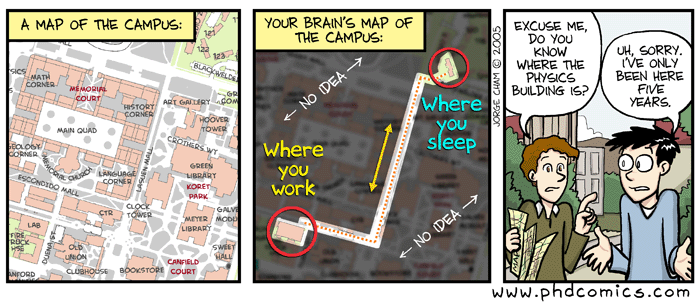
So I've not felt like blogging lately, apparently. According to Jorge Cham, this isn't a bad thing; "procrastination is when you're doing what you want to be doing." I heard him say so himself Tuesday night when he gave a talk here at OSU to an auditorium full of graduate students. (Is it bad that though I knew there was a coffee shop on the first floor of the building, I had no idea what its name was?)
Anyhow, the talk was entertaining, even for someone like me whose been reading the comics regularly for the last, uhm, six years. It started with a routine "I had to learn about Ohio State before coming here" bit ... talking about how the Wikipedia article for OSU is gushing about how big and great of a university it is ... and then we find out that Larry Sanger apparently is an OSU alum and it all begins to make sense.

So this part isn't going to be funny; I know, and I'm sorry, but deal with it. Apparently one of the main points of Cham's talks is that many graduate students are depressed. Apparently, for many people, graduate school is the first time when the ratio of what they think they know to what they think they don't know becomes very small, the first time they feel as if they are not "one of the best" at something. Uhm, so that would have been ... 11th grade for me, at the latest. And if it hadn't happened then, a few days at MIT would have cured that right up. And it goes without saying that my self-confidence is muuuch higher now than it was when I was an undergrad ... although that really isn't saying all that much. My view of stress as an undergrad v. as a grad student is somewhat skewed; while MIT is a high-stress environment, it's also true that my current department most certainly is not, relative to other places (or what's portrayed in the comics). And, seriously, if people are unhappy as graduate students because they don't like what they're doing, then, uhm, why are they in grad school to begin with? People should be doing what makes them happy.

Anyhow, the talk was pretty good and all around entertaining; the only thing that could have made it funnier would have been if he'd actually made a L'Hopital's Rule joke instead of just alluding to the possibility of one. More jokes about how annoying undergrads are would have also been appreciated. They were, unfortunately, not selling the new book (which ships, I think, tomorrow). I'd even brought money from one of my officemates (which I should return ...) to buy one. Instead, I was one of three people to win a raffle for a free (old) book, which is funny because I already own both books. Two years ago Cham gave a talk at MIT, and instead of going, I took a nap. (I was thesing, OK?) A friend bought both books for me—and got them autographed—as a graduate gift. So, I decided to give my free book to one of my officemates, who had decided to not come to the hour-long talk because he needed to work. No lie. Severe workaholic silliness I try very hard to not compare myself to.

Regardless, how come there aren't any couches in my department? My brother, a graduate student in history, maintains his office has one exactly like this:

Tuesday, May 01, 2007

iGoogle?

I'd understand if this was April 1, but it's May 1. And so I don't understand:

It's like Google is getting it on with my computer and/or iPod, and I'm just not sure if I'm OK with that. And why doesn't Apple already have iFoo trademarked for all Foo?

Wednesday, April 25, 2007

American Idol, Landfills, and Juvenile Justice

Alright, I confess. I'm an American Idol fan. I'm all about the brainrot. It's pathetic, I know, but what's even more pathetic is that I don't even own a television and I watch a taped version of the Tuesday night show on Wednesday evenings. Last night's show revolved around "Idol Gives Back," this "big" war-against-poverty campaign they're doing. The big thing they kept mentioning is how for each vote, NewsCorp was going to donate $0.10, for up to five million dollars. They never really said where the money was going, except that it was to *gasp* Save Lives! Also nevermind that this is freaking NewsCorp and five million dollars is barely a drop in the bucket, if that. It probably did do some good and made a lot of people feel warm and fuzzy inside, so I can't complain too much.

So, last night, instead of forcing us to watch Bono "coach" the contestants (oh God thank you for sparing us that pain), we got to see a bunch of short segments of the host and the judges going around the US and Africa. The parts from Africa were ... familiar. (Nevermind that they never told us where in Africa they were; it's one big homogenous place, so it must not really matter anyhow. And while they did talk about how horrible of a disease malaria is, they didn't mention AIDS even once. American Idol is a family show, after all.) But, yes, the shots of people walking through landfills and of large groups of orphans happily eating in large bare rooms... it was a total deja vu, except the grinning kids in the video had darker skin that the ones in my memory.

In August 2005, in the middle of a month-long trip through southeast Asia, my father and I found ourselves in Phnom Penh, the capital of Cambodia. (If you don't know anything about Cambodia, quit being ignorant and go check out the wikipedia article or something. Especially the parts about the Khmer Rouge and Angkor.) We knew that Phnom Penh was going to be horrible, the worst combinations of a large dirty city and abject poverty in a country still recovering from large-scale genocide. Cambodia's tourist attractions are are elsewhere, and we were only in its capital out of necessity. My father's all-too-natural solution was to spend our one full day in town visiting the dump.

I'm not kidding. You just can't make this stuff up. We had met a couple in Siem Reap (the town near Angkor) who had spent a few days volunteering at the Centre for Children's Happiness in Phnom Penh. This organization actually runs two orphanages; the kids are separated by age and amount of time since they've lived in the landfill. Lived in the landfill. Like the girl in the picture on the left, these kids have all lived in the Phnom Penh dump as "garbage pickers" before coming to the orphanage. They go through the trash trying to find something, anything, they can sell for mere pennies in order to try to get enough money to buy food with. They literally live and sleep in the dump; the lucky ones might even live there with older siblings or even a parent. Most are orphans, or have parents in worse situations than them (e.g., missing a limb from the copious land mines scattered throughout the country). The CCH carefully picks children living in the dump to come live in the orphanage instead—and, importantly, the kids have to decide for themselves that this is a change they want in their lives. Usually the children coming straight from the dump have to spend about three months (if I remember correctly) in a hospital gaining strength and being treated for various diseases. (Actually, many only spend a few weeks, but some must spend many many months in recovery.) At the orphanages, they get a chance at having a "real childhood." They learn to read and write (in Khmer, English, and Japanese), they learn math, they learn job skills, they learn traditional Khmer dance and art, they learn how to care for one another and how society runs better if people treat each other with respect, have jobs, and take care of themselves. And, oh yes, they learn math. The walls of the courtyard in the main orphanage are covered with painted lessons: vocabulary, useful math formulas and ideas, proverbs, etc. I spent a while talking to one of the older students, a 16 year old boy who had been in the orphanage for three years. He said he really liked math, "especially trigonometry," and working on the computer. This is what we call a "motivated player." He said that when he turned 18, he wanted to work for the orphanage as a full-time employee; this was two years ago, and I do not know what he has wound up doing. The founder of CCH, Mech Sokha, is very open about the workings of the orphanage; the main office (where the computers live, and thus where many of the children spend much of their time) has a whiteboard dedicated to a breakdown of exactly how much it costs per child per day, and where all of that money both comes from and goes, as he is explaining to my father in the picture on the left. This is one of my favorite pictures (aside from all of the math!) from the orphanage because the kid you see standing next to Mech is so typical. For the first time in their lives, these children are somewhere safe, and it was so obvious just how safe they felt. Kids were running around, hugging each other, hugging Mech (like this one here), and generally just being happy. (I was the one with the camera, so many of them while I was there were taking turns having their picture taken, inspecting the preview on the screen on the back, informing me it wasn't good enough, and making me retake pictures. Oh, the cuteness.)

My dad actually got really excited by the entire experience. One thing we noted is that their computers were all really old and crappy; they had about ten, but only one or two would ever work at a time. My dad thought, "I have a lot of friends; we could easily get dozens of nice computers here." So he tried to help, to forge a bond, but apparently Mech just quit responding to his emails, the last I heard. I personally found the entire experience depressing rather than invigorating; it is difficult to see people making so much out of so little and not feel guilty for making so little out of so much opportunity in my own life. I'm still naive and idealistic; instead of seeing one potentially solvable situation, I see a whole helpless world full of Things That Should Not Be. In my head, I know what the world should be like, but the real world around me is so different that it's overwhelming to know how to go about fixing it. Well, there's that, and the fact that I'm incredibly cynical and impatient and people annoy me.

My father, you see, is different. (It takes a special kind of person to decide to visit the Phnom Penh dump on a tour of southeast Asia, yes?) He was a high school guidance counselor for almost 30 years, and somewhere along the way got involved with a volunteer organization associated with the state's Department for Juvenile Justice. Whereby "involved with," I really mean "founded," and whereby "Department for Juvenile Justice," I'm referring to "juvy," the prison where kids under 18 go. My strongest memories of Christmas morning when I was a kid don't center around getting up at the crack of dawn to run downstairs and see what presents I got; they revolve around getting up before the crack of dawn to drive out to DJJ to hand out bags of Christmas gifts to the teenage inmates there—gifts like pads of paper, pre-stamped envelopes, an orange, and a toothbrush. Since his retirement my senior year of high school, my father has poured himself into running this multimillion dollar philanthropic adventure. Explaining everything they do would require a whole other post, not to mention actually listening when he's going on about all of it on the phone.

My father's philosophy is that charity has its limitations; money can only go so far, and if you actually want to make a difference, then you need to actually do something. Charity is trying to treat symptoms ("we need to feed these hungry children!"), while philanthropy is trying to cure the cause ("we need to help these children's parents feed them!"). Charity makes people feel all warm and fuzzy inside; it has immediate gratification and results, and it's easier, but it the results aren't lasting. Philanthropy, on the other hand, is hard. Philanthropy requires thought, action, and inspiration in additon to mere money. It's one thing to give incarcerated kids prestamped envelopes, but it's something all together to try to change their lives and keep track of them so that when they get out of jail they don't go back to their old (criminal) habits upon returning home.

This is part of what has me cynical about the whole "Idol Gives Back" nonsense. I'm not saying it's bad; I'm saying it sounds like it isn't going to be as effective and useful as it could be. Money going to food doesn't solve problems; it merely postpones them until the next meal, while teaching people that they don't have to work for what they get. In Africa, wouldn't the money be better spent teaching safe sex and supplying condoms so fewer unwanted kids are born? Shouldn't we be trying to attack the problems instead of simply making ourselves feel better?

And, yes, I was glad to see Sanjaya go.