Showing posts with label real people. Show all posts

Wednesday, January 28, 2009

Snow Days are for Lazy Wusses

President Obama would like for you to all grow up and deal with it. "It" in this case is the weather. Quit being lazy, suck it up, clear your roads and get to work.

... Obama said he wanted to make an unrelated comment to the press. In a slightly amused tone, he noted this his daughters' school, Sidwell Friends, was canceled today because of a snow and ice storm that hit Washington.

The suburban schools systems and many private schools in the region were closed today and the District public schools opted for a delayed opening because of the sleet and freezing rain that made some roads and many sidewalks treacherous.

"Because of what? Because of some ice?" Obama said to laughter around the table. ...

He concluded by saying: " ... I'm saying that when it comes to the weather, folks in Washington don't seem to be able to handle things."


In the meantime, half of the graduate students in my department were here this morning for Coffee. We even talked about science for forty minutes, in a way that didn't resemble Lord of the Flies at all. No one else has shown up yet.

Wednesday, October 01, 2008

Book Review: Autism's False Prophets by Paul Offit

I recently received and read Autism's False Prophets: Bad Science, Risky Medicine, and The Search for a Cure by Paul Offit through the ScienceBlogs Book Club. Offit first details the history of various attempts at defining the cause of and curing autism, focusing the most on first the MMR vaccine and then thiomersol (which contains mercury), which is contained in many vaccines (though not MMR).

In general I found this book interesting and educational (all I knew going in was that the "vaccines cause autism" nonsense was both quackery and dangerous), and I recommend it to anyone interested in the so-called controversy—there is no controversy as far as the science is concerned—as well as for the book's interesting discussion on the interaction between science and the public via the media. People distrust science and its authority figures all the time; usually this just leads to ignorance, but in the case of "let's not vaccinate our kids" it can lead to death. Which isn't cool.

Summary: Autism's False Prophets begins by offering a pre-vaccine history of autism and attempts to cure it. A pattern is established: people come up with some desperate theory, put a lot of time and effort and money in trying to "cure" their children, some of the "cures" wind up doing severe damage, parents move to next theory. Then enters the vaccine theory, which is actually two-fold. It begins in England with Andrew Wakefield announcing that the Measles, Mumps, and Rubella (MMR) vaccine increases rates of autism; he's even got an (unsupported) idea as to why this should be the case. (People seemed to not mind that he's had it out against MMR since the 1980s.) Meanwhile, as the MMR-autism link isn't able to be reproduced in independent studies and Wakefield is exposed as a fraud, a panel in the US realizes that the amount of ethylmercury in vaccines (used as a preservative, which makes the vaccine both cheaper and safer to use) is higher than the amount of recommend safe-levels of methylmercury. Spurred on by parents who have decided that their kids got autism after getting their vaccines (most austism symptoms become the most apparent about a year or so of age, right around when kids get many of their vaccines, so the emotional causal link isn't unsurprising), the panel figures that there isn't any harm in being cautious. So they announce that while there isn't any reason to be afraid, they will be looking into the situation. And all hell breaks loose.

Offit traces this aftermath right up to the Omnibus Autism Proceedings, a huge court case of thousands of parents claiming that vaccines caused autism in their children; the court's decision is due out early 2009. Offit then discusses how this controversy is a classic example of fear, scandal, and headlines driving the media narrative more than responsibly informing the public of the facts: the scientific case showing no linkage between vaccines and autism has actually been established for some years now. But, Offit argues, the public equates going online and reading what shows up on a Google search with scientific literacy, and our culture likes to buck authority, and so the result is kids dying of measles. The book closes with a short look into what actually does cause autism (it's genetic), and how a few parents of autistic children who know vaccines weren't the cause—and who don't like having their children referred to as "mad," "damaged," or "soulless"—have been responding to this whole fiasco.

Review: In general, I liked this book and found it easy to read. However, there were several stylistic points which were downright annoying. (I get the impression that while the author did his job, the editor did not.) First, there are several simultaneous storylines weaved throughout the text, yet as the story is not always told chronologically, it's difficult to keep any of the dates and the relative orderings of different "plots" straight. In this same vein, the book is written with the understanding that vaccines do not cause autism, but often the story is told like it is a story, a thriller: the case against vaccines-cause-autism isn't made strongly and irrevocably until well into the book, so someone could easily read halfway and think "zomg! conspiracy!!!" Also, as this is a book talking about how important believing the scientific consensus is, I would have appreciated it if the end notes listed at the back of the book were actually marked in the text itself. The organization of the book is also somewhat shaky, causing some interesting points get a bit buried in the text. For example: if vaccines-cause-autism really is this big conspiracy, then how come the scientists, etc. supposedly perpetuating this conspiracy vaccinate their own kids? Or that kids absorb more methylmercury from breast milk and baby formula than from vaccines in their first few months of life anyhow, a fact which is just mentioned in an off-hand kind of way in the middle of some chapter.

The two chapters towards the end of the book on science and the media and how the general public portrays science were both interesting and elucidating. I can't come up with solutions to these problems, but Offit at least lays out the issues well.

Monday, September 08, 2008

Book Review: Halima Bashir's Tears of the Desert

Over the weekend I read Tears of the Desert: A Memoir of Survival in Darfur by Halima Bashir.

Tears of the Desert details the life of Halima Bashir, a doctor who grew up in Darfur and now lives in the UK. Her story is told in a straightforward manner: how she grew up and how her family and village were important to her, how she went to school and enjoyed it and eventually went on the medical school, how war crept into her life until it became un-ignorable and eventually destroyed her life, her home, her family, and how she finally escaped from Sudan and managed to put together a new life in England. It most places—even the childhood stories—the story is riveting (which, unfortunately, also means that some of the explicit statements of foreboding come across and cheesy and unecessary). The storytelling is also often unexpectedly hilarious; I found myself laughing out loud quite a few times.

As a personal accounting of the history of the Darfur conflict, Tears of the Desert is a powerful story of how innocent lives are completely torn asunder. Bashir has lived through things that most of her readers cannot possibly imagine (yet, of course, as the book is written in the first person, we the readers know that, she at least, has survived). Her story thrusts raw emotion into the too easily glossed-over refugee and death statistics streaming out of the region. However, I found the book almost too insular at times; for example, the only year explicitly stated (aside from in the short epilogue), is the date of Bashir's birth: 1979. I was constantly adding and subtracting to determine approximate dates, and so as an actual history Tears of the Desert unfortunately falls a little short and does not serve well as an introduction to the Darfur crisis, and I fear that in ten to twenty years this fact will make it an even more difficult read. Likewise, no map is offered and only a brief description as to the underlying cause of the conflict and why the UN is doing little to stop it is given in the epilogue.

Regardless, a reader who first spends half an hour reading about the Darfur situation online should have plenty of context in which to set this book, and Tears of the Desert provides a far more personal and accessible accounting than anything the internet (or most anywhere else) has to provide.

Tears of the Desert will be on sale in the US on September 9, 2008.

Wednesday, August 22, 2007

Google Sky and Astronomy for the Masses

So some lady just called me looking for the Political Science department .... I told her that I am in the Astronomy department, not Political Science. So she asked me if I believe the universe is expanding. Yes ... "That's because of the redshifts, right?" Yeah ... "So who owns the Hubble telescope?" Uh ... "The US Government owns the Hubble telescope, right?" Well, I wouldn't put it quite like that. "The French government doesn't operate it, so it must be the US." Does that really follow? "Astronomy is a science, right? What's the phone number of the chair of the science department?" Uhm ... It's 6pm... I don't think anyone is going to be in their offices right now.

Sigh. I clearly need more practice talking to crazy people while still allowing them to remain "interested" in astronomy, though this one seemed rather well-informed, albeit with big warning bells going off all over the place. In other news, Google announced today that the Sky is now part of the Earth, in that Google Sky is now part of Google Earth. This was enough of an incentive for me to finally download Google Earth and waste lots of time looking at pretty galaxies and galaxy clusters and nebulae and other such fun things. Constellations and planet orbits are included. Much like Google Earth, Google Sky is much more in the hokey fun category than the useful category, and unfortunately the objects I'm prone to looking at first are the ones I know well enough to be annoyed at how poor some of the data is. The entire sky has been mapped by the Digital Sky Survey (DSS), and a fourth of it by the more recent and absolutely fantastic Sloan Digital Sky Survey (SDSS). The Sloan images include all of the delightful astrometric precision of SDSS, as well as all five wavelength bands of the survey. Then, for the popular select few objects, the Hubble Heritage project has kicked in with "informative" blurbs about "zoom lenses" (also known as "the Virgo Cluster") and other such things, though one useful bit about these is the links to outside sources like ADS for said objects. The Hubble Heritage project by itself is a pretty interesting archive to nose around in if you haven't already, as well as the recently released Hubble Legacy Archive (which is actually good for scientific purposes).

Sunday, July 01, 2007

Miracles and Missions

Last Tuesday morning I went with my family to the groundbreaking for the new "community center" at the South Carolina Department of Juvenile Justice (DJJ). I've mentioned DJJ on here before; my dad is heavily involved with volunteer efforts out there, and apparently he was building coordinator for this multi-million entirely-donated dollar effort. The idea behind the community center is that, compared to once they re-enter the real world, it's relatively easy to get an incarcerated kid back on track while they are still behind bars. But in the real world, normal high schools—let alone colleges—don't want these kids in their halls. It's harder to get a job, to become a fully functioning member of society... and so they slip back into old habits. If I understand it correctly, the idea behind the community center, which is being built for cost on the DJJ campus, is to serve as a place where kids can become more integrated into the community before their release date. I can't keep track of how many years have been spent on this project to get it this far, and I have only the vaguest sense of how much effort and work it has taken. As such, I was completely taken aback when speaker after speaker at the little ceremony talked about how this is "a miracle from God." Seriously? It's one thing if you don't give yourself any credit for all of your hard work, but what about your coworkers and those who have donated money? Wouldn't a true miracle have been having this building just show up five years ago so that it could have benefited all the kids who have gone through DJJ during that time? I understand that these people think that God works miracles through people—I don't understand why they think this, but I understand that they do—but wouldn't it be a more positive message to send to people trying to put their lives back together before they've barely started that if you work really hard for something you can achieve it, rather than saying if you work really hard for something, that's nice and all, but it's not your accomplishment in any case?

So then Tuesday afternoon, the girl I was best friends with growing up got into town, and I got to hang out with her for the rest of the day. (Our parents lived two houses apart since I was five.) In July, she's off to Nicaragua for three years to teach at a school for children of missionaries. She'll be making barely enough to live off of, and since the school doesn't have a large influx of money (the kids have to pay tuition, but you can imagine how much spare money missionaries have in the first place), they want for the teachers to donate a good chunk of their salary back to the school. The solution? "Stateside" support, i.e., have your church, friends, and family back home "donate" money for you to live off of for three years. While I am worried about some aspects of this venture, I do think it will be a good experience for her, especially since she wants travel and adventure and has been trying to get a job teaching elementary school for the last year and a half. But this whole thing has gotten me thinking a lot about mission work; Nicaragua is an officially Roman Catholic country, but more and more people are becoming protestant. Why a christian country needs missionaries is a little bit beyond me, but over lunch on Tuesday, my uncle was explaining to me how his kids have been involved in mission projects in Mexico. These projects are to build a house for a family in a short time frame, free of cost. In the meantime, the kids get to learn about poverty, form a bond amongst themselves, and learn the personal benefit of helping others—all good things independent of any religious motivation. (Again, Mexico is extremely Catholic ... why would they need evangelizing to?) It seems that Chad over at Uncertain Principles has been thinking along these same lines this past week (see here and here, and be sure to read the comments): are there any atheist/non-religious charity organizations that provide both this kind of charitable work and such an enriching experience for the people involved? Values and religion are not the same thing, of course, and it is important for children—regardless of the religion or lack thereof of their parents—to learn values (whatever that might mean) and the importance of hard work and the power of people in action instead of praying that some god is going to miraculously fix the world in his own sweet time.

Friday, June 29, 2007

There might be a lesson or two in here somewhere ...

The plan was for me to come back from South Carolina on Wednesday and do my oral exam on Thursday. Roughly speaking, that's what happened, but like many stories, there's a nice "travelling sucks" story stuck in the middle.

So Wednesday morning, my mom drove me up to Charlotte and it was no problem at all getting to Detroit (I was flying Northwest). As we were landing, a nice thunderstorm broke out, and so we got to sit on the tarmack for about an hour before someone would come out and bring out the jetbridge so we could get off. I grabbed a sandwich and talked on the phone for a bit (long layover) and worked on my presentation some. I was working enough that I didn't even notice my flight back to Columbus had been delayed a bit, but I didn't care since I didn't have a tight schedule. When they finally let us onto the plane, the two people ahead of me in line got all huffy with the boarding ticket lady because they didn't realize that they couldn't bring their big suitcase onto the plane and had to check it planeside. Oh, and they were rather drunk. Finally get on the plane and one of them is sitting across the aisle from me and smells like a nice ashtray—quite unpleasant. Eventually someone comes onto the plane and asks to "talk" to them "for a minute." They go; I get two seats to myself. We then sit at the gate for another twenty minutes for security to deal with the drunk people (why they needed the plane there to do that is beyond me). We then go sit on the runway for about an hour before the pilot tells us that we don't have enough fuel to get to Columbus because we're being rerouted, so they take us back to the gate before letting us know the flight has been cancelled. By this time it's after 8pm, and I was supposed to be back in Columbus before 6:30. Needless to say, Northwest was fully uninterested in getting me back to Ohio that night; they said they "might" be able to get me back "tomorrow." Tomorrow? Might? I have an exam at 2:30 that I'm—oh yeah—unprepared for! In the meantime, I had made friends with some ladies in the back of the plane (apparently watching smelly drunk people get kicked off a plane is a bit of a bonding experience). One of them was able and willing to rent a car on her company credit card and drive the four of us back to Columbus. (Thanks, Robin!) By the way, this is another example of why to never check luggage; I was the only one in the car with all of the stuff I had been hoping to leave with. I pretty much never spend time around "real" people, so I was pleasantly surprised when the conversation was lively and interesting the whole way back—and it definitely made for an upbeat ending to a rather shit-tastic birthday. I was dropped off at the airport, where I picked up my car and finally made it home sometime after 1 a.m.

Thursday, I was fairly dead to the world. I was reeeeeally hoping that some combination of caffeine, adrenaline, and maybe even anxiety would suffice for waking me up, but not so much. The hour before the presentation I spent trying (unsuccessfully) to nap on my desk. The talk itself went okay; somewhere in my academic past I have learned to give a half-decent presentation on auto-drive. The more than an hour of questioning afterwards, however ... let's just say it was a rather embarassing experience I'd rather not reminisce over and leave it at that. I passed of course, and I went out for wings afterwards (BW3s has finally re-opened near campus), but I am forced to wonder how it would have gone if I had actually been cogent and lucid, and actually, you know, prepared for the ordeal instead of taking a five day joy trip to a place that has the power of giving me a really thick accent.

Wednesday, April 25, 2007

American Idol, Landfills, and Juvenile Justice

Alright, I confess. I'm an American Idol fan. I'm all about the brainrot. It's pathetic, I know, but what's even more pathetic is that I don't even own a television and I watch a taped version of the Tuesday night show on Wednesday evenings. Last night's show revolved around "Idol Gives Back," this "big" war-against-poverty campaign they're doing. The big thing they kept mentioning is how for each vote, NewsCorp was going to donate $0.10, for up to five million dollars. They never really said where the money was going, except that it was to *gasp* Save Lives! Also nevermind that this is freaking NewsCorp and five million dollars is barely a drop in the bucket, if that. It probably did do some good and made a lot of people feel warm and fuzzy inside, so I can't complain too much.

So, last night, instead of forcing us to watch Bono "coach" the contestants (oh God thank you for sparing us that pain), we got to see a bunch of short segments of the host and the judges going around the US and Africa. The parts from Africa were ... familiar. (Nevermind that they never told us where in Africa they were; it's one big homogenous place, so it must not really matter anyhow. And while they did talk about how horrible of a disease malaria is, they didn't mention AIDS even once. American Idol is a family show, after all.) But, yes, the shots of people walking through landfills and of large groups of orphans happily eating in large bare rooms... it was a total deja vu, except the grinning kids in the video had darker skin that the ones in my memory.

In August 2005, in the middle of a month-long trip through southeast Asia, my father and I found ourselves in Phnom Penh, the capital of Cambodia. (If you don't know anything about Cambodia, quit being ignorant and go check out the wikipedia article or something. Especially the parts about the Khmer Rouge and Angkor.) We knew that Phnom Penh was going to be horrible, the worst combinations of a large dirty city and abject poverty in a country still recovering from large-scale genocide. Cambodia's tourist attractions are are elsewhere, and we were only in its capital out of necessity. My father's all-too-natural solution was to spend our one full day in town visiting the dump.

I'm not kidding. You just can't make this stuff up. We had met a couple in Siem Reap (the town near Angkor) who had spent a few days volunteering at the Centre for Children's Happiness in Phnom Penh. This organization actually runs two orphanages; the kids are separated by age and amount of time since they've lived in the landfill. Lived in the landfill. Like the girl in the picture on the left, these kids have all lived in the Phnom Penh dump as "garbage pickers" before coming to the orphanage. They go through the trash trying to find something, anything, they can sell for mere pennies in order to try to get enough money to buy food with. They literally live and sleep in the dump; the lucky ones might even live there with older siblings or even a parent. Most are orphans, or have parents in worse situations than them (e.g., missing a limb from the copious land mines scattered throughout the country). The CCH carefully picks children living in the dump to come live in the orphanage instead—and, importantly, the kids have to decide for themselves that this is a change they want in their lives. Usually the children coming straight from the dump have to spend about three months (if I remember correctly) in a hospital gaining strength and being treated for various diseases. (Actually, many only spend a few weeks, but some must spend many many months in recovery.) At the orphanages, they get a chance at having a "real childhood." They learn to read and write (in Khmer, English, and Japanese), they learn math, they learn job skills, they learn traditional Khmer dance and art, they learn how to care for one another and how society runs better if people treat each other with respect, have jobs, and take care of themselves. And, oh yes, they learn math. The walls of the courtyard in the main orphanage are covered with painted lessons: vocabulary, useful math formulas and ideas, proverbs, etc. I spent a while talking to one of the older students, a 16 year old boy who had been in the orphanage for three years. He said he really liked math, "especially trigonometry," and working on the computer. This is what we call a "motivated player." He said that when he turned 18, he wanted to work for the orphanage as a full-time employee; this was two years ago, and I do not know what he has wound up doing. The founder of CCH, Mech Sokha, is very open about the workings of the orphanage; the main office (where the computers live, and thus where many of the children spend much of their time) has a whiteboard dedicated to a breakdown of exactly how much it costs per child per day, and where all of that money both comes from and goes, as he is explaining to my father in the picture on the left. This is one of my favorite pictures (aside from all of the math!) from the orphanage because the kid you see standing next to Mech is so typical. For the first time in their lives, these children are somewhere safe, and it was so obvious just how safe they felt. Kids were running around, hugging each other, hugging Mech (like this one here), and generally just being happy. (I was the one with the camera, so many of them while I was there were taking turns having their picture taken, inspecting the preview on the screen on the back, informing me it wasn't good enough, and making me retake pictures. Oh, the cuteness.)

My dad actually got really excited by the entire experience. One thing we noted is that their computers were all really old and crappy; they had about ten, but only one or two would ever work at a time. My dad thought, "I have a lot of friends; we could easily get dozens of nice computers here." So he tried to help, to forge a bond, but apparently Mech just quit responding to his emails, the last I heard. I personally found the entire experience depressing rather than invigorating; it is difficult to see people making so much out of so little and not feel guilty for making so little out of so much opportunity in my own life. I'm still naive and idealistic; instead of seeing one potentially solvable situation, I see a whole helpless world full of Things That Should Not Be. In my head, I know what the world should be like, but the real world around me is so different that it's overwhelming to know how to go about fixing it. Well, there's that, and the fact that I'm incredibly cynical and impatient and people annoy me.

My father, you see, is different. (It takes a special kind of person to decide to visit the Phnom Penh dump on a tour of southeast Asia, yes?) He was a high school guidance counselor for almost 30 years, and somewhere along the way got involved with a volunteer organization associated with the state's Department for Juvenile Justice. Whereby "involved with," I really mean "founded," and whereby "Department for Juvenile Justice," I'm referring to "juvy," the prison where kids under 18 go. My strongest memories of Christmas morning when I was a kid don't center around getting up at the crack of dawn to run downstairs and see what presents I got; they revolve around getting up before the crack of dawn to drive out to DJJ to hand out bags of Christmas gifts to the teenage inmates there—gifts like pads of paper, pre-stamped envelopes, an orange, and a toothbrush. Since his retirement my senior year of high school, my father has poured himself into running this multimillion dollar philanthropic adventure. Explaining everything they do would require a whole other post, not to mention actually listening when he's going on about all of it on the phone.

My father's philosophy is that charity has its limitations; money can only go so far, and if you actually want to make a difference, then you need to actually do something. Charity is trying to treat symptoms ("we need to feed these hungry children!"), while philanthropy is trying to cure the cause ("we need to help these children's parents feed them!"). Charity makes people feel all warm and fuzzy inside; it has immediate gratification and results, and it's easier, but it the results aren't lasting. Philanthropy, on the other hand, is hard. Philanthropy requires thought, action, and inspiration in additon to mere money. It's one thing to give incarcerated kids prestamped envelopes, but it's something all together to try to change their lives and keep track of them so that when they get out of jail they don't go back to their old (criminal) habits upon returning home.

This is part of what has me cynical about the whole "Idol Gives Back" nonsense. I'm not saying it's bad; I'm saying it sounds like it isn't going to be as effective and useful as it could be. Money going to food doesn't solve problems; it merely postpones them until the next meal, while teaching people that they don't have to work for what they get. In Africa, wouldn't the money be better spent teaching safe sex and supplying condoms so fewer unwanted kids are born? Shouldn't we be trying to attack the problems instead of simply making ourselves feel better?

And, yes, I was glad to see Sanjaya go.

Monday, February 26, 2007

Well, That Was Interesting

I had a layover in Philadelphia this weekend, and as such, found myself in need of coffee. I was standing in line at "Java Jazz" admiring the tanalizing display of nearly topologically interesting objects nearby when the fire alarm went off. Bright white flashing light and a siren like what I'm sure a fire truck barreling down the nearby corridor would sound like. A few people looked annoyed and conused, and then a voice came over the intercom letting us know the fire alarm was going off (thanks for letting us know!) and that we should move to the nearest exit. A few people spoke more loudly so that their orders could be heard over the ruckus, and the TSA folk looked a little bewildered as to what to do. The pilot in line behind me was making wisecracks like, "Welcome to Philadelphia." I don't think he likes his job very much. After a few minutes, the alarm went off, as I pulled out my credit card to pay for my coffee. I was told their credit card machine was broken, which was FANTASTIC since I don't carry cash. I told her she should put a sign up saying the machine is broken, but apparently it is against airport rules to post handwritten signs, and she has to abide by those rules.

Now, something in the story I just told you strikes me as deeply wrong and twisted, but I'm not sure what it is exactly.

Saturday, September 02, 2006

Vietnam's National Day

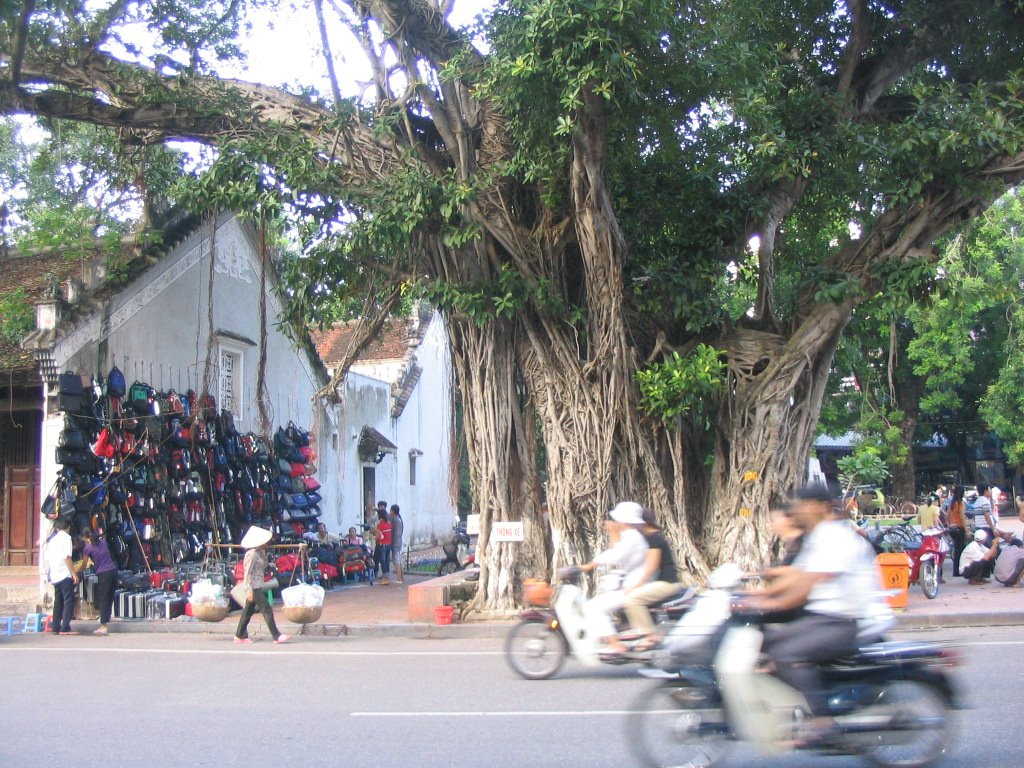
My father and I left Hanoi for the States a year ago today, after a full month touring southeast Asia. Coincidentally, September 2 is also Vietnam's National Day. We had managed to miss the Queen's Birthday in Thailand by a day, Malaysia's National Day by a few weeks, and Singapore's National Day by two days. But for Vietnam's National Day, we were in the capital, trying to get out, and staying within near spitting distance of the Vietnamese equivalent of the Esplanade on the Fourth of July. Both of us were in a horrendous mood; my father's wallet and glasses had been stolen as we squeezed through half a mile of ass-to-stomach thick crowd the night before, and I didn't know whether I more wanted American food or to walk down a hassle-free Walmart aisle.

Our flight out was shortly before midnight, so we took our last dinner at the cozy backpacker's place we had already frequented on a number of occasions. While my dad was shooting off a final email to my mother, I had a few drinks and made a final purchase of a 750mL bottle of Da Lat red wine. I hadn't actually had any on the trip, and we hadn't actually made it to Da Lat, which is in the mountains north of Ho Chi Minh City (also known as Saigon). Next time I'm in Vietnam, I'll definitely try to get there; we simply didn't have time on this trip.

We trudged back to the hotel, going well out of our way to this time avoid the burgeoning masses of people around the lake, getting back around 7:30 or so. The roads around our hotel were completely blocked off, and it only took about ten minutes to realize that "we ordered a taxi for you" really meant "I have no idea what you said, but I don't want you mad at me." So we walked away from the commotion for a few blocks, looking for someone to give us a ride to the airport.

Now, for those of you who haven't had the distinct pleasure of travelling somewhere where they can tell you're a foreigner by the color of your skin (please note that this is not an issue in the U. S. of A.) and where everyone knows that you can take advantage of a foreigner because they are endless fountains of money, let me explain something. One of the main reasons I was so ready for this slightly-too long trip to be over was that I had begun to cultivate an intense desire to be able to walk down the street without every other person yelling at me, Hey lady, want a taxi? Considering this, there is a strong level of irony to the fact that we had a hell of a hard time finding someone willing to give us a ride to somewhere else for the exchange of a few colorful pieces of paper.

We eventually found two guys on motorcycles, and realizing this was the best we were going to get, decided on a slightly too high price, and set off. There had been a bit of discussion over the word "airport," and then some arguing between the two of them as to, presumably, the best way to get there, but it was good to be on our way.

We arrived only about twenty minutes later. At the (closed) Vietnam Airlines head office. I honestly do not think that either of these gentlemen really knew what an airplane or an airport is. But they wanted their money. And explaining to them that they hadn't taken us where they told us they would didn't really work. And we really really needed to get to the airport.

At this point, the streets were completely packed, we were out a decent bit of cash (wallet stolen and all, we had a finite amount, see), and now no earthly clue as to our location, except that there probably wasn't a plane headed to Seoul within a mile.

One advantage to the street being at a standstill is it wasn't too difficult to find a cab. We agreed on a definitely too high price, and climbed in. And just sat there. And moved a little bit. And then sat there some more. Sometime between getting off of the motorcycles and into the cab and the cab not really going anywhere, the fireworks had started. Now, in the U.S., if you're in a car, and you're on the road, even if it is July 4th, if fireworks start going off, ... you keep driving, right? Right? You don't stop the car, get out, and watch the fireworks, even if you're in the middle of making a left-hand turn. This is probably because most people in the United States have actually seen fireworks before... as one kind woman about my age explained to us as we were trying to get the Red Traffic Sea to part, "But it's our National Day! Everyone is so excited!"

The only car that made any perceptible progress for the next half hour was the taxi (originally) next to us, with six people in it, most of whom were hanging out of the windows yelling and motioning at everyone else in the traffic jam. I think they were everso calmly explaining, "We've got a lady giving birth in the back seat, so please move over so we can get through."

Once the (rather brief, even if you are worried about missing an international flight) fireworks display was over, and we were definitively on our way, I recognized a familiar tune in the instrumental music on the radio. It was a forty-five minute ride out to the airport, we didn't miss the flight, and I was only mildly scolded by the immigration agent because my visa expired on the first of September. As I was moving shortly after returning, I even had the joy of going to Walmart almost daily for a week.

And now I've been here for almost a year. When my parents visited a couple of weeks ago, I marinated some steaks for them, and my dad opened up the bottle of Da Lat wine I had been saving for a special occasion. We toasted and sipped. Only one sip each. It was... earthy, in that thick muddy black dirt under your toenails kind of way. At least it'll make for good cooking wine...