Friday, February 23, 2007

Happy Birthday, Supernova Remnant 1987A

Today marks the 20-year anniversary of the arrival of the neutrinos of SN1987A to Earth.
The defining dramatic burst of light for this explosive stelar death was first observed the following night. SN1987A is famous because it is the nearest supernova in modern times, i.e., since we started looking at such "guest stars" with telescopes and actually thinking about the associated physics. The now supernova remnant 1987A (pictured to the right when it was eight-ish years old) lives in the Large Magellenic Cloud (known to friends as the LMC), a dwarf galaxy orbiting our own Milky Way. The LMC is only 150000 or 170000 lightyears away, depending on who you ask. which is close enough to be seen with the naked eye in the Southern Hemisphere.

Even though 20 neutrinos from SN1987A were detected (and some of these are still disputed as whether or not they are "true" detections) they were heralded as undeniable proof that indeed >99% of the energy released when certain stars die is in the form of these elusive tiny neutral particles.

So: happy birthday and thank you, SN1987A for exploding and sending us some of your neutrinos and light. Astronomers across the world celebrate you this week with conferences, drinks, and cookies. We especially appreciate it seeing as how no star in our own Galaxy has been so kind in the last few centuries or so.

Thursday, February 22, 2007

Faculty Search

So there's this paper I've been stalling on writing for the last while. It's difficult to define "while" in this context, but there have been at least two months during which I feel like I just... haven't done anything. Or the things I've been working on haven't been the right things. Or all the time I think I've been working I've secretly been playing computer games without telling myself. Or perhaps with the quarter starting in January I managed to come across a veritable plethera of excuses for not working.

Once such excuse is that we've had four faculty candidates visit in the last six-ish weeks as part of our search for a theoretical cosmologist. The OSU Department of Astronomy being the graduate student friendly place that it is, this means that a handful of us (myself included) got to have lunch with all of the candidates, sans faculty. Well, all of the candidates except the unlucky one who visited in the middle of last week's snowstorm and University shutdown. I think the setup is fantastic: I'm a fairly judgemental person, and I like free food and talking about science. Then there's "speaker harassement," the hour-or-so the graduate students spend with the speaker (we do this for any colloquium speaker, not just job candidates) after their talk, harassing them about science and minute details of their talk. Different people react differently during speaker harassment; we often get visitors who treat speaker harassment as fun and interactive, asking all of us graduate students our names and what we're working on and with whom, but then we also get the ones who sit there like duds just waiting to be asked something. I have also noticed when eating out with visitors, in general, that some will make a point of asking me about my research, whereas others are satisfied by keeping the conversation in their own area of expertise. Normally, I just assume that those who don't ask me what I'm working on after a two-hour science-laden conversation simply don't care to know what I'm working on, and they don't care to know what I am working on because on some level they are a big fat self-centered jerk. Ah, but with the faculty candiates I found myself wondering: do they not care because they don't think of graduate students as Real People with Real Research, or do they not care because I give off "I AM UNINTERESTING" vibes, or do they not care because they are ignorant and afraid of anything outside of their own little niche?

In any case, I've been glad to note that I have enjoyed talking about science with each of the candidates—whatever writer's block I have isn't due to falling out of love with astrophysics—though it is quite entertaining to watch certain cosmologists' eyes glaze over when I mention I'm cataloging variable stars at the Galactic center. (Stars are so boring!) Sociologically, the entire process is quite entertaining to observe—entertaining because, as a lowly pion, I don't have to deal with the political decision-making goop of the whole thing. It's this intricate dance of, we're trying to impress the candidate so they'll like us, and the candidate is trying to impress us so we'll give them a, you know, job offer. It's also interesting learning about the job-search-and-pick process from this end (e.g., what exactly does one have to do in order to leave a "good impression"?) before I have to go through it myself. During a one-hour job talk, for example, it's probably a good idea to know whether or not your presentation has a burning desire to be two hours long. That falls under the "obvious" category. In the not-obvious category we have such examples as, how much of what kinds of science should I do now in order to ensure I'll be able to find a job when the future arrives?

It's just a hunch, but I'm going to guess that it's probably better for this paper to get itself finished so I can move on to something else. Rather than, you know, not.

Monday, February 19, 2007

Ma'am

I proctored an exam this morning for the class I'm TAing. One of the students called me "ma'am" more than once. He can't be more than four years younger than me, if that. I feel midly disturbed, kind of old, and, yet, oddly powerful.

I also had an amusing exchange with someone in the physics department today. It went something like this: "So what's your position over there in Astronomy?" "... I'm a second year grad student ..." "And they let you work on just whatever you want?!" "Well, yeah ..."

Tuesday, February 13, 2007

Snow (Half-)Day

Ohio State shut down today at 1:30p.m. This is because Columbus doesn't have enough snow plows in order to deal with a bit of snow—and apparently sleet and frozen slush isn't looked too kindly upon, either. It has actually quit snowing and sleeting for now, but soon it will be getting very very cold. How lovely.

We have a faculty candidate visiting today, and he was supposed to give a colloquium this afternoon at 3:30. There were donuts and everything. So when the announcement was made that the staff were headed home for the day, somehow two boxes of very delicious looking donuts wound up in our office. Shortly afterwards, rumor spread that the colloquium was being moved to tomorrow, followed by a crowd of people flocking around our door, with mumbles about how donuts go stale after a day. Because nothing says "Snow Day!" like donuts and coffee without an accompanying colloquium.

I was all excited about the donuts and the "ooh, snow!" until I realized that "school is closed" also means "campus buses will quit running today," and I didn't actually want to walk home in the dark ice snow slush sleet badness. There is a layer of ice forming on everything, and I'm now mildly afraid that it'll discover the power lines, do a little tango, and there will be more badness. Weather is intertaining and all, but it's an inherently outside phenomenon, and I don't remember giving it permission to futz with what's going on inside. I was all stoked for working today—I have this fun variable infrared source that's also friends with a few masers and X-ray emission I'm trying to figure out—but noooooo ... I had to go home. And what if the university is still being a bunch of wusses tomorrow and the bus isn't running and I have to take a walk in the cold iciness just to get some work done? Life is so unfair.

And then I saw my car. Poor car. I so excited the first time my car got to learn about snow, I took a picture. But now? Now my car is learning about snow drifts and sheens of bumpy ice (see right, see left). At least it's not one of those sucker cars parked on the curbs of busy streets that now have frozen muddy slush all over them.

Monday, February 12, 2007

I Do It For The Money

CNN has an article today listing the 50 highest paid professions in the U.S., based on median annual salary. Here's my summary of the top 30:

1. Doctor: $177,690

2. Doctor: $174,240

3. Doctor: $171,810

4. Doctor: $163,410

5. Doctor: $160,660

6. Internists, General: $156,550 <-- what does that even mean?!

7. Head Doctor: $146,150

8. Doctor: $146,080

9. Doctor: $140,370

10. Person with big corner office and no hobbies: $139,810

11. Doctor: $139,230

12. Airline Pilots, Copilots, and Flight Engineers: $135,040

13. Doctor: $133,680

14. Doctor: $111,250

15. Lawyers: $110,520

16. Air Traffic Controllers: $105,820

17. "Managers": $105,470

18. Computer people: $102,360

19. "Managers": $101,990

20. Astronomers: $101,360

21. "Managers": $99,140

22. "Managers": $98,510

23. Petroleum Engineers: $97,350 <-- oil, yick

24. "Managers": $96,620

25. Former Lawyers: $95,570

26. Doctor: $95,500

27. "Managers": $95,470

28. Computer People: $94,030

29. Judges, Magistrate Judges, and Magistrates: $91,500

30. Physicists: $91,480


Take that, you "real" physicists.

Also note that all those doctors and lawyers (and probably many of the managers) had to have lots of icky schooling after college—icky because they probably had to pay lots and lots for it instead of, you know, not.

Saturday, February 10, 2007

Global Warming is Bad

Now that I've ranted about how cold it is, I'm going to rant about how warm it is. Whereby "rant," I mean something much much more than that, but you'll see.

On Monday we discussed in Coffee the recent IPCC (Intergovernmental Panel on Climate Change) report to policy makers. You can see the full thing here (in pdf form); all of the figures I'm showing are snatched directly from there.

The report is entitled "Climate Change 2007: The Physical Science Basis," and it essentially describes the unambiguous evidence that Earth's climate is going through rapid transitions, and this warming is unambiguously due to human action. The report also outlines several climate change models, and describes how even the most conservative and optimistic models predict drastic and nearly irreversible changes. What is even more terrifying is that, scientifically, their approach to the the entire thing is incredibly conservative and almost certainly underestimates the problems. For example, the report completely ignores "catastrophes," rapid events that could strongly alter sea levels and atmospheric content (like the Arctic ice cap melting, or all of the frozen peat in Siberia undergoing a phase transition [i.e., melting] and releasing a bunch of methane into the air all at once). They ignore possible catastrophes because, frankly, they can't be well modeled yet, and things that can't be well modeled have no business being in models.


The graph on the left shows the increase in carbon dioxide (CO2 10,000 years; the inset shows a blow-up of the last two hundred years. Clearly, something happened that made this trend go from slowly increasing to increasing really-really-fast. The report has similar graphs, showing disturbingly similar trends, for both methane and nitrous oxide. On the right-hand side of these graphs you can see the ") in the air in the lastradiative forcing" due to each of these gases. Basically, a certain amount of gas in the air can cause the atmosphere to either warm up or cool down. (The warming up is what is commonly referred to as the "greenhouse effect.") What I find painfully ironic about relative radiative forcing amounts is that apparently it wasn't until around the 1950s that people actually started noticing the increase in temperature of Earth's atmosphere due to gases like CO2. This is because the Earth's temperature wasn't actually increasing all that much until the 1950s. Why not? There were certainly pollutants in the air from cars and factories pre-1950. The reason is because the ickier pollutants—think nasty particulate smoke from Industrial Revolution era factories—acted as a coolant, effectively counterbalancing the warming effect from the other gases. Once people realized that "smog is bad" and started cleaning up cities, the greenhouse gases were able to start really doing their thing. On the right is a series of plots showing this increase in temperature and its affect on the average sea level and the amount of snow in the northern hemisphere (between March and April) since 1850 or so. The smooth black curves represent averages for a given decade, while the grey dots are actual yearly values. Note, especially for the snow and temperature plots, that just because the amount of snow is up or the temperature is down in Columbus, OH for a given week, month, or year does not mean that the average global temperature is decreasing.

The report then goes on to describe, and show, that these observed changes are not due to purely natural causes. "Natural" here essentially means solar activity and volcanos, whereas examples of anthropogenic (human) causes include pretty much everything that separates first world and third world countries. One of the neat things about this report is that it culls information from a variety of scientific reports; instead of the authors running their favorite model, they cite results averaged over 58 models.

Then comes the nightmarish predictions, as summarized by the graph to the left. The plot shows global surface warming as observed over the last century (the top panel of the previous plot, remember) and as predicted for the next century. The bottommost model curve, the yellow-orange one, is if we hold the as-is atmospheric content completely constant: not another engine turning on, not another cow pooping, just—statis. And, behold, the yellow curve is increasing, and a thousand years from now the changes we have caused to the atmosphere would still be noticeable. And look: the other curves (red, green, and blue), show even higher increases in temperature. The models take things like population and economic growth into account differently, and the report says there isn't any reason to favor one over the others. It is interesting, though, that all of the models have the global population peaking around 2050. The report also gives predictions for distributions of temperature change across the globe; those of us living in the northern hemisphere should realize that the predicted average change in temperature for where we live is about twice the global average shown on the above plot.

One of the scariest parts of these predictions is the increase in sea level. If in 2100 the average global temperature were to level out at the amount of the green line in the above plot, then the sea level would rise by about half a meter by 2300, due solely to the fact that water expands as it warms. That is, this prediction of half a meter completely neglects the fact that glaciers and ice caps will simultaneously be melting and increasing the amount of liquid water in the oceans. Think of your favorite seaside city (Boston? New York? San Francisco? Hong Kong? Singapore?), and then wonder what it will be like in a few hundred years.

So now the question is: what does humankind need to do in order to save the world and ourselves? The obvious is that if we are going to do this without simultaneously butchering the economy, then someone needs to conjure up an alternative fuel, and fast. Meanwhile, converting to soley nuclear fuel for electricity (and everything else from heat to cars being electric) would give us some time to figure all of this out without continuing to be so worsening the problem trying to solve it. But individuals on their own aren't going to make the requisite lifestyle changes; I for one know I care, but when I am cold I am going to turn my heat up. It's the classic prisoner's dilemma: it is better off for the group if no one drives big cars, but it is better for me if I drive a big car. And this is why God invented Big Government to help force people to make the right decisions, like chosing the correct lightbulb.

If I remember correctly, the IPCC will be releasing another report in April with suggestions for just what global and local changes should be made.

Thursday, February 08, 2007

IT WORKS, BITCHES.

A slightly belated christmas present came in the mail today. I'm so psyched, but unfortunately, it's a short-sleeve t-shirt, and while I am wearing it, no one can tell. It'll be our little secret for now.

On the front:


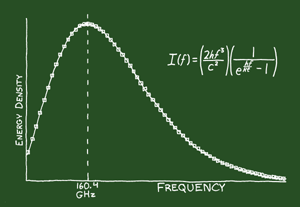
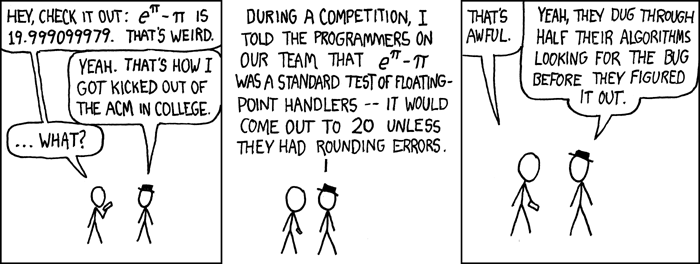
And on the back ...


This is, of course, the Cosmic Microwave Background (CMB) spectrum, with the COBE data on top of the predicted model, where the errorbars/points are grossly oversized, and it is, of course, from xckd. Because where else would you see the ACM mentioned in a comic—let alone one that is also discussing the inherent hilarity of trancendental numbers disturbing cozy close to integers?
And now I must stop, lest I either link to or show every other comic on the site. Bitches.

Monday, February 05, 2007

Living in a Dorm v. Living in an Apartment

I've heard this week described as "the coldest night of the year." How that works, in a temporal sense, I don't really understand, but I believe it regardless of any such minor details. And for the first time since starting graduate school, I'm really missing living in a dorm. Specifically, I miss living in the dorm I lived in for four years: Random Hall. I don't miss having to share a kitchen with 13 other people (plus whatever friends and significant others might be using my oven and leaving a mess on my kitchen table)—it, in fact, feels really nice and grown up to not get angry emails about the dirty dishes that have made a nice comfortable home in my sink while the clean dishes become better friends with the inside of the dishwasher. No, no no, I miss the everso Random quality of it being below zero outside (remember, for example, that nice winter three years ago when the Patriots played in a stadium that had half its seats filled with snow?) and so hot in my room that I had to crack open the window. Random has this freaking huge boiler in the basement, which, well, puts out a lot of heat. Typically radiators are only kept on in the kitchens, lounges, and bathrooms—something's wrong with you if you're capable of sleeping an entire night with the radiator on in your room. I miss being able to walk around barefoot with short sleeves on, mindless of the mind-numbingly cold outside "real world." I miss not being afraid I'm going to wound up frozen to the toilet seat if I go to the bathroom as soon as I get home. I also miss not having to worry about such things as, how much will money will it cost me if I turn the thermostat up a few degrees?

On the other hand, I'm not exactly a big fan of doing dishes ... or being annoyed when other people don't do theirs ...

Friday, February 02, 2007

Happy February

Image courtesy of NRAO/AUI

The 2007 AAS calendar's picture for February is the above image of the "Integral Sign Galaxy" (UGC 3697). The blue is neutral hydrogen, from the VLA, on top of optical image. The warp is thought to be due to a small companion galaxy gravitationally tugging on this one—but really—it's just so that we can have a galaxy that looks like an integral sign. Other than π, what other mathematical symbol could possibly be written in the stars?

Wednesday, January 31, 2007

Dark Matter, Rap, and Murder

Apparently one of the many things with Alfred P. Sloan's name (and some of his money) on it is the annual Alfred P. Sloan Prize at the Sundance Film Festival. The prize of $20,000 goes to a filmmaker whose film either focusses on science or technology, or has a scientist or mathematician as a main character. This year's winning film is "Dark Matter," a film by Chen Shi-Zheng based on the University of Iowa murders in 1991. Science? Murder? The general lore behind this sad story is that graduate Gang Lu was rather displeased that he was not awarded some prestigous prize for his dissertation work. In the movie setting, apparently they are all cosmologists instead of mere physicists. The fantastic aspect of this seemingly minor change is that one of the characters does the infamous "Dark Matter Rap" written by Ohio State's very own David Weinberg (lyrics here, and! mp3 here). Unfortunately, the rapper is one of the ones who is murdered ... but I still can't wait to see the film. And with Meryl Streep as one of the "stars," how much better can it get??

Monday, January 29, 2007

The LBT on the Discovery Channel

The LBT was recently featured on the Discovery Channel's show "Really Big Things." The LBT, or Large Binocular Telescope, is a, well, really big telescope Ohio State is helping build on Mount Graham in Arizona. It's got two 8.4-m (that's 9.1 yards) diameter primary mirrors—for perspective, in the picture below, the mirrors are the two round shiny things.

But this post isn't actually about the LBT at all. It's about the Discovery Channel's depiction of science while attempting to be "funny."

What really angers me about this episode is the attitude of the show's host/interviewer "Matt," and thus the editors, etc. of the entire show. Whenever the conversation would drift towards science—you know, the reason this telescope is being built—the host would start trying to crack jokes about how confusing it is and how he doesn't understand it. Yes, the LBT is an amazing feat of engineering, and, yes, it's really big, and yes, we (as astronomers) will be able to do mind-boggling awesome things with it. But that doesn't mean that the driving science behind building it can't be explained—in fact, I think the scientists and engineers they interviewed did a fantastic job of explaining why astronomers want large mirrors and high resolution ("like an HDTV").

What gets me is how the host was obviously pretending to be stupid/ignorant and then trying to make a joke out of it. For example, at some point he asks if the telescope will be able to be used to look "back in time"—obviously he knows the answer is yes, and I highly doubt that someone would be able to even get a job hosting a show like this without having some proclitivity towards scientific thinking. The fact that looking far out in space is like looking back in time because it takes a long time for the light from far away to reach us is a standard explanation for astronomers, and I think the astronomer doing the explaining explained it well given the time constraints. And then the host was like, whoa, I'm in a time machine, that's too much for me.

Seriously? I applaud the Discovery Channel for trying to reach a different demographic (i.e., not "nerds"), but are they now implicitly supporting the idea that "science is hard" and "normal people will never be able to understand science"? Let's get this straight once and for all: science is nothing to be afraid of. Sure, there are levels of understanding which the average person won't be able to reach after a brief explanation—there are reasons why people spend so many years in school studying this stuff, after all—but that doesn't mean there isn't some level at which they should be able to understand how their computer works or why we know the universe was once a hot, dense, goupy soup of fundamental particles. This is part of what it means to be an educated individual in today's society—or at least what it should mean. I'm not saying that everyone should already have such&such knowledge and understanding, but rather, have the willingness to learn more instead of being afraid of the everso slightly mathematical unknown.

At least the Discovery Channel has the "hey, this is really cool" aspect figured out... but I am disappointed that they are also playing around in the "let's make ignorance and stupidity look funny" field.

Tuesday, January 23, 2007

Winter Quarter Rundown

Many of you have told me that you like it when I give "my perspective." I'm not sure what that means, but here's a bit of my perspective for you: life sucks when it's cold outside.

Now, the cold and the suckage are probably not actually causally related, but I can at least assume they are. Winter: cold and busy and stressful. Summer: warm and busy and not stressful. Clearly, I can blame the temperature. Well, that, and in a Perfect World, I wouldn't waste two minutes putting on complicated clothing just because I want/need to *gasp* go outside. Not to mention the gas bills. Oh, yes, and "cold" is another word for "sick," and "sick" is another way of saying, "I'm not really going to get any work done today, but I'm not going to have any fun either."

This quarter I am taking two classes (because there are two classes to take). They are Radiative Gas Dynamics and Observational Cosmology. Observational Cosmology really means, AGN and maybe some observational cosmology if there's time left at the end of the quarter. I'm going to learn a hell of a lot of physics and astronomy this quarter, and it'll be great, but let's examine my schedule for Tuesdays and Thursdays for a moment, shall we. In short, they are Teh Suck. The idea is that we can dedicate the other days of the week to Doing Research, but seriously, days like Tuesdays and Thursdays this quarter make me want to crawl under my covers and get drunk. Specifically, I've got Coffee from 10:30 until Radiative Gas Dynamics starts at 11:10 or so, which goes until 12:30. Then Observational Cosmology launches at 1:30 and goes until 2:48 (:48? what the ... ?). Thursdays are even better because we have colloquium at 3:30 (with unskippable donuts at 3) until 4:30 or so, and speaker harassment at 5. Yick yick yick. I think I also have office hours on Tuesday, at like 4 or something.

Oh, yeah, and I have office hours this quarter. Because I'm apparently TAing and introductory astronomy course. It's not that TAing takes a lot of time—it takes five hours a week, max, and that includes the office hours that will be sparsely attended—it's that it's just something else to keep track of and do. I'm not TAing because my advisor was particularly unwilling to pay me (i.e., to give me an RAship) this quarter, but because I'm supposedly near the end of my current project and they really need TAs this quarter. This is one of the top ten things wrong with the quarter system. The astronomy department has several two-quarter sequence classes; they all either go fall-winter or winter-spring, and so winter just winds up being "let's teach lots and lots of astronomy classes!" time. At least I don't have to go to the class I'm TAing. It's at 9:30AM every single morning. I have the sneaking suspicion that the professor I'm TAing for would really kind of like for me to go to class every day, but is nice (and smart?) enough to not ask me to. Seriously, why do people take this class? I'm sure it's "intersesting," but 9:30AM interesting? If it were something like galaxies or cosmology, I could understand. But this is the solar system. And so far, it's not even "cool" solar system; it's like, zomg what causes a lunar eclipse?! See, this is why I wasn't an astronomy major.*

And, oh yes, I'm apparently close to the end of my current project. Which is to say, I'm finished with my current project, except that I need to actually write the paper. And, apparently, it has been decided that I should have said paper done by February 1. February 1 is terrifyingly soon, in case you hadn't noticed. And, of course, now that I've mentioned it on my blog, I have to have said paper finished by February 1. Well. We'll see how that goes ...


* Please ignore the fact that MIT neither has an astronomy department nor offers a B.S. in astronomy.

Monday, January 22, 2007

Seed and the Quote of the Week

Via the December/January 2007 Seed (p. 45), this week's quote comes straight from my advisor:

"Now we can conclusively say there is a better chance you will get shot in the face by Dick Cheney than Earth getting hit with a gamma ray burst."

Saturday, January 20, 2007

Spheroid

One of my Favorite People in the Whole World (tm) has decided to start a blog. And, so, I must tell you people about it. It is called Spheroid. Its author, Amali, is an undergrad in Physics at MIT and is just totally awesome. She is, in fact, TRULY FASCINATING; she also doesn't like marmalade. If her blog is going to be anything like she is (which I'm guessing it will be) and if her blog is going to be anything like it has been so far (which it has been, so far) then it will be of the abso-friggin-lutely laugh-til-you-cry hilarious—yet subtlely funny—variety. And she loves physics. Amali bounces about physics, in a way most of us only do on the inside, or *gasp* have you forgotten what that kind of excitement feels like?? So far she's already discussed both chocolate and telescopes—you just can't get better than that.

Mmm, yes, so: if you would like to bring entertainment and the excitement of physics and learning back to your life, add Spheroid to your blogroll—and stop over and say hello!

Friday, January 19, 2007

Picture of the Day


It was cold and snowy this morning, and now it's just cold. Days like today need memories like this one: we were so grateful it was a cloudy day so that it wasn't too hot. That's my dad's leg over there on the left of the picture. This is near China Beach in Vietnam (we were staying in Hoi An at the time, if I remember correctly); we had rented a motorcycle and ridden out for a nice day at the beach. Saigon beer (cold, with ice!) and a nice Coca-cola ... in the shade, listening to the waves, with the sand in your toes ...

Thursday, January 18, 2007

Mystery Hunt 2007

Many others have already pitched in their comments about this year's Mystery Hunt (including Aaron and Noah from my own team). (My earlier post on, "this is what the Mystery Hunt is" can be found here.) The big list-o-puzzles can be found here, and a general description of how the Hunt worked is over here. They do a good job explaining the plot and how the Hunt was structured, so I'm not going to repeat it here.

The team I was on, Metaphysical Plant, consisted of about 35 people at MIT and about 15 in Berkeley doing "remote solving," also known as, "we don't know what to work on, so we'll solve a meta." Having a room dedicated to a Skype connection with Berkeley was also fun, and I think it worked well.

There were very few puzzles this year that I was excited about once while solving them. (Though I wasn't working on it and I'm pretty sure we backsolved it anyhow, I was still highly amused when the Blather puzzle started throwing monkey poo all over the room. My code will start doing this now.)

The puzzles!, in no particular order, except the ones I liked probably come first:

  • Nur einzelne Zahlen erlaubt!: I enjoyed this puzzle because it was simple and clean, and the solver gets to play with sudokus without "doing a sudoku." I was also really excited once I realized that the phrases that came out were real Japanese words and not just gobbly goop, and I like how they fit into the title. Oh, and for once I got to help a group become un-stuck on something!
  • Ducks Playing Poker: I can't not mention the "duck konundrum." I mentioned before that puzzles rarely come with "instructions." The duck konundrum is an infamous reversal of this rule. You want instructions? We got instructions. Our team has had a bit of practice with this particular version of puzzle (this is D4), so when we were told to encourage our duck to move one space to the left, we had to call HQ and ask how encourageable our duck was. You never know. I was very happy that this konundrum had no bugs in it (unlike previous ones we've been forced to debug), but the answer was somewhat anticlimatic. I definitely prefered the way D2 worked; it involved trying to find a certain footnote in the author's thesis, which was way cool.
  • Course Load: This puzzle was also a lot of fun, though much of it may have had to do that with the fact that it came late in hunt and we had a large group working on it after the small group gave up. We wrote the triplets of course numbers on the board and started trying to figure out what to do with them. We tried figuring out how many units each one was worth (a few were "units arranged"), we tried averaging them (they didn't all sum to something divisible by 3), we tried various kinds of "take the nth letter..." and none of these worked. We finally asked Berkeley for a random suggestion; how about adding them? You'd think that averaging them would lead to adding them first, but no, no no. It was very exciting once it started actually working. The actual fake course titles were also kind of amusing.
  • Negative Ad Campaign: Speaking of funny, this one was really funny. I didn't actually work on it (it came in the middle of Friday night when I was already a sleepy puddle of sleepiness), but the slogans are all hilarious, and it was still being discussed the following day. For example, what's the opposite of Subway's slogan "Eat Fresh"? Vomit Rancid! Hehehe.
  • The Meta-meta Dodecahedron: Very cool. This was a lot of fun to work on, especially in a big group. We eventually started just trying random-things-you-can-do-to-words-to-get-other-words, and it worked! My only complaint (which a lot of others have had) is that there was no way to solve it without one of the metas. Such as the Round VIII meta, as a random example.
  • The Round VIII Meta: Alright, so only like everyone has commented on this already. Yes, it was broken or underclued or whatever, and yes, it did hold up the hunt, and yes, if it had been easier the hunt would have ended earlier and perhaps differently. Blahblahblah. My main complaint is that it was basically all we were working on the last few hours of Hunt, and so we were all in a rather annoyed mood at the end. It had quit being fun. (We were still having fun, and Berkeley had busted out the alcohol and the Wii, and we weren't dying to win, so it was all good, but still.)
  • Manipulating the Masses: Okay, let's talk about giving useless annoying information. Why would you arrange icons like that if the arrangement wasn't important? And providing 9 icons that are ... completely irrelevant? And the random anagrams? Who's ever going to think of anagraming random phrases into names?? We spent a lot of time on this puzzle, but we eventually realized it wasn't going to happen. Luckily, the meta for this round allowed for backsolving,* so when someone asked the room which puzzle we were least likely to actually solve, we all agreed it was this one, so the backsolved answer was called in for this puzzle. It was correct; we were glad.


Overall, I liked that we knew fairly early in the game what the overall structure of the hunt was going to be: this many rounds, with this many puzzles per round, and so on. The early runaround and everyone-finds-the-coin thing was kind of lame. We wanted to do a similar thing last year, but decided not to because, well, there just isn't any way to do it without it being lame. I didn't even know there was a runaround until I noticed we had solved it. Not revealing the structure of the Hunt until after kickoff meant that kickoff was a bit lame as well, but it did mean that it was fun trying to figure out what the real theme was going to be. The events were mostly either kind of lame or totally evil. The Lust event was more on the lame side, but it was short and amusing, and since it was at midnight, lameness was perfectly OK. The Gluttony event was just pure evil, but oh, so amusing. In general, though, it is just plain difficult to write a good non-lame event puzzle. (Sorry; I don't think descriptions for the event puzzles are up yet.)

All in all, though, I had a really fun time. I'm usually better at criticizing than praising; no puzzles had substantial bugs in them, which is certainly something that couldn't be said for some previous Hunts. I'm really glad I Hunted with Metaphysical Plant—it's always good to stay up all night with old friends, and I'm all ready for next year.

Well, that, and you know the scene from A Beautiful Mind when John Nash (Russell Crowe's character) is standing in his office with newspapers and magazines taped up everywhere and all these patterns are jumping out at him? That's my life this week, that, right there. Everything is a puzzle.


* Backsolving a puzzle means that you have solved a meta puzzle and know what format the answers for that round must be in. In this case, the answers were constrained to the extent that we knew exactly which answers they were, just not which puzzles they belonged to.

Wednesday, January 17, 2007

Bismuth Crystals

I have a friend living in Cambridge who has recently gotten into Bismuth crystal making. Unlike lead, bismuth is a surprisingly non-toxic (real) heavy element—in fact, it's the reason for the "Bism" in Pepto-Bismol. You can buy it for about $20 a pound. It melts at about 520°F, which is cool enough that you can melt it on the stove. To form a crystal, melt some bismuth on the stove (my friend uses some stainless steel bowls he's dedicated to the mission), and let the molten bismuth sit for a bit. It will begin to cool and crystalize on the surfaces (top and along the sides of the bowl); as it crystalizes, you can kind of break off pieces. It's easier to get lots of small pieces than big ones, and it takes some magic to figure out how to control the color of it—the color is due to a thin layer of bismuth oxide which forms on the surface of the crystal as it cools. If I remember correctly, gold (clearly the least interesting color when up against purple and blue) is due to too much oxidation. It is also possible to make "Bismuth eggs" (or really, "Bismuth any-kind-of-mold-you-might-have") by melting the Bismuth in a mold and then pouring out the molton Bismuth before it gets too crystalized and fills up the mold.


It's difficult to tell from this perspective, but the upper-right one looks like a conical square spiral, both inside and out. The bottom right one (zoomed in below) totally looks like a Frank Gehry building, but that might be because I've seen more of Building 32 in the last weekend than I have in the last year. The two on the left were originally one piece, which was going to be a Christmas tree ornament, but it broke while spending the day in my pocket. I guess I could still glue the two pieces together (they both have relatively flat sides) and stick a piece of string in the glue as well and still end up with a nice ornament.

UPDATE (09/13/2007): My friend has a few corrections and comments to add.

The colors: it's interference coloring, like you get on soap bubbles and oil slicks, based on how thick the oxide grows. As the layer grows in thickness, it will cycle through the colors repeatedly until the oxide gets too thick to easily transmit light, or something, and then I think it just turns gray. With the crystals, the oxide stops growing as the crystal cools. I do think I got more interesting colors when the crystals were cooler before they were exposed to air, so that they oxidized less, but I think it's a mischaracterization to say that one color or another is the result of too much oxidation.

Friday, January 12, 2007

Puzzles

De-lurk, de-lurk, de-lurk!

I'm in Cambridge, MA (MIT's campus, to be more specific) this weekend for the annual MIT Mystery Hunt. When it's over, I'm going to want to be able to give a straightforward ohmygodthatwasamazing or awhellthatsucked kind of post, so I figure I should explain now just what Mystery Hunt is and why it's cool enough to be worth taking a 6 day weekend off for.

Mystery Hunt is a weekend long puzzle competition. It kicks off Friday at noon and goes until it's over. Sometimes (like last year) this means roughly midnight Saturday night, whereas other year's it's meant more like 8a.m. Monday morning. The puzzles aren't like "conventional" puzzles: they aren't jigsaw puzzles or crossword puzzles or sudoku puzzles—unless they've been severely ... improved. These are self-contained puzzles. It is rare for a puzzle to come with a set of instructions; I'm sure there will be one exception to this rule this year, and I'm sure it will be a diabolical puzzle. A puzzle might be a set of pictures, a list of words, a list of numbers, an odd looking diagram, a set of mp3 files, or some combination of these. And the puzzle solvers are expected to just come up with the answer.

The other fun thing about Hunt is that it comes with a storyline, some sort of funny plot. If there's any place where regular expressions can save the day, then this is it. The reason it is called a hunt is because all of the teams are nominally hunting for a coin hidden somewhere on campus. Find the coin, win the Hunt. Win the hunt, get to write the Hunt for the next year! Two years ago the team I was on (finally) won, so last year we ran Mystery Hunt. You can see our puzzles, etc. here. Our basic storyline was that there was this evil guy, Professor Moriarty, who had this plot to take over the world (and make a lot of money) by creating a weather-controlling device. He would turn the entire planet into a snowball, except for certain locations of his choosing, such as tropical islands he owned, which he could then charge exorbitant prices for visitors. We (the team running everything) were the good guys, S.P.I.E.S., and we needed to enlist the help of the participating teams in contacting our agents all over the world. Now, each agent had left clues scattered in various cities as to where they were hiding—also known as puzzles. Solving these puzzles would give a list of words, which in turn were some kind of puzzle (known as a "meta" puzzle). The meta answers were passwords which would allow the team to go talk to the agent. (I was Guildenstern. It was fun. I got to toss coins to Rosencrantz and say funny confusing things.) Hidden in the "header" information for each puzzle was another puzzle, which we called antes. Solving the ante would tell the team both which city they needed to "travel" to next, and which agent they should expect to find there. The final meta answer was "Prof Moriarty," signalling that the team was ready for endgame: literally a run around campus following different clues and getting past different obstacles using information learned from past agents. After defeating Moriarty, the team still had to find the "key" (i.e., the coin) to the weather machine—a snowglobe hidden in an airduct in a sub-basement on the far side of campus. Other hunts have had other fun themes: there was the Monopoly hunt, the "Hunt of Horror", the Matrix/Time Bandits hunt, the Smallville hunt, etc. etc. etc. One big thing people always speculate about pre-hunt is what the theme will be. The "Lord of the Rings" theme and the "Figure Out What The Mystery Hunt Theme Is" theme are always too obvious; Pinky and the Brain trying to take over the world would be too annoying (and, besides, Pinky was one of our agents last year). What will it be, what will it be?

Another question I often get about Mystery Hunt is just who does it and just how large it is. Last year, approximately 2000 people on foo number of teams participated. A good hunt is challenging for the teams with really good puzzle solvers, but still fun for that group of four friends who has never tried solving a puzzle before. A good hunt has plenty to do for a team with dozens of members, but is not overwhelming for a team with only ten. The organizers almost always make sure that it is impossible for a team to win—but still possible to have fun!—if the team does not have members with an intimate knowledge of MIT's campus, computer system, classes, etc. It is, after all, technically a student group and completely run from MIT's campus. The team I hunted on my four years at MIT was based in my dorm; we took over the place, with approximately 100 people on our team (though in later years, a good chunk of those were hunting remotely from Berkeley, as they are again this year). Other teams are just a group of friends who like solving puzzles together and are have headquarters in some classroom or lab on campus. The team I am on this year is more like this second kind of team: not all of us wanted to go back to a dorm where we know few people, and would rather have a more exclusive team than brushing elbows with annoying freshmen. And, trust me, after two nights of not-sleeping-really-all-that-much, one develops a much more inclusive sense of just who qualifies as "annoying."

If you want some warm-up fun, you can try solving the puzzle I had in the Hunt last year. Only 3 teams got to it because it was towards the end of the Hunt, but I still really like it—but then, I might be biased. It's called "Numeracy." Here it is, but you'll probably want to look at it in simple plain text. I'll even give you two hints: the answer is a nine letter word, and one of the following numbers has several special qualities you will want to take note of:

208152530300915766601936320121070276789832815290551198867952849839923077652916264682207754561886987270447708
4692498159489787945483859708015730116908132616677088632588995169035741355863239309492578214457474645069660160
28704409123883107995641954349010565038039534018624637898643335378744685983060398866221495129416672163571989750522944
10077101562809078099507568545155052457097081880521651265131065660281889815624795042906120967789024197524260818292576255
13363002477125110222406669219596335614838650949013199336098772247121573120164951531379671223475621081888657354736327524
9999999999900000000000909999999099099900000990999099909909990999099009909900990909090909909900099090000000000099999999999
49444474103175161151704218372962042349503982725634998190449861168732861208847426267012082190643069962289331487975277372922
11069059529774739510522015966486361031918918265065510668481840031997902257789570546091398107797709304199206235826465282966939467839
277089780035848252542041569441323553197842374908129690062447655116773801236887648860345210556260512508286837890325813426895270205535

Thursday, January 11, 2007

Happy De-Lurking Week!

No, it's not a Girls Are Pretty headline; it's a blatant fishing for comments! I know, I know, Lurking is Learning, but that's irrelevant. So! It's time for you to de-lurk.

  1. Have we met in person?
  2. How did you learn about my blog?
  3. What do you do (i.e., are you a scientist)?
  4. Are the "technical" posts too technical or too dumbed-down?
  5. Which kind of posts do you enjoy the most?
  6. Anything else?

Wednesday, January 10, 2007

3-D Dark Matter Map

I don't normally jump on board when big press releases come out with some new "revolutionary" astronomical discovery, and I don't normally give link dumps to what other people have to say, but when it's my former advisor whose name is being plastered all over, I can't help but say a little something. Of course, the big news was released two days ago, so I'm a little late.... Others (see Galactic Interactions and Cosmic Variance, for example) have already given nice lengthy explanations of the results. You can also take a look at the press release and the paper (subscription required). Essentially, gravity bends the path light travels in much the same way it bends the path of a thrown baseball. By looking at the distortions of faraway galaxies due to all of the intervening matter, astronomers can map out the 3-D mass distribution of the universe as shown above. (If you want a slightly more in depth discussion of what "distortions of faraway galaxies" means, you can see my earlier post on weak lensing.) This particular piece of research isn't all that revolutionary: they are using techniques that have been used before and a fairly well-established method, but the amount and quality of the data is somewhat mind-numbing. To get really high resolution data, you have to go to space, which is why the main dataset for this project is from the Hubble Space Telescope (HST). But you also need a huge area of sky for this kind of weak lensing project... and HST doesn't exactly see a lot of the sky at once, which is why this data corresponds to 575 separate pointings of the telescope.

And, oh yes, COSMOS (the multi-observatory project this research stems from) long ago won my prize for largest stretch for an acronym: Cosmic Evolution Survey?!

And since I'm playing the day-late, dollar-short bandwagon game anyhow, yes, please, I would like an iPhone (plus 2 year Cingular plan) as a gift. Thank you.

Monday, January 08, 2007

Apparently I Was Tagged

Apparently Rob Knop over at Galactic Interactions tagged me a bit ago in some sort of blog meme-y thing. So, of course, I have no choice but to comply.

The rules (as copied from Rob as copied from Doug Natelson as presumably copied from someone else and so on):

In this game I’m supposed to grab the nearest book, go to page 123, go to the fifth sentence, and write down the next three sentences. Then I’m to tag three more people, presumably ones that I think will play the game.
I'm sitting right next to my bookshelf, but the nearest book to me is Ernest Hemingway's The Snows of Kilimanjaro and Other Stories, original copyright 1927, this printing is 1970 and cost $1.65. I haven't read most of the stories yet—I've been meaning to, really!—but the book currently claims the very important job of being the object on which my right computer speaker normally sits.

Page 123 is near the beginning of "The Short Happy Life of Francis Macomber." I can't count to three very accurately, so here's the relevant 3±2 sentences:
"Might put it on," said Wilson.
"You know you have a very red face, Mr. Wilson," she told him and smiled again.
"Drink," said Wilson.
"I don't think so," she said. "Francis drinks a great deal, but his face is never red."

Well there you have it. And now I'm supposed to tag someone, so ... ∫wh, John, and The Angry Astronomer... go!

Friday, January 05, 2007

Quote of the Week

This is in regards to NASA cutting funding for the Space Interfermetry Mission (SIM), a mission which would be able to do all sorts of awesome things:

The decision to cut funding has not gone down well, with Gould citing "stupidity" as one reason for the cut.
-- Nature, Vol 445, 4 January 2007
The rest of the article, entitled Alien Earth (subscription needed, sorry), is a concise, fairly interesting discussion of the prospects of finding an Earth-like planet around another star, something in which many astronomers have invested a lot of time—and bet money.

Thursday, January 04, 2007

A Googol of Particles?

A few weeks ago, some friends asked me whether or not there are a googol particles in the universe. I copped out at the time, pleading hunger, but it's an interesting question, so I found myself trying to answer it yesterday.

First off, a googol is defined as 10100, or a 1 followed by 100 zeros. It's a big number, which is why the Google people wanted to name their company after it; unfortunately one of their first buyers wasn't very good at spelling... I'm also going to define "in the universe" to mean "in the known, observable universe." Obviously, if the actual universe is infinitely large, then there will be more than a googol particles in it. Second is the question of what we mean by "particle." I'll start by assuming that particle means "atom," specifically hydrogen or helium atoms, since there are relatively few other atoms around. I'm also going to take "known universe" to mean "observable universe," and for both of these terms to refer to the entire observable universe at an age of 13.7 billion years old. This isn't actually how the universe is observed; because it takes time for light to travel to us, the farthest away we can see in the universe corresponds to when the universe was very young. Taking this into account would needlessly complicate the question and the calculations.

To get a feel for numbers of particles in big, massive things: how many particles are there in the Sun? The mass of the Sun is roughly 2 x 1057 times that of the mass of the proton, and since about one out of every four atoms in the Sun is a helium atom (which has the same mass as four protons), there are roughly 1057 particles in the Sun.

So how many particles are there in our galaxy, the Milky Way? The mass of the Milky Way is difficult to define, and we have to be careful to only talk about the baryonic mass for now—that is, the mass that is in the atoms we are trying to count. Let's say it is 1011 solar masses; the number of particles in the Milky Way is therefore 1011 x 1057 = 1068.

From here, we can estimate how many particles are in the known universe if we have a good estimate for how many galaxies are in the known universe. This is a tricky number to estimate, because we can't actually see all of these other galaxies. We are also assuming that the Milky Way is a typical galaxy of typical mass. The internet gives a lot of different numbers for the "total number of galaxies in the universe." NASA's "ask an astronomer" page claims 125 billion, which is the same as 1.25 x 10¹¹; other sources give similar answers, so I'll use 1011. Under these assumptions, we calculate that there are on the order of 1079 "particles" (specifically, atoms) in the known universe.

Another way to do this calculation is to first figure out the number density of atoms for the universe, and then multiply by the total volume of the known universe to obtain a total number of atoms. I don't really feel like going into cosmology right now, but essentially, the density of the universe is inexorably linked with its geometry. We know that that universe is pretty damn flat, so we know what the density is fairly well. ("Flat" here means just what it sounds like; you can think of it as meaning that the three angles of a triangle have to add up to 180°.) This "critical" density is approximately 10-29 g/cm3. This is really really tiny: for comparison, the density of water is 1 g/cm3, the density of air at sea level is roughly 10-3 g/cm3, and the density of air in the best vacuum that can be made on earth is 10-20 g/cm3. Cosmologists tell us that only 4% of the universe is made up of atoms, so the density of atoms is more like 4 x 10-31 kg/m3. The mass of a typical atom is still about the mass of two protons, so this corresponds to about 1 x 10⁻⁷ atoms per cubic centimeter. (If you don't like fractional atoms, you can think of this as about 1 atom in every ten cubic meters instead.) The volume of the observable universe is determined by its radius. Even though the universe is 13.7 billion years old, its radius is not 13.7 billion lightyears; it's actually more like 93 billion lightyears, or about 9 x 1026 m. This gives us a volume of 3 x 1081 m3, and a total number of atoms in the observable universe of about 1077. I put a lot of assumptions and simplifications into these calculations, so it isn't too surprising that they give slightly different results. When I was doing the calculations yesterday, I was getting more like 1080 for both methods.

So we have determined that there are fewer than a googol atoms in the observable universe. This number won't increase by much if we expand the definition of "particle" to mean all electrons and quarks, the most fundamental particles of matter. But what if we include photons and neutrinos? The ground-up way to do this calculation is to start with a number density of photons (approximately 400 per cubic centimeter) and a number density of neutrinos (approximately 200 per cubic centimeter). Multiplying by the same volume as above, we now get a total of 2 x 1089 particles. There are therefore fewer than a googol known particles in the known universe. An easy check this number—as well as an alternate way of doing the calculation—involves using the known baryon-to-photon ratio of roughly 10-10. ("Baryon" being the word used in cosmology for "stuff that turns into atoms.") This is in fact approximately the ratio between the two total number of atoms and the total number of photons (and neutrinos) we calculated.

I said above that there this means that there are fewer than a googol known particles in the known universe. I have already mentioned that once we no longer restrict ourselves to the observable universe then there can clearly be more particles, but the distinction of known particles is important as well. I said earlier that about 4% of the universe by mass is made up of atomic-like particles; about 20% of the universe is made up of some other kind of mass that we don't really know what is, known as dark matter. A popular assumption is that the dark matter is some kind of as-yet unknown, un-detected particle—with some currently unkown mass. Using the calculation above, if there are going to be a googol dark matter particles in the observable universe, then the dark matter particle would need to be about 10-20 as massive as a proton—that's tiny—so stupidly small that it is in fact ruled out by the fact that we observe the universe to have structure. Such a small mass for the dark matter particle would lead to what is known as the "Hot Dark Matter" scenario; essentially, if the dark matter particle has very little mass, then regular matter won't get cold enough to condense and form nice things like stars and galaxies.

In conclusion, a googol is in fact a very very large number.

Sunday, December 31, 2006

Rubik's Cubes

Rubik's cubes are not really all that difficult to solve. You just need to have an algorithm, and to follow it. It was amazingly difficult to find Rubik's cubes in stores this Christmas season, thanks to Will Smith solving one in The Pursuit of Happyness. It really gets me that people think that solving a Rubik's cube is "impossible," or that only "smart" people can do it. It is much like many older people with "technology" (i.e., computers): they decide it is difficult and they do not know how to do it, and like any self-fulfilling prophecy, the task becomes insurmountable.

While it does take a calculating mind capable of 3-D visualization to invent/discover complicated moves that move around certain pieces in a particular way while not disturbing other certain pieces, it takes a much less creative mind to simply follow directions and to figure out which order to apply these moves in. I am in the second category: I do not have the patience or the foresight to come up with complicated maneuvers, but I can look at a cube and figure out what needs to be done in order to solve it. Different people use different algorithms for solving Rubik's cubes. For the classic 3-by-3-by-3 cube, I choose a face (usually the yellow) to start on. I first get the four yellow corners in place, and correctly oriented. You can tell when the four corners are in the correct place when the yellow side is on the same side as the yellow center and the other-colored side (such as, say, blue) is on the same side as the other-colored (e.g., blue) center. I then get the yellow edge pieces in place, with the correct orientation. My next step is to put the four white corner pieces in the correct locations (these being the four remaining corner pieces). Once these four corner pieces are in place, I rotate them so that they have the correct orientation; I usually do this by "storing" one of the white corner pieces in a yellow corner spot while twisting the others around. I then take care of the white edge pieces; it usually possible to get them all in both the correct location with the correct orientation, but sometimes one will have the wrong orientation. This leaves the four other non-yellow and non-white edge pieces, which are easy to move to the correct positions. Sometimes I am left with a pair of edge pieces in the correct locations but with the wrong orientations; correcting this is the only fancy-schmancy "magical" scripted move I use.

If you know how to solve a 3-by-3-by-3 Rubik's cube (3x3x3? I'll call it a 33), then the 2-by-2-by-2 (a 23) is easy because it is just like solving the corners of a 33 one. I haven't quite yet figured out how to solve the 43 one, which I got for Christmas, though the algorithm I am currently trying is to basically try to reduce it to the 33 case, which I know how to solve. First, I want to get all of the 2x2 centers together, since the lack of fixed centers in the 43 cube is one of the reasons it is so tricky. For example, in a 33 cube, if the yellow and white faces in the solved cube are opposite one another, then it is impossible to make the center yellow and white pieces be on adjacent faces. This is not the case with the 43 cube. Having completed the step of consolidating the 2x2 centers—with the correct relative orientations—I now want to gather all of the edge pieces together. That is, there are two edge pieces that have blue and white on them, and I would like for them to be next to one another such that the two blue sides are adjacent and the two white sides are adjacent. I have not yet done this part, but I think I know how to. Once I have this done, the 43 cube will essentially be reduced to the 33 case: it will have 2x2 centers instead of fixed single centers and two pieces per edge instead of one, but if I treat these groups of pieces like single units, I can solve it like I would a normal 33 cube. At the end, though, it will be possible that, for instance, one edge will be flipped relative to its neighboring centers, which is not possible in the 33 case.... but I'll wait until I get there to deal with that.

The 5-by-5-by-5 cube is not mine to play with (and I'm not allowed to mess it up)*, but I am guessing that it is similarly reducible to some combination of the 33 and 43 cubes. Because it has fixed centers (thanks to the odd number of pieces per edge), it does not suffer from the same orientation issues as the 43 cube.

Apparently the original Rubik's cubes and the newer "retro" cubes have opposite faces differing by yellow: red is across from orange, blue is across from green, and white is across from yellow. The Rubik's cube I learned how to solve first, though, had blue and white across from one another (and yellow and green across from each other), so I still get mildly confused when I see an edge piece with both blue and white on it.

The 23 cube is notoriously stiff and difficult to move. This one in particular is also difficult to solve because the orange and red faces are nigh indistiguishable; I have colored the red squares red with a red Sharpie, but this now means that anyone who plays with it will be repaid with red fingertips. This 33 one is brand new, and amazingly smooth and easy to twist and turn. (I in fact bought it to replace no fewer than four 33 cubes that had been used and taken apart so much that none of them moved well anymore, and most of them had stickers of indiscernible color.) The only disappointing part about the new 33 cube is that the orange color is a rather icky orange. The 43 and 53 ones are monstrous and difficult to handle; note also that the more pieces a cube has, the smaller the individual pieces are. The 43 one one seems more poorly constructed than the 53 one; the stickers are not exactly in the middle of the squares, and already one piece has simply popped out and had to be stuck back in.

By the way, if you know where I could obtain a 1-by-1-by-1 Rubik's cube, please let me know. We'd like to complete the collection at the small-n end.


* Playing with Rubik's cubes is really really bad for your wrists, especially if you already have wrist problems induced from RSI (Repetitive Stress/Strain Injury). This means that Rubik's cubes are dangerous to have around if you have RSI and are ... compulsive.

Tuesday, December 26, 2006

Egg Nog

My father said I could share our super-secret family recipe for egg nog, as long as you all promise not to tell it to anyone. It's real egg nog, none of this wussy nasty syrupy stuff they sell in grocery stores these days. It's also about 40 proof and so fluffy and soft you don't even notice as it slides on down.

6 eggs (you want these to be fresh, so don't buy them a week before making the egg nog!)
3/4 cups sugar
1 pint whipping cream
1 pint half & half
1 1/2 cups Jack Daniel's
1 oz rum (though when my father and I are in charge, we usually assume "1 oz" means "1/4 cup")

About a day before you plan on actually having the egg nog, separate the eggs. Beat the yolks with 1/2 cups sugar until lemon colored and thick. Add the whisky, rum, and half & half. Separately, beat the egg whites with 1/4 cups sugar until stiff. Fold this into the yolk mixture.

Age this mixture in the refrigerator overnight. This is so that the alcohol can "cook" the eggs, making the final product completely safe to drink. The next day, whip the whipping cream (with a dash of vanilla). Fold the whipped cream into the refrigerated mixture; you don't want to mix them too much. The final mixture will be somewhat heterogenous at first, but after sitting for a bit will be light and fluffy and delicious. It is also quite yummy with a touch of nutmeg.

Here's to a happy rest-of 2006 and a delightful 2007!

Sunday, December 24, 2006

Seed

For the big gift-exhanging holiday of December, my brother gave* me a subscription to Seed magazine, along with a copy of the current (November 2006) edition. The seed media group is the same group that puts out ScienceBlogs—a brilliant move, by the way, as I had kind-of-sort-of heard of them before ScienceBlogs, but now there is that instant name recognition. The magazine itself is really pretty: large shiny pages with gorgeous high resolution pictures and interesting layouts. I have only flipped through the magazine a few times, but so far it seems to be couched at a level that, while not too technical, doesn't "dumb things down" like many other popular science magazines tend to do. They are also quite clearly unafraid of tackling issues of science and culture; indeed, their slogan is "Science is Culture."

There was one article I really liked as I was flipping through the November edition, looking at pretty pictures. It's on page 31, and the title is: From Shanghai to Stockholm, A new program attempts to fast-track China's quest for science gold. I wasn't even going to bother reading the article (perusing for pretty pictures, remember?) until the three little letters "RSI" jumped up at me. Yes, it's a short article about the RSI-Fudan program I was a staff member at for two weeks this summer. If I have been able to determine on a personal level what the role of RSI should be in improving education in China, I have certainly not yet been able to verbalize it. Regardless, it's always entertaining to open up a magazine and unexpectedly see someone quoted on a topic I discussed with her just last weekend ...


* Standing in front of the magazine rack and mentioning, 'I wouldn't mind having a subscription to this magazine, myself,' helped in this decision.

Wednesday, December 20, 2006

A Case of "It's Funny 'Cuz It's True"

I'm currently "taking time off." This means that I wasn't paying attention while booking flights this year and am spending an extra week "away" than I had really planned on. But that's okay, because I can work on my paper from anywhere, because I have a laptop and many many papers strewn about this table and room. So far, I'm somewhere around panels 3–5, but without the little kids running around:

Panel #2 was also nice, especially seeing as how I didn't sleep at all on Saturday night.

You can also refer to this particular post if you're wondering why the blogging is ... less often and of lower quality over the next few weeks than usually.

Wednesday, December 13, 2006

Grand Canonical Ensemble

Will has pointed me to the new webpage for his band of second year Harvard physics grad students. Go. Revel in the unspoken euphenisms, metaphors, and sheer nerdiness of their subtitle of, "bringing you to the critical point." Laugh as they try to not laugh at their own abso-friggin-lutely hilarious lyrics as they ask the timeless question: How many roots of a Henkel function, between one point seven and three? If you've been looking for the proper way to immortalize George Smoot (who was, coincidentally, Will's undergraduate advisor), then the ode "Crack the Cosmos" will be right up your alley. Still confused about that rogue former planet, Pluto? The go check out "Planet Nine." And while I'm completely unqualified to comment on it, the actual music isn't glaringly awful either ...

Go, be amazed. And then mentally chide them for being Hahvahd students who use myspace.

Monday, December 11, 2006

Questions Raised by ApJ Proofs

My peanut star paper got accepted and is set to be published soon. How soon is unclear, though. On the proofs, after the author list, it says, Received 2006 October 9; accepted 2006 November 8; published 2006 December XX. But at the top of the page, it says, The Astrophysical Journal, 654:L000-L000, 2007 January 1. So what I want to know is: is this paper mollishka et al. (2006), or mollishka et al. (2007)? I know it is probably 2007, but 2006 would make me seem so much more productive and would be much less confusing ... and apparently the page charges are less per page for 2007 than for 2006, but the page charge sheet they sent with the proofs was for 2006 and not 2007.

Also, since when did Kelvins become kelvins?

Sunday, December 10, 2006

Epic(?) Bets

Which do you think will be discovered first: the Higg's boson, or an Earth mass planet orbiting a G or K dwarf star* in the habitable zone?

Last night at the astronomy department holiday party, Jason and Jon (two graduate students) put $20 each on a bet that an Earth mass planet orbitting a G or K dwarf star (the Sun is a G dwarf star; K dwarfs are slightly cooler) in the habitable zone will not be discovered by the time the first one of them graduates, which should be roughly summer 2010. Scott, who orchestrated the bet and is set to earn $40 if such planets are discovered by 2010, is an expert on planet finding studies—especially compared to two graduate students! It came out later in the evening that the Kepler mission, a satellite specifically designed to search for planets, hasn't been delayed until 2012 like the grad students thought, but rather, is likely to launch in about two years. The European analog(-ish) to Kepler, COROT, is set to launch in about two weeks. The general expectation is that unless something goes horribly wrong with both of these missions—or Earth is the only Earth-like planet— then an extrasolar Earth analog will be detected by the time I get a Ph.D.

I was unwilling to get in on the planet game, but I did bet Mandeep $1.00 that the Higg's boson will not be discovered by the time I graduate. Coming from a particle physics background, he is certainly more qualified to make such predictions, but that's completely beside the point. The LHC ("Large Hadron Collider") is due to start collecting data in 2007, and there is lots of evidence pointing at if the Higg's boson exists, then it should be detected by the LHC. On the other hand, we know of at least one Earth mass planet orbiting a G dwarf star in the habitable zone, whereas the Higg's boson is still a mere postulation and prediction.


* Aside from Earth itself, of course!
N.B.: This post title is shamelessly stolen from a recent similarly-themed post over on Galactic Interactions.

Wednesday, December 06, 2006

End of the Quarter

It is officially the end of the quarter. Huzzah.

Now back to our regularly scheduled programming.

Friday, December 01, 2006

Lists

There's this thing I've been (nominally) working on for the past two days which I very muchly so do not want to be working on. In fact, there are many things I would rather be doing. Here is a random list of such alternatives that have come to mind:

  1. Calculate π to a 1% uncertainty by throwing frozen hot dogs down the hall. I leave it as an exercise for the reader to calculate how many thows this will require.
  2. Visit The Federated States of Micronesia. I think the fastest way to get there from here is via Houston and then either Guam or Honolulu on Continental; it should take about two days. Then I could go to Yap! Don't worry; Micronesia still has about an order of magnitude more people than Vatican City, and almost twice as many as Greenland.
  3. Go candlepin bowling, preferably at the bowling alley near the Alewife T-stop.
  4. Fingerpaint in red wine.
  5. Make a t-shirt where the front is the image to the right and the back says, "I believe!"
  6. Have a free dinner of Indian food with today's speaker, even though I didn't go to this talk because I was supposedly working on this thingie. Note that I do not like Indian food.
  7. Make a 3-D snowflake.
  8. Play with my pet dragon. Or penguin.
  9. Fill my office up with a house of cards. And then knock it all down.
Of course, what I'm working on isn't all that bad ... if it were, the above list would look more like the following:
  1. Be gently flogged to death with scented bootlaces.
  2. Marry an axe murderer.
  3. Gnaw my fingers off one by one.
  4. Watch Gigli again. It's a painfully bad movie—and not in a good way.
  5. Read all 3964 3671 messages in my spam folder.
  6. Take a swim off of Revere Beach near Boston, MA, right now at night in the cold and rain and mist.
  7. Sit at my desk with a stopwatch, staring down the hall, and measure—repeatedly—just how long it takes for the motion sensors to allow the lights to go off.
It's interesting to note that #6 on that first list was the only one of these I've actually done, and the item on the first list most likely to make the second as well. I had garlic naan and a mango lassi and some lamb. I don't know what that means, though.

Sunday, November 26, 2006

AstroVino #9: Pinot Noir (& Beaujolais)

This past Monday we had the final night of wine-tasting in the class I have been taking this quarter. Focussing on the wines of Burgandy ("Borgogne" in French), we primarily had Pinot Noir, with one bonus bottle of Beaujolais at the end. Burgandies are apparently fairly fickle wines; to shamelessly quote from our notes, "... like the Cubs or Red Sox, it more often than not disappoints its ardent fans." The Pinot Noirs we tried lived up to the analogy: a few were delicious, while a few were simply not very good.

We started the evening with a 2003 Joseph Drouhin Côte de Beaune from Borgogne, France. (Côte de Beaune here is the coast being made fun of in the "Côte du Bone" from a few weeks ago.) An earthy wine (it "smells like dirt"), it seemed to become oakier as the night went on. Some people claimed to find hints of "chocolate and cherries" in it, but I didn't.

The 2005 Sebastiani Pinot Noir from the Sonoma Coast, CA was incredibly tannic and oaky; if you can get past this, it apparently is rather "fruit forward." We had a rather strange 2005 Parker Station Pinot Noir from Santa Maria, CA which was incredibly difficult to place ... it smelled something like fruit-scented Clorox, which is to say, like pineapples, pears, or candied apples, but kind of off. The 2004 Argyle Pinot Noir from Willamette Valley, Oregon was much clearer and paler than the others, and also somewhat more acidic. While some people claimed to taste cloves in it, it was really just "kind of yick." The 2005 Saint Clair Vicar's Choice Pinot Noir from Marlborough, New Zealand was one of the evening's spicier choices, giving off airs of black pepper and cinnamon.

One of the grad students taking the class donated a 2004 Laetitia Estate Pinot Noir from Arroyo Grande Valley, CA, which started off rather oaky, but got tastier and tastier as time drew on. I could actually believe claims of "chocolate and cherries" with this one, and also perhaps a lot of fruitiness.

My favorite wine of the evening, though, was not a Pinot Noir. Our bonus wine, a 2005 Morgon Beaujoulais from Romanèche-Thorins, France, is the only one on the list earning a smiley face. Beaujoulais wines are designed to be incredibly fresh and fruity, and are meant to be drunk in the year they are made. The grapes are fermented via carbonic maceration; the entire grape, stem, everything is thrown in the tank for the fermentation process. The Morgon we tasted was a dark purple color, smelled "perfumy," and tasted incredibly jammy, almost like blackberry jam.

We visited Charleston, South Carolina on Friday, and I saw a sign advertising an upcoming Beaujolais tasting. I was terribly excited by the fact that I know what that means! It's taken a few months, but the words associated with wine are no longer just nice sounding words: they actually have some meaning behind them ...

Wednesday, November 22, 2006

Coordinate Calibration

The coordinates used by astronomers are referred to as "RA" and "dec." RA, or right ascension, tells us when an object will be viewable and is measured in hours (and minutes and seconds). It is set so that the RA of the sun on the March equinox (the first day of spring in the northern hemisphere) is 0 hours; the RA of the sun on the September equinox (the first day of autumn in the northern hemisphere) is 12 hours. Each month, the sun (and thus the sky) moves by 2 hours in right ascension. Since astronomers generally like to look at the sky at night, when the sun is not up, this means that objects with an RA near 12 hours are best viewed around March, while objects with an RA near 0 hours are best viewed near September.

The other coordinate is the declination, or "dec." The declination of an object, measured in degrees, is just the projection of the lattitudes on Earth onto the sky. For example, Columbus, OH is at a lattitude of 40°, so any star or galaxy directly overhead will have a declination of 40°. It also means that the so-called North Star, Polaris, which has a declination of 90°, will always be 40° above the horizon in Columbus.

RA and dec are designed so that by simply knowing an object's coordinates, an astronomer can tell you whether or not the object will be viewable from a certain location, and, if so, when. For example: can the center of the Milky Way (theoretically) be observed from Columbus, OH? NED tells me that the coordinates of the supermassive black hole (Sagitarrius A*) right at the center of the Milky Way are 17h45m40.0s -29d00m28s. The second set of numbers there is the declination: -29°. Columbus is at 40°, which means that the Galactic center will be 40°+29°=69° down from the zenith (the "zenith" is a fancy word for "straight up"). 90° is all the way down to the horizon, so when the Galactic center is "up," it won't get very far off of the horizon, and you'd be hard pressed to find someone to let you tilt their large telescope over that far. This is why the Galactic center is more commonly observed from the southern hemisphere, such as at one of the many observatories in Chile.

So when is the Galactic center observable? Well, the RA is at 17 hours and 45 minutes—let's call it 18 hours. 18 hours is halfway between 12 hours and 0 (=24 hours), so the Galactic center is best viewed halfway between March and September, also known as June. Luckily, this is also when the nights are the longest in Chile (Chile being in the southern hemisphere and thus June being in winter), and so when the Galactic center is up, it's observable for a long time.

This is all fine and dandy, but once you have an image of the sky, how do you know what the coordinates of all of your objects are? The standard way is to compare the locations of the objects on your image to the locations of objects in some catalog where they have measured this very carefully (known as astrometry, or "the measure of the stars"). Generally, you have a pretty good idea of where the telescope was pointing when the image was taken, and thus the coordinate of the middle of your image. You also generally know what the pixel size of your image is. When astronomers talk about "resolution," they don't mean a number of pixels (like 1600x1200) like you hear people talk about with normal digital photography. Instead, astronomers talk about how large a single pixel is on the sky.* For example, the pixel size of ACS, the newest camera on the Hubble Space Telescope, is 0.04" (the " is arcseconds; there are 3600 arcseconds in one degree). Ground-based telescopes generally have pixel sizes varying from ~0.2" to several arcseconds; HST has a smaller pixel size because there is (basically) no atmosphere in space, making it possible to resolve smaller objects than can be resolved from the ground.

Like with a map, it's a fairly straightforward procedure to go from one known position, a certain scale, and a sense of direction (given by the "known" stars in the catalog) to a set of coordinates for all of the objects in the image. Well, sort of. The first problem with this analogy is that, generally, when we make maps of things like cities or continents, we actually "know" where the things are we're mapping: we can physically go there, pull out a ruler, and measure the distances between buildings or whatnot. This doesn't really work when we're talking about stars thousands of lightyears away. And what if the resolution of our catalog is worse than of our data, and where they saw one blobby thing we see three or four stars? Which position do we believe or use for calibration? The second problem is that the sky is not flat, and, in general, the projected size a telescope "sees" at the edge of an image is not going to be the same as it "sees" at the center. If we want really precise astrometry, then these slight changes have to be modeled accurately.

And yet, deciding the coordinates for an object is massively simpler and less convoluted than trying to decide how "bright" it is ...


* More precisely, the resolution is given by the size of the smallest object that can be fully resolved, which is larger than one pixel and depends on many different factors, but that's a little too complicated for now.