Wednesday, June 06, 2007

Anticlimatic

I forgot to mention that I am now done with classes. Forever. In a rather anticlimatic move, I discovered on Sunday that apparently my final class will not be having a final exam this week. As such, I did my final classwork about two weeks ago, when I actually turned in a problem set late (I had the due date remembered wrong). Apropos, I suppose.

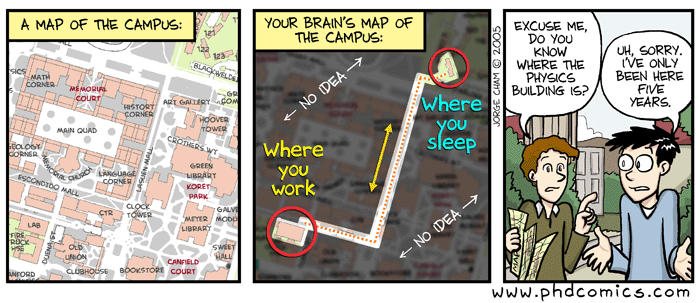
Also, apparently this exam I'm trying to stay awake all day to work on is a "candidacy exam." It seems that I am not yet a PhD candidate, and somehow being a PhD candidate is different from having been admitted into the PhD program. Or something. I get the point of the exams, I do, but the language and the bureaucracy come across as forced and arcane. And buraeucratic.

Monday, June 04, 2007

General Exams Begin

I start my general exams today. I think that's what they're called. I've been informed they are definitely not quals or qualifying exams, but I don't understand the difference in semantics, and seeing as how they're just something I have to do, I don't really care either—thought I might again in a month.

As I explained last time in agonizing detail, our department just changed the policy for the exames-taken-after-classes-are-finished. I, like everyone else, chose to do the "new format," which is to say, I'm going to be learning a whole lot about the Lyman-α forest in the next ten days. (It's supposed to be two weeks, but thanks to extenuating circumstances, well, ten days is kind of like two weeks, right?) Then, a little less than two weeks after I turn in a pile of summary papers to my committee, I have an oral presentation scheduled ... on a completely different topic.

I spent today reading the Rauch (1998) review article of "The Lyman Alpha Forest in the Spectra of Quasistellar Objects." ("Quasistellar object" is a back-in-the-day word for "quasar.") Man, review articles are intense. The first review article (fine, it's actually from a lecture series, but anyhow) I ever read was Narayan & Bartelmann's discussion of graviational lensing. For the two years I worked on gravitational lensing (starting from absolutely no knowledge whatsoever), every time I went back to the article, I discovered some little nugget of information that simply hadn't penetrated my skull previously. Hopefully in the last four years I've learned a little bit about how to learn, as well as gained a tad of astronophysical background ...

Let this also suffice as a warning that blog posts might be somewhat more intermittant than usual for the next couple of weeks.

Thursday, May 31, 2007

Day 3 at the 210th AAS: I Am So Tired

Yesterday was a slow day for me. While there were several individual talks I was interested in going to, there weren't any sessions I was willing to stay in for more than half an hour. But since yesterday was the first day my poster was up, I spent most of my time hanging out in the poster room. The two posters on either side of me were getting a lot more traffic. One was simply an interesting idea involving the gravitational lensing of gamma ray bursts by primordial black holes as will be viewed by GLAST; instead of a "classical" lensing, an interference pattern should be seen in the signal. While the probability of such an event is low (10-5) and contingent on which model of primordial black holes and subsequent destruction you take, it is still a neat idea. On the other side of me was a poster about the dynamical origins of the local Hercules stream—they think it's due to a dynamical ripple thanks to the Galactic bar. People like hearing about the structure of the Milky Way, so this project was one of the three discussed at the press conference I attended (as an interested listener) in the late morning.

In the afternoon, also in the exhibit hall, I got the chance to go inside the Star Lab they have set up in the corner of the hall. For the low low price of $15,000 you too can own the ultimate tent for camping out in the living room. The Star Lab is essentially a portable planeterium, a big grey plastic bubble that you crawl into, with the stars projected onto the inside surface. The inside of the bubble goes up to 10 feet high and is large enough to lay down in while the presentation is being given. The presentation I was given focused on Hawaiian navigation: how did the Polynesians and Micronesians find Hawai'i? Apparently there was this big controversy about four decades ago over whether or not the Hawaiian islands were "stumbled upon" or purposely found. I don't really understand how you can purposely go find something you do not know (or have reason to believe) exists, but anyhow. In the 1970s a group called the Polynesian Voyaging Society formed themselves and learned how to navigate cross-ocean using no instrumentation. They built a few double-hulled canoes and went from Hawai'i to Tahiti... with no instrumentation. In canoes. We re-learned all of the familiar constellations and asterisms with their Hawaiian legends, and a few of the more southern constellations I have never seen with my own eyes.

Today is the last day of the conference, and things will be pretty much done by lunchtime. I have no idea of details yet, but I'm hoping to find some people to explore the island with... I've gotten only a few blocks from the hotel and convention center since arriving here on Sunday.

Wednesday, May 30, 2007

Day 2 at the 210th AAS: Wide Field Surveys

Yesterday there were no big invited talks, only posters still up from Monday and three day long topical sessions: Astrophysical Ionizing Radiation Sources and their Impact on Life (think about how nearby supernovae or the orbit of the Sun around the Galaxy might have affected evolution type thing), Turbulence in Diffuse Astrophysical Environments (the majority of the talks here had "turbulence" in the title), and Wide-field Surveys in the 21st Century. I spent the day in the Wide-field Surveys room, and I got to hear a lot about how Pan-STARRS is going to be amazing, but in general I liked most of the talks because I like it when astronomy can be a "real" statistical science instead of mere stamp collecting. The two main reasons, I think, why people keep talking about Pan-STARSS here is because it's starting this year and because it is largely based in Hawaii. (In the afternoon I finally heard why I had gotten the impression that people outside of the Pan-STARRS collaboration speak of it with a bit of a sardonic or deriding tone in their voice; apparently it got its funding as a rider on some bill in Congress... was it the Iraq war bill?)

Lunch yesterday was the calmest of my meals here; I went out with just one of my officemates who is here, a former grad student from Ohio State who is now planet hunting at Space Telescope Institute (and actually finding them, unlike when he did his thesis), and another guy from STScI. It's been less true even this meeting than when I attended the 2005 winter meeting of the AAS in San Diego, but one of the nice things about these kinds of meetings is seeing people you haven't seen in a long time. I've been meeting a lot of new people, certainly, and as I guessed before coming, attendance here seems to be dominated by grad students and young postdocs.

Today will be much more interesting: my poster goes up today and I'll be attending a press conference, so stay tuned for tomorrow's report!

Tuesday, May 29, 2007

Day 1 at the 210th AAS

To the left is the view from my room. It is sunnier this morning, but yesterday I enjoyed watching the fog (or perhaps that is rain?) in the valley lift up and re-descend. Jet lag here isn't so bad; I like the concept of being a morning person, but in practice it never holds.

The conference kicked off yesterday morning with a talk by John Tonry on Synoptic Sky Surveys. Essentially, the Sloan Digitial Sky Survey (SDSS) is coming to a close. Sloan has mapped about a fifth of the sky in visible wavelengths, with stupidly large numbers of cataloged stars, galaxies, quasars, and what-have-yous. I think in some ways the holy grail of observational astronomy is to have the entire sky mapped down to the faintest magnitudes possible, at all wavelengths, and to continually observe the entire sky for time variability. According to Tonry, we are rapidly approaching the first goal for visible wavelengths; it is likely that in ten to twenty years, the entire optical sky will be mapped down to the faintest magnitude allowed by the atmosphere. Surveys like Pan-STARRS and SkyMapper are coming online this year. In 15 years, will astronomy be a field of searching databases and waving the wand of statistics, or are we practically already there with SDSS?

After the first talk, everyone trickled down to the room with the posters and exhibits; more specifically, the room with the pastries and coffee. I like going around to the exhibits and talking to the people there; I've already collected half a dozen bookmarks (to make up for forgetting to bring one with me) and more stickers than I know what to do with.

Then it was time to break into individual sessions, with five minute "normal" talks and fifteen minute "disseratation" talks. Several people simply did not show up to give their talk in a few of the sessions I attended; I cannot understand how someone can not only just not "show up," but also be rude enough to not inform the organizers that their plans have changed. I managed to miss most of the talks I had wanted to go to, since I was skipping around the galaxy evolution and galaxy cluster and variable star sessions, but most of the talks I heard were in fact interesting.

At lunch, I found myself with a solar physics group from Boulder, Colorado. This meeting is in conjunction with the Solar Physics Division, which is to say, there are a lot of astronomers here who have taken the "day shift." The sun is fascinating; one would think that being the nearest star, we would know everything about it we might want to. But people don't even agree on simple-seeming things, like the amount of oxygen relative to hydrogen. It is also an interesting field in that we can measure all sorts of things from the sun that we can't in other stars: details of sunspots, coronal mass ejections, granulation, helioseismology, sun flares, etc. etc.—things we would looooove to know about Other Stars, but we just can't make the measurements yet. After all, the sun is just a star, and what we really want to know about is stars, and in many plots, we only have the one data point. A few of the solar folks I talked to are excited about the upcoming missions to search for extrasolar planets; by making exquisitely accurate measurments of the light coming from stars, we can also hope to learn about astroseismology (literally, starquakes) of stars not our own.

Speaking of extrasolar planets, apparently the big news release yesterday was on a bunch of new ones being announced. (One of the breakout sessions yesterday was on extrasolar planets, but I did not go.) There have been rumors circulating for months that 2007 will see a huge increase in the number of known extrasolar planets; many of the ongoing searches for transiting planets are finally coming to fruition. It is heartening to see people announcing more than a handful of planets at a time; it means that the field is growing from one of stamp collecting to one in which they can actually do statistics and begin to really learn about planet formation.

In the afternoon, I went to the COSMOS session. I have a soft spot for the COSMOS project since it was my first real introduction to astronomy; the summer I spent at Caltech in 2004 was centered on playing with all of the HST COSMOS data that was available at the time (about half of it). It's a gorgeous data set. Apparently the S-COSMOS data set, the Cycle 2 Spitzer data of the COSMOS field, is now available. Many of the talks were about these infrared bright galaxies, though the talk I found most intriguing was the one on asteroids found in the COSMOS field with Spitzer: one person's trash is another's science.

After all of the talks, I went over to some nearby beach with a group of graduate students mostly from the University of Hawaii. Yesterday being Memorial Day, there was a Lantern Floating ceremony; people light little lanterns on little boats in remembrance of lost ones, and at sunset let them out into the sea. There was music and ceremony and many many people. I took lots of pictures, but none of them are very good. I didn't care much for the overly fancy rituals projected onto the big screen by the people running the shindig, but watching the people who had brought their own personal lantern boats walk to the ocean, I think I like this way of honoring and remembering the dead. As the sky grew darker, the water became more and more littered with bright lights.

Monday, May 28, 2007

Day 0 at the 210th AAS: Honolulu!!

I flew in yesterday afternoon via Chicago on American Airlines. It was a 9 hour flight, and yet they didn't have any food resembling a meal back in steerage class, just things like overpriced chips and overpriced cookies and sodas. I guess I've been spoiled by the only four hours longer trans-Pacific flights where they have two real meals, as well as snacks. So when I arrived at the hotel yesterday afternoon, I didn't know if I was more hungry or more tired.

I've never been to Hawaii. It's 7 a.m. here, six hours behind the east coast of the continental US. This kind of jet lag isn't so bad, as I can both sleep for a long time (still recovering from a cold) and feel like I'm getting ujp early. From my hotel room (which comes with a nice balcony!), I can see two moutains with either really thick fog or rain between them. From what I've seen so far (airport, mall, convention center), this is a really indoor-outdoor place; I like it. I like how I can not realize that I'm outside until the ceiling above me disappears.

Last night there was a small reception on the roof of the convention center. This is another way of saying, there was a small amount of food, but enough to make me not want to go foraging for a real meal. I only keep mentioning the food because I really haven't eaten since like Saturday, but I'm not a breakfast person, so I still don't feel like eating now. Anyhow, I met a group of people from the University of Texas, a girl who plans on conquering the infamous eigenvector 1. In the increasing darkness over dumplings and fresh fruit, we discussed said eigenvector and other AGNy things like the broad-line region, FeII, FeVII, and NeV, with Greg Shields and Richard Green. I sometimes wonder what's going through people's minds when they ask me the simple question of what I work on, and I stammer a little, explaining that I am presenting here on variable stars at the Galactic center,
but now I'm working on the Lyman-α forest. Do I seem well-rounded, or indecisive and noncommittal?

Today is the first day of talks and posters. The posters will be up in two batches; the first batch today and tomorrow, and the second batch Wednesday and Thursday. Mine is in the second batch. There are several simultaneous talks I know I will want to go to, and I haven't decided which I'll actually go to yet. One thing people always complain about with the AAS meetings is that they are so big; talks are limited to 5 minutes each (and, of course, people routinely go over, which mostly serves to annoy the audience and the moderators). The irony is that since the meetings are so big, no one comes. They say it's good for undergrads and graduate students (and, to an extent, postdocs) to go and meet people, but if no one who "matters" goes, then who is there to schmooze with?

A much more relevant question, though, is whether I give this post an EST or an HST timestamp.

Saturday, May 26, 2007

Ready for Honolulu

I leave tomorrow morning for Honolulu for a meeting of the American Astronomical Society (AAS). I just want to assure everyone that astronomy conferences are not always in exotic locales. Here, for instance, is a picture from the last conference I went to, in Ishigaki, Japan.

While I'm sure there won't be any talks nearly as interesting as this one at the AAAS this March, it will probably be a fun and interesting conference. I will have a poster on variable stars at the Galactic center; the paper has been accepted for publication and I even bought a nice purple poster tube to carry it in. I might even try to post on the exciting goings-on while there.

Tuesday, May 22, 2007

A Sort-of Book Review: I Sold My Soul on eBay

Hemant Mehta, also known as the Friendly Atheist and author of I Sold My Soul on eBay, will be at Ohio State on Thursday night to discuss his book. (Details on his blog; apparently he will also be at Easton on Sunday signing books.)

I bought and read the book about a month ago, and I've been meaning to write up a review-type-thing, but well, haven't. But since those of you who have a chance to go to the talk should go, and since anyone at all interested in religion (if you are a churchgoer, you count) should read his book, I might as well try saying something.

As he explains in the first few pages of the book, he didn't actually sell his soul on eBay; the title is a descendant of an (embraced) inaccurate headline. Hemant is an atheist who, because he was raised in a non-Christian religion in a nation innundated with Christians, is interested in learning about Christianity. He figured the obvious way to do this was to "go to church," but as someone who knew nothing about churches or Christianity, he decided it would be more fun to sell the right to pick which church to go to on eBay. The cost was $10 per hour in church; all money raised by the auction was donated to a secular organization.

The book is a fast easy read; I read it over the course of two short flights, though unlike some I wasn't interrupted by entertaining or annoying conversations. Unlike many in the religion debates, Hemant does not describe his point of view as something which he believes the reader should embrace. Take, for example, Sam Harris's Letter to a Christian Nation (also an enlightening read). Harris explicitly tells the reader that belief in Christianity is harmful; as a prelude to the reasons why religion is bad, Harris details why it is first and foremost wrong. Hemant is less antagonistic; he explicity tells the reader why he does not believe in the supernatural, but he does not explicity pass judgement on those who do. In fact, one of the main selling points of the books is to tell Christians what they might want to try if they actually want to attract and convert (and not alienate) atheists. There's even a discussion guide for Christian groups at the end of the book.

If you are interested in more reviews and opinions, Hemant has a decent compilation of them on his blog as well.

Sunday, May 20, 2007

My Mother, the Math Teacher

The post a while back wherein I mentioned my dad's crazy doings was somewhat popular, so I figure I'll go with the flow and let y'all know about my non-stereotypical mother. Consider it a belated Mother's Day post. The actual impetus is Friday's xkcd comic:
a(b+c)=(ab)+(ac).  Politicize that, bitches.My mother is a chronic middle school math teacher. She half-heartedly tried retiring sometime when I was in high school, but continued to work full time. Then, about a year ago, we had a big retirement party for her because she was quitting for real. So then she worked part-time for most of the last year... and announced earlier this week that she will be teaching part-time next year. My brother and I keep reminding her of the definition of "retirement," but the message does not seem to stick. We think she is beginning to think of herself as a "free lance math teacher." This new job will not be at the school she's been at for the last 15ish years; instead, she will be teaching at a "gender magnet school," teaching 8th grade girls Algebra I and Geometry. This will be her 40th year of teaching.

The xkcd comic also rings true because my mother is not the kind of person who decided what she believes about the way the world should work decades ago, only to stop thinking about it now. She still talks about what she wants to be when she "grows up" ... perhaps she thinks retiring is the same as growing up? Regardless, it's going to be interesting hearing her perspectives on same-gender education over the next year. She says she hasn't given it much thought yet; she took the job because it's a good job, not because it involves teaching in a gender-separated environment. The more I think about it, the more morally opposed I am to gender separation in an academic environment; but then, it's something I've never had to actually experience myself. The teachers and the students are the ones who can attest to how bad or good of an idea it is, and how it does or does not "work." I'm yet to meet a student who has had both co-ed and gender-separated education and believed the gender-separated to be superior.

And, sadly, this is certainly one way to "politicize" math. Jerks.

UPDATE: Comments were disabled for unkown reasons. Everything should be working fine now, though.

Thursday, May 17, 2007

People Study Astronomy; Hijinks Ensue

Typically, one would be afraid that a 244 page anything showing up on astro-ph would be dry and boring in addition to being long, especially if it lacks figures. The recent summary of Astrophysics in 2006, which showed up on astro-ph Monday evening, is in fact a 244 page report sans figures. But it's far from dry and boring—instead it's fresh and funny and snarky. I like snarky. And I know you blog-reading types are more likely to look for ways to punt on Fridays than other days of the week, so here you go. Think of it as a an astronomy blog carnival, only, papers instead of blogs.

The paper goes into all sorts of "real" astronomy, like "things of which there is currently only one (habitable planets, the Sun, and the universe)," but what I find the most entertaining are the sociological-esque aspects. This is especially true as the suspicion is that one motivation behind this treatise is providing an opportunity for the first author to rant. See for example,

the departures of Wesley Huntress, Eugene Levy, and Charles Kennel from the NASA Science Advisory Comittee. Their error seems to have been in advising that science continue to be done.

Or, in Section 4.2:
Each year, anything from 10 to 50 folks respond to requests for suggestions of highlights of the past year. The request is intepreted in interestingly different ways, ranging from “My gut feeling is that, for the first time in my career, the most exciting things may be in the fields of solar system studies and the discovery of planets rather than in my own realm of the extragalactic” to a list of 17 papers on arguments for the respondent’s own ideas, of which he is the senior or sole author. The “he” is deliberate. None of the responses of that sort were from women, though this may be a selection effect − 10% of 10% of 50 is 0.5 (and you must supply your own hermaphrodiate joke). This year the author who collects most of these responses thought it only fair to be sure that at least one paper or topic proposed by each respondent get mentioned. A good many of the suggestions already had green circles, red rectangles, or other notebook entries; some were out of period (perhaps in Ap07) or otherwise not in the data base.

Can you imagine having collaborators like this?:
We caught at least two papers being retracted out from under their first authors, who either disagreed or were not consulted (Nature 437, 940; Science 310, 49; Science 310, 425). One of the first authors concerned plans to sue.

Of course, to the outside world, the biggest happening in astronomy in 2006 was that whole Pluto and "definition" of a planet mess. So, of course, this is mentioned on at length, including some of the press reaction:
Concerning Kuiper Belt and Trans-Neptunian objects, there is both good news and bad news. The good news is that 2003 UB313, the one that caused all the fuss and bother about what is a planet is now merely Eris, named for the goddess of discord, and her moon is Dysnomia, goddess of lawlessness and daughter of Eris. Those are IAU committee decisions and so to be trusted as much as any IAU committee decisions. But the LA Times article reporting the names also declared that Clyde Tombaugh named Charon after his wife Charlene. Yes, Tombaugh (1906−1997) was very much alive when Charon was discovered in 1978 (by James W. Christy of the US Naval Observatory), but he was not the discoverer, and his wife was Patricia (nee Edson) 43. You might want to start over and assume that Christy’s wife’s name is Charlene and that the LA Times has (at least) one editor like the one who just processed a chapter of ours for a book on evolution in general.
Given that I like the sociological aspect, the most entertaining (and potentially embarassing) section is the final one, "Misteaks Were Made." A few of these are clear honest errors (e.g., “four redshift bins over 0.1 Mpc < z < 3.0 Mpc"); others were just plain hilarious:
ISS is like an old suitcase whose handle is missing − it is totally useless, but you just can’t bear to part from it” (Nature 437, 1214).
They also mention at least twice the acknowledgements including the "faint praise" of "EB thanks the Israeli Army for hospitality during the last month of this project.” And did I mention the snarkiness?:
“Does it really make a material difference whether references are arranged by authors (alphabetically) or numerically?” (Nature 437, 1232). Oh, only to the grammatical structure of about every third sentence.
Mmm, snarky.

Monday, May 14, 2007

Abell 611 from the LBT

I apparently still don't feel like blogging, so here's a pretty picture of a nice galaxy cluster, Abell 611, for you to look at:
This is one of the clusters we're looking at with the LBT for our weak lensing study. A nice example of strong lensing is the pair of blue arcs above and to the left of the center of the image; those are background galaxies being lensed by the cluster.

Some stats for those of you who care about that kind of thing, copied blatantly from the CCAPP webpage which was in turn copied blatantly from the observer who took the data and made the pretty picture:

Details: the image is about 2 arcminutes on a side, North is up, East is to the left. The integration times were 20min in Uspec, 60min in g-SDSS,and 15min in r-SDSS. The image quality in the combined images is about 0.6" FWHM in g and r, but they were smoothed them to match the 0.7" image quality of the u-band image.

Saturday, May 12, 2007

The Lyman-alpha Forest

It seems that I am now working on the Lyman-α forest, a fair cry from stars or the Milky Way. One of the great aspects of working on the Lyman-α forest is that it relates to so many other aspects of astronomy. And, recently, it's been difficult to spend much time here and not become interested in the composition and geometry of the IGM (e.g., this and this and this).

I had heard about the Lyman-α forest for quite a while before truly understanding what it is; in this particular case, it was a picture that made all the difference.

For example, this cartoon, shamelessly borrowed from Ned Wright's page explaining the Lyman-α forest. There are three separate pieces needed to explain what is meant by the "Lyman-α forest, " or what is commonly written as the Lyα forest. First, there's the Lyman-α bit, which involves a bit about atoms and rudimentary atomic physics. Then, there's the large reservoir of gas between galaxies creatively known as the intergalactic medium, or IGM. Finally, there are the notions of redshift and thermal broadening and other fun things that can happen to change the wavelength at which a photon of light is observed.

Atoms and energy levels: As you should recall from your high school chemistry class (or as wikipedia [or here] would remind you if you were asleep that year), atoms come equipped with energy levels, and the electrons can move between the different levels. These transitions have different names, and the Lyman-α transition is the one between the n=1 and n=2 states. (Lyman-β is n=3 to n=1, Lyman-γ is 4 to 1, Lyman-δ is 5 to 1, and so on. The series of transitions into n=other states are have different names; the Lyman series is just the one named after some dude named Lyman.)

When electrons move from a higher energy level to a lower one, a photon (or two if it's a super-duper-forbidden transition) is emitted by the atom in order to conserve energy. Because the photon is carrying away the energy the atom had when it was in the excited state (i.e., when the electron was in the higher energy level), the energy the photon has is exactly equal to the energy difference between the two levels. So, when one counts the number of photons as a function of energy of some source—this is called taking a spectrum—there are certain wavelengths at which there are lots and lots of photons because lots of atoms have undergone energy transitions and emitted photons with near-identical energies. These are called emission lines.

Of course, the same thing can happen the other direction. If a photon of just the right energy encounters an atom, the atom can absorb the photon, essentially moving the electron from a lower energy level to a higher one. So if we take a spectrum of some bright source, we will see regions where a bunch of atoms have absorbed a bunch of photons all of one wavelength. These regions are known as absorption lines/features/troughs/whathaveyou.

The Intergalactic Medium (IGM): Hydrogen is by far the most common element in the universe; roughly 75% of all atoms in the universe are hydrogen atoms. Nowadays, most of the hydrogen is ionized, so instead of a proton and an electron hanging out together, they are separate. For electrons to be able to move between energy levels, it has to be associated with some nucleus, i.e., the atom has to be neutral. Even though the vast majority of hydrogen atoms in the IGM are ionized, there is enough neutral hydrogen around that Lyman-α (and other) transitions can trace the structure of the IGM. Of course, there are lots of other elements in the IGM, but we can only observe those with atomic transitions in convenient wavelength ranges; commonly observed other species are singly-ionized magnesium (MgII in spectroscopy lingo) and triply-ionized carbon (CIV).

As it turns out, the cartoon description above of the IGM as a bunch of isolated clumps of gas is wrong. A more accurate model has the gas distributed much more smoothly; the gas isn't perfectly uniform, and there are regions of low density and of high density, but the contrast between these regions is not large enough to think of the high density regions as "clouds."

Redshift, etc: The real key to being able to use absorption features to study the IGM is redshift. If we observed all of the intergalactic gas to absorb light at one wavelength, then it would be next to impossible to decipher any physical structure from a spectrum. Luckily, though, we live in an expanding universe, and so light travelling across long distances is redshifted, that is, the wavelength of a single photon gets longer as it propogates. (This is a redshift since longer wavelength means redder light.) The amount by which light is redshifted depends on the distance the light has travelled; this so-called cosmological redshift is the main thing for which Edwin Hubble is famous for figuring out. So, to return the the cartoon above, if we have some really bright faraway source, like a quasar or a gamma ray burst, then light coming towards us from this source will be redshifted. Specifically, light that was originally bluer than that of the Lyα transition will be redshifted to this wavelength, and if there is some neutral hydrogen sitting around where this happens, then it will be able to absorb that light. The more neutral hydrogen (i.e., the higher the neutral hydrogen density) at a given location, then the more Lyα light that will be absorbed. There is a lot of hydrogen in the universe, and the universe is really big, so spectra wind up looking more like this than the above cartoon:
The big peak on the right is due to Lyα emission from the quasar itself, and all the mess to the left (bluewards) of that is the Lyα forest. Lots and lots of absorption.

If this was the end of the story, then it would be fairly easy to go from a map of absorbed light to a density map of the IGM along some line of sight. Alas, this is astronomy, so there are lots of extra things going on. The first is that the gas in the IGM isn't perfectly cold; it has some temperature and so the atoms are moving around relative to one another, which causes individual lines to be smeared out. Observationally, this isn't all bad: we astronomers like knowing about temperatures as well as densities—and the relationship between the two.

As I mentioned earlier, astronomers now know that the IGM does not consist of discrete clouds floating around in a vast emptiness; the gas density instead fluctuates about some constant value. Part of what I am working on now is to try to determine what sets the scale of these fluctuations, or, equivalently, what sets the scale on which the IGM and the Lyα forest are smooth.

Monday, May 07, 2007

Let's Play Good Idea, Bad Idea

Recently, a Chemistry professor at OSU had their house broken into. Among the stolen items were two laptops. Typically, when someone has their laptop stolen, it sucks for them, but that's the end of the story.

But this is Ohio. They do things differently here.

You see, the laptops were ones on which said professor stored class rosters. And, among other things, these class rosters included the social security numbers of approximately 3,500 current and former students. Which is bad. And so the university has had to find and contact these 3,500 some odd individuals and let them know their identity security has been breached. Some of these students were from many many years ago, and as such, private investigators and the like had to be hired. Which costs money. Apparently this has cost the chemistry department and the university something like $80,000 so far.

That was in February. In early April, some other computers on campus were hacked into and something like 14,000 SSNs were "exposed." These SSNs are a subset of everyone who receives a paycheck from OSU ... including various faculty and staff, which (it seems like) was enough to make people go from saying "this is a problem that should be fixed" to actually trying to, you know, fix it.

There is much specialness abounding in this situation. The most obvious one to me is that there is no reason why a professor should ever have students' SSNs. So why do they? Well, it's because at this prestigious university, SSNs have long been used as student ID numbers. (Yes, I have complained about this before.) What this means is that they are routinely included on all class rosters, grade lists, etc etc. Which means that someone somewhere along the way had to think that was a good idea. Sure, it might have been back before the days of identity theft when everyone was all good and moral ... but a lot of software (e.g., for grade submission) has been written since then that didn't need to include that information. And once it became obvious that this practice could cause problems, someone somewhere had to make the decision to "phase" in a solution (apparently they've been saying this for years) instead of doing a rapid change manouver.

Which is what they're trying to do now, but with a great deal more... panic. No one likes a lawsuit, so another brilliant decision that someone somewhere made was to hold individuals liable. Not just the poor sap who has SSNs stored in his mail from over a decade ago, but also the individual responsible for that computer, aka, your friendly local tech support guy who is really not enthused at the idea of policing a department's worth of computers for nine digit strings, but is rather motivated at the idea of keeping their job.

Best part is, someone has realized that all of this goes against FERPA regulations ... pesky laws. We're assured that it'll all be fixed by the start of Autumn quarter in September, and the Astronomy department is definitely being all pro-active in purging computers of these data records. Besides, it's not every day you learn that Professor X has found Famous Astronomers Y and Z's social security numbers on their computer ...

Friday, May 04, 2007

Jorge Cham at Ohio State

So I've not felt like blogging lately, apparently. According to Jorge Cham, this isn't a bad thing; "procrastination is when you're doing what you want to be doing." I heard him say so himself Tuesday night when he gave a talk here at OSU to an auditorium full of graduate students. (Is it bad that though I knew there was a coffee shop on the first floor of the building, I had no idea what its name was?)
Anyhow, the talk was entertaining, even for someone like me whose been reading the comics regularly for the last, uhm, six years. It started with a routine "I had to learn about Ohio State before coming here" bit ... talking about how the Wikipedia article for OSU is gushing about how big and great of a university it is ... and then we find out that Larry Sanger apparently is an OSU alum and it all begins to make sense.

So this part isn't going to be funny; I know, and I'm sorry, but deal with it. Apparently one of the main points of Cham's talks is that many graduate students are depressed. Apparently, for many people, graduate school is the first time when the ratio of what they think they know to what they think they don't know becomes very small, the first time they feel as if they are not "one of the best" at something. Uhm, so that would have been ... 11th grade for me, at the latest. And if it hadn't happened then, a few days at MIT would have cured that right up. And it goes without saying that my self-confidence is muuuch higher now than it was when I was an undergrad ... although that really isn't saying all that much. My view of stress as an undergrad v. as a grad student is somewhat skewed; while MIT is a high-stress environment, it's also true that my current department most certainly is not, relative to other places (or what's portrayed in the comics). And, seriously, if people are unhappy as graduate students because they don't like what they're doing, then, uhm, why are they in grad school to begin with? People should be doing what makes them happy.

Anyhow, the talk was pretty good and all around entertaining; the only thing that could have made it funnier would have been if he'd actually made a L'Hopital's Rule joke instead of just alluding to the possibility of one. More jokes about how annoying undergrads are would have also been appreciated. They were, unfortunately, not selling the new book (which ships, I think, tomorrow). I'd even brought money from one of my officemates (which I should return ...) to buy one. Instead, I was one of three people to win a raffle for a free (old) book, which is funny because I already own both books. Two years ago Cham gave a talk at MIT, and instead of going, I took a nap. (I was thesing, OK?) A friend bought both books for me—and got them autographed—as a graduate gift. So, I decided to give my free book to one of my officemates, who had decided to not come to the hour-long talk because he needed to work. No lie. Severe workaholic silliness I try very hard to not compare myself to.

Regardless, how come there aren't any couches in my department? My brother, a graduate student in history, maintains his office has one exactly like this:

Tuesday, May 01, 2007

iGoogle?

I'd understand if this was April 1, but it's May 1. And so I don't understand:

It's like Google is getting it on with my computer and/or iPod, and I'm just not sure if I'm OK with that. And why doesn't Apple already have iFoo trademarked for all Foo?

Wednesday, April 25, 2007

American Idol, Landfills, and Juvenile Justice

Alright, I confess. I'm an American Idol fan. I'm all about the brainrot. It's pathetic, I know, but what's even more pathetic is that I don't even own a television and I watch a taped version of the Tuesday night show on Wednesday evenings. Last night's show revolved around "Idol Gives Back," this "big" war-against-poverty campaign they're doing. The big thing they kept mentioning is how for each vote, NewsCorp was going to donate $0.10, for up to five million dollars. They never really said where the money was going, except that it was to *gasp* Save Lives! Also nevermind that this is freaking NewsCorp and five million dollars is barely a drop in the bucket, if that. It probably did do some good and made a lot of people feel warm and fuzzy inside, so I can't complain too much.

So, last night, instead of forcing us to watch Bono "coach" the contestants (oh God thank you for sparing us that pain), we got to see a bunch of short segments of the host and the judges going around the US and Africa. The parts from Africa were ... familiar. (Nevermind that they never told us where in Africa they were; it's one big homogenous place, so it must not really matter anyhow. And while they did talk about how horrible of a disease malaria is, they didn't mention AIDS even once. American Idol is a family show, after all.) But, yes, the shots of people walking through landfills and of large groups of orphans happily eating in large bare rooms... it was a total deja vu, except the grinning kids in the video had darker skin that the ones in my memory.

In August 2005, in the middle of a month-long trip through southeast Asia, my father and I found ourselves in Phnom Penh, the capital of Cambodia. (If you don't know anything about Cambodia, quit being ignorant and go check out the wikipedia article or something. Especially the parts about the Khmer Rouge and Angkor.) We knew that Phnom Penh was going to be horrible, the worst combinations of a large dirty city and abject poverty in a country still recovering from large-scale genocide. Cambodia's tourist attractions are are elsewhere, and we were only in its capital out of necessity. My father's all-too-natural solution was to spend our one full day in town visiting the dump.

I'm not kidding. You just can't make this stuff up. We had met a couple in Siem Reap (the town near Angkor) who had spent a few days volunteering at the Centre for Children's Happiness in Phnom Penh. This organization actually runs two orphanages; the kids are separated by age and amount of time since they've lived in the landfill. Lived in the landfill. Like the girl in the picture on the left, these kids have all lived in the Phnom Penh dump as "garbage pickers" before coming to the orphanage. They go through the trash trying to find something, anything, they can sell for mere pennies in order to try to get enough money to buy food with. They literally live and sleep in the dump; the lucky ones might even live there with older siblings or even a parent. Most are orphans, or have parents in worse situations than them (e.g., missing a limb from the copious land mines scattered throughout the country). The CCH carefully picks children living in the dump to come live in the orphanage instead—and, importantly, the kids have to decide for themselves that this is a change they want in their lives. Usually the children coming straight from the dump have to spend about three months (if I remember correctly) in a hospital gaining strength and being treated for various diseases. (Actually, many only spend a few weeks, but some must spend many many months in recovery.) At the orphanages, they get a chance at having a "real childhood." They learn to read and write (in Khmer, English, and Japanese), they learn math, they learn job skills, they learn traditional Khmer dance and art, they learn how to care for one another and how society runs better if people treat each other with respect, have jobs, and take care of themselves. And, oh yes, they learn math. The walls of the courtyard in the main orphanage are covered with painted lessons: vocabulary, useful math formulas and ideas, proverbs, etc. I spent a while talking to one of the older students, a 16 year old boy who had been in the orphanage for three years. He said he really liked math, "especially trigonometry," and working on the computer. This is what we call a "motivated player." He said that when he turned 18, he wanted to work for the orphanage as a full-time employee; this was two years ago, and I do not know what he has wound up doing. The founder of CCH, Mech Sokha, is very open about the workings of the orphanage; the main office (where the computers live, and thus where many of the children spend much of their time) has a whiteboard dedicated to a breakdown of exactly how much it costs per child per day, and where all of that money both comes from and goes, as he is explaining to my father in the picture on the left. This is one of my favorite pictures (aside from all of the math!) from the orphanage because the kid you see standing next to Mech is so typical. For the first time in their lives, these children are somewhere safe, and it was so obvious just how safe they felt. Kids were running around, hugging each other, hugging Mech (like this one here), and generally just being happy. (I was the one with the camera, so many of them while I was there were taking turns having their picture taken, inspecting the preview on the screen on the back, informing me it wasn't good enough, and making me retake pictures. Oh, the cuteness.)

My dad actually got really excited by the entire experience. One thing we noted is that their computers were all really old and crappy; they had about ten, but only one or two would ever work at a time. My dad thought, "I have a lot of friends; we could easily get dozens of nice computers here." So he tried to help, to forge a bond, but apparently Mech just quit responding to his emails, the last I heard. I personally found the entire experience depressing rather than invigorating; it is difficult to see people making so much out of so little and not feel guilty for making so little out of so much opportunity in my own life. I'm still naive and idealistic; instead of seeing one potentially solvable situation, I see a whole helpless world full of Things That Should Not Be. In my head, I know what the world should be like, but the real world around me is so different that it's overwhelming to know how to go about fixing it. Well, there's that, and the fact that I'm incredibly cynical and impatient and people annoy me.

My father, you see, is different. (It takes a special kind of person to decide to visit the Phnom Penh dump on a tour of southeast Asia, yes?) He was a high school guidance counselor for almost 30 years, and somewhere along the way got involved with a volunteer organization associated with the state's Department for Juvenile Justice. Whereby "involved with," I really mean "founded," and whereby "Department for Juvenile Justice," I'm referring to "juvy," the prison where kids under 18 go. My strongest memories of Christmas morning when I was a kid don't center around getting up at the crack of dawn to run downstairs and see what presents I got; they revolve around getting up before the crack of dawn to drive out to DJJ to hand out bags of Christmas gifts to the teenage inmates there—gifts like pads of paper, pre-stamped envelopes, an orange, and a toothbrush. Since his retirement my senior year of high school, my father has poured himself into running this multimillion dollar philanthropic adventure. Explaining everything they do would require a whole other post, not to mention actually listening when he's going on about all of it on the phone.

My father's philosophy is that charity has its limitations; money can only go so far, and if you actually want to make a difference, then you need to actually do something. Charity is trying to treat symptoms ("we need to feed these hungry children!"), while philanthropy is trying to cure the cause ("we need to help these children's parents feed them!"). Charity makes people feel all warm and fuzzy inside; it has immediate gratification and results, and it's easier, but it the results aren't lasting. Philanthropy, on the other hand, is hard. Philanthropy requires thought, action, and inspiration in additon to mere money. It's one thing to give incarcerated kids prestamped envelopes, but it's something all together to try to change their lives and keep track of them so that when they get out of jail they don't go back to their old (criminal) habits upon returning home.

This is part of what has me cynical about the whole "Idol Gives Back" nonsense. I'm not saying it's bad; I'm saying it sounds like it isn't going to be as effective and useful as it could be. Money going to food doesn't solve problems; it merely postpones them until the next meal, while teaching people that they don't have to work for what they get. In Africa, wouldn't the money be better spent teaching safe sex and supplying condoms so fewer unwanted kids are born? Shouldn't we be trying to attack the problems instead of simply making ourselves feel better?

And, yes, I was glad to see Sanjaya go.

Friday, April 20, 2007

Please Step AWAY from the Dark Energy

An interesting essay by Simon White showed up on astro-ph Wednesday night entitled "Fundamentalist physics: why Dark Energy is bad for Astronomy." The whole thing is an interesting sociological read, highlighting in very clear terms the adage (mantra?) that astronomy doesn't want to become like particle physics:

Dark Energy is the Pied Piper's pipe, luring astronomers away from their home territory to follow high-energy physicists down the path to professional extinction.
This topic is big enough that both Rob and Sean have already commented on it (I was travelling! no interenet!). As someone who got into astronomy because cosmology was so interesting (I didn't like astronomy as a kid, and MIT doesn't have a separate astronomy department), I find this topic to be quite enlightening. Sure, we could all be working on what is arguably the "most interesting" topic, but what's the fun in that?

What I found most interesting in the essay, though, were the cold hard numbers behind the reality of the situation, i.e., how the culture of writing and citing papers has changed in the last, say, 30 years. The final figure in the essay outlines how the number of refereed papers, distinct authors, authors per paper, and references per paper have changed from 1975 to 2006.

The numbers in parentheses are the 1975 values.
By 2006 the number of authors had quadrupled but the number of papers had only doubled. On the other hand, the mean number of authors per paper also doubled, so that the number of papers signed by a typical astronomer remained constant at about 2 per year. The size of the astronomical community has thus increased dramatically and a drop in the mean productivity of its members has been masked by the tendency for more individuals to sign each paper. In 1975 over 40% of all papers in the major journals had a single author and fewer than 3% had 6 or more authors. In 2006 only 9% of papers had a single author while almost 28% had 6 or more authors.
...
As an extreme example, the fourth ranked astrophysicist by citations to papers published over the last decade has never written a first-author paper for a refereed journal and has gained almost all his citations through his right to sign official papers by a large collaboration in which he played a purely functional role
Why these trends occur and just how bad (or good) they are is harder to pin down. I know that big long author lists are extremely uncommon in most fields; are there even any other fields within physics that support papers with more than 6 authors on an "oh, that's normal" basis? I doubt we've found a nice equlibrium within the collaboration system yet: the benefits of "more people means more ideas" has to be balanced out by the fact inidividuals can get lost, e.g., that after the first author, it's difficult to track down just how much each author contributed.

Tuesday, April 17, 2007

I'm a Published Photographer!


Check out page 34 of the current edition (Spring/Summer 2007) of the Harvard Design Magazine! The issue, subtitled "New Skyscrapers in Megacities on a Warming Globe," has several articles discussing the interplay of urbanization and high-rise buildings. It's an interesting dichotomy I've never considered: on the one hand, it's presumably better for the environment for people to move to the cities and get around on foot and via public transportation than to live in the suburbs and guzzle gallons of gas each day, but on the other hand, if moving to the city means building tall buildings, then the fact that tall buildings consumer enormous amounts of resources should also be considered. This being a "Design" magazine, the role tall buildings play in their cities is also discussed at length; essentially, no one has yet found a way to pleasantly incorporate skyscrapers into cities that isn't off-putting or mildly hostile. They go over the history of skyscrapers; in the 1960s it was all about maximum volume efficiency, but then not only was it discovered that people are unhappy working in cubicle farms, but also that these new-fangled "computers" need lots of wiring, which requires extra space between floors. Additionally, all these extra electronics means extra cooling is needed; extra cooling in turn means more energy consumption. And so on. After several articles of people talking about buildings generating their own energy and being "green," they have a nice article entitled, "No Building is an Island." It pleases me to know that there are people actually thinking about these kinds of impacts, both on local and global scales.

The other aspect discussed at length is the rapid increase in skyscrapers: apparently, as of June 2006, "40% of the world's 200 tallest buildings have been completed since 2000." Furthermore, many of these buildings are in countries essentially saying, "Look! Our *ahem* building is taller than yours; we must be important!!" I definitely found this to be the ambiance surrounding the Petronas Twin Towers in Kuala Lumpor (I took the picture above, which was featured in this issue, looking down from the skybridge connecting the two towers about halfway up). The Petronas Towers were basically bought in order to showcase Kuala Lumpor for the rest of the world: in 1998, people were like, "Kuala Lumpor? Where's that? They have the tallest building(s) in the world now??" They are situated in the middle of a large park, the Kuala Lumpor City Centre (commonly referred to as the KLCC). There are essentially no other tall buildings nearby; the Menera Maxis building is actually directly adjacent and connected underground to the Towers, but as it is more than half as tall as the Towers themselves, from ground level they are nigh indistinguishable. From the sidewalk, there is just no good perspective; sure, they're tall, but I for one couldn't tell they were all that tall. For comparison, in March 2001 I stayed for a few nights at the Marriott World Trade Center in New York, and, yes, the World Trade Towers seemed quite tall, in part because they were noticeably so much taller than their already tall surroundings.

Having never even considered picking up and reading an architecture magazine before, I'm finding this to be rather entertaining and educational. If you can, you should go pick up a copy and read it. And check out the most excellent photography on page 34.

Monday, April 16, 2007

Post #100: Happy Blogiversary!

I apologize to my three loyal readers for having not posted much the last few weeks. I tried to make up for it by making the few posts much longer than usual, but the truth is, there has to be a good reason for my not mentioning such things as Coffee being mentioned on Cosmic Variance (apparently, we're fiesty!) or my winning a book for correctly picking The Number. You see, I am extremely silly and therefore had no choice to seize the opportunity to make my 100th post be one year after my first post. It wasn't very substantial, I know, and I didn't really start posting regularly until August or so, but still, a first post is a first post and a blogiversary is a blogiversary.

I could wank about how things here have changed over the past year (e.g., I no longer change the colors and template once a week, and I've even picked a title and everything), or ask for the zillionth time what people would like to read posts on in a desperate attempt to increase readership, but that would be both boring and pathetic. Instead, I've decided to celebrate this auspicious day by writing all about all of the topics I never write about.

First, there are all sorts of personal things I don't tell you about. For example:

  • Any significant other(s) I may or may not have or have had
  • The fact that though I live right next to a very active set of train tracks, the only irritating source of noise pollution in my apartment comes from the couple in the apartment above mine. They fight. A lot. Usually around 3a.m. (Hint: if she's yelling, "get the fuck off of me," you might be doing something wrong, man.) And then they freaking get up at 7a.m. and start banging around and vacuuming. Seriously, what kinds of people vacuum that early on a Saturday morning?? They must be vampires. Or, zombies. And I have started keeping my broom under my bed for just such special occasions.
  • Actually, there are all sorts of people who get on my nerves, and were this a non-anonymous blog, the title would probably be "a geocentric rant" rather than "a geocentric view," and you would be privileged with an explicit insight to one of my officemate's eating habits.
You may have also noticed I generally don't link to other people's stuff, blog posts or articles or youtube videos or what-have-you. Other than just not feeling inclined to, I suppose it's because I don't see much of a point in discussing what everyone else has already said. I also don't typically discuss "issues," though whether this is out of shyness or apathy depends on the specific topic. Take, for example, these two:
  • Gender/feminism/"women in math/science/technology"/blahblahblah: Apparently, this topic makes me rather snarky. The thing is, to first order, I just don't care. It's not that I'm particularly pleased with the current gender ratio in science, and it's not that I think "girls are dumb" (generally, I am inclusive enough to include all gender identifications in such a generalization). A lot of my frustration with this topic is centered on the fact that I don't think of myself as a "woman in science"—I think of myself as a scientist, and so when it comes to science, I get annoyed when people feel the need to apply such labels, even if it is to "applaud" all of the "obstacles" I've "overcome." The next level of frustration is do to the fact that, at least on the internets, a good number of the people who like talking about this crap are the types who blame every obstacle someone with two X chromosomes encounters on her gender. Maybe their parents didn't read "The Boy Who Cried Wolf" to them when they were little or something.
  • Religion or the lack thereof: I happen to have rather strong opinions on this particular topic, and like everyone else with an opinion on religion&c, I know my view is correct and yours is wrong and it's my duty as a human being to enlighten you. And, were we to meet in person in a non-professional setting and you were to bring up the subject, I'd let you know exactly what I think. But the interweb is different, and, for now, I'm just not ready to come out of this particular closet; in general, my family believes in a God and my readership does not, and it's up to the latter group to guess which camp my tent is in.
Well, now that I've effectively ruled out almost every non-science topic other science-oriented blogging types discuss, I'm sure I'll have no problem resuming a regular blogging-rate this week.

Thursday, April 12, 2007

"a geocentric view" is Not a Geocentric Universe

I recently got my first comment from some kook ascribing to the idea that the Earth really and truly is the center of the universe (of the, "I interpret the Bible as saying so so it must be true" type). I figure he can't be the only nutjob googling for support of the geocentric "theory" of the universe who finds themself on my blog, and every now and then geocentric whackos with too much power make the news, so I'll take this opportunity to make this perfectly clear:

Having a blog title "a geocentric view" is not the same as believing the Earth is the natural center of the universe; furthermore, anyone who actually believes that the Earth is the center of Everything is an arrogant, egotistical idiot of the worst kind.

Glad we got that settled. The idea (and the deluded who believe in the idea) that the Earth is the center of the universe is inane and archaic enough that I really don't see any sense in trying to explain it with off-center circles and diagrams and history lessons. If you are interested in the history and the math, though, I highly recommend the book "The Eye of Heaven: Ptolomy, Copernicus, Kepler" by Owen Gingerich. He gave a quite interesting talk here sometime last year which touched on a similar topic (though I think the material covered then was related to his more recent book, "The Book Nobody Read").

So since I'm on the topic, why did I choose "a geocentric view" to be my blog's title, if as an alive not brain-dead person in the 21st century I clearly know the Earth goes around the Sun? As I've already explained, the phrase comes from a poem by Auden; I like good poetry, so that's a good start. Partly from the context of the poem, the concept I get from the phrase "a geocentric view" is that regardless of whether or not the math and the paradigms are easier to stomach if the Earth is going around the Sun and the Sun is going around the Galactic center and the Milky Way is going towards Andromeda and the Local Group is going away from pretty much everything else in the universe—regardless of all of that—we are still people on Earth, observing the universe around us from the viewpoint of Earth. It's a geocentric view; no matter how much we know about the rest of the universe and our "real" place in it, those things that really matter to us (even to us astronomers) are those things confined to this pale blue dot, and no amount of learning will take that biased stance away from us.

On the other hand, the math really is easier if we let the Sun or the Galactic center the the origin of our coordinate system ...

Monday, April 09, 2007

Quals

Our department's chair of graduate studies met this afternoon with the students who will be taking qualifying exams this summer to (unsurprisingly enough) talk about taking qualifying exams this summer. The matter is made slightly more complicated than usual because the faculty are apparently discussing a new format for the written component of the qualifying exam.

Let me back up. The general idea is that graduate school consists of two components: becoming familiar with the language and basic material of the field, typically via classes, and contributing to the field via new research and publishing papers. Because one needs to have at least a rough grasp of and familiarity with the material in the field, it's standard for the first two years of a PhD program to be primarily dedicated to taking classes, and for the following years to be class-free and dedicated to towards the "dissertation," i.e., research. At the end of the first two years (or, rather, the completion of classes), students have to take "qualifying exams" (the exact name varies from institution to institution) to demonstrate that they have mastered knowledge of the field; after passing quals, they are given a Master's Degree. In a PhD program, the Master's Degree really doesn't matter... it's like getting a shiny gold star, or a consolation prize if at this point in their academic careers someone doesn't go for the PhD. (This is, of course, a markedly different paradigm from programs in which the Master's is the end goal.)

In our department, we have to take nine classes our first two years. This isn't as heavy as it sounds, since we're strange and on the quarter system; at any given point, we aren't taking more than 2 "real" classes. Because we're a small department (compared to, say, a physics or engineering department), all of the students take classes at the same time, so the graduate classes are offered every other year. At the end of the year, the 2nd year graduate students (e.g., me, this year) take the qualifying exams. Typically, qualifying exams ("quals") have both a written and an oral component. Currently, the written component consists of being tested—again—on the material from the nine classes. There are nine 45-minute exams (or eight if the professor from the last class [i.e., the last class ever!!] we took is feeling magnanimous and is willing to use the final as a qualifying exam) spread out, morning and afternoon, over two days. Each individual exam is written by the professor who taught us the corresponding class. To pass, one must average at least 60% over all of the exams. As you can expect, these exams are preceded by lots of freaking out and studying, and the time spent freaking out and studying is generally not accompanied by nice productive research. We're told we shouldn't worry about quals, and that if we have a good research track record by the time we take them, we'll pass, but from what I understand, that message doesn't exactly... sink in, shall we say. It is true that it's almost unheard of for someone to flunk quals here—rumor has it that it has happened once in the last five years, but no one seems to admit to knowing who it was. This is quite unlike other places who try their best to weed people out of the program. Why admit students you're just going to try to get rid of later? You prospective graduate students out there: when you visit schools you're considering, try to get a solid answer of what percentage of students in an entering class pass quals, and what percentage of students in an entering class actually leave with a PhD.

So the format of the qualifying exams might change. The philosophy behind the possible new format is that we've already passed all those silly classes; why be tested again on material we've already demonstrated mastery of? So, instead, we could do an in-depth excursion into a field of research we're interested in, like "brown dwarfs" or "galaxy formation." The proposed format consists of three parts: (1) summarize three papers in the field (two to three pages per summary); (2) do, and write up, some order-of-magnitude calcuation related to the field; (3) write a 5–10 page description/review of the current state of the field. One complication is that the University wants a guarantee that this is our own work, so none of these papers can include a copy-pasted bit from some other paper we've co-authored elsewhere (even if it's published and we are the first author).

If the faculty approve this change—and as uninformed graduate students, we don't know whether or not it will be approved—then we second-years get a choice between the old and new formats, because we've been told since we arrived that we would be given the old format. We each get to decide individually, which is nice, I suppose. I currently don't know which format I prefer. One the one hand, I absolutely loathe timed, written tests, and I think I know what I would do for the research field excursion format. On the other hand, the test-taking format is over at a set time: if I decide half an hour before the exam is supposed to start that I want to study for another week, then I'm shit out of luck because I have to take the exam anyhow. But for the paper-writing format, if I decide half an hour before I plan on turning the stack of papers in that I'd like to put another week of work in, I'm basically free to do so... which also means that I'm more likely to spend more time than desired (i.e., being a silly perfectionist) on the paper-writing format than on the test-taking format. Either way, it's a chunk of time spent not doing research; the question is simply how to minimize that amount of time and effort.

The oral component of our qualifying exams consists of a short presentation on some (not necessarily published) research we've done while at OSU. The trickiest part of this component is timing: it has to happen within 30 days of the completion of the written component, and we have to have a committee for it. A committee means four faculty members who are both in town and willing to basically sit and listen to the presentation; ideally, this is the same committee as one's thesis committee, but doesn't necessarily have to be. The problem with that idea, of course, is that it assumes that we know what the hell we want to do our thesis on, which some of us *ahem* most certainly do not. One of the problems with the old sit-down-and-take-tests format of the written component is that, since they are tests, all of the second years took them at the same time, so the 30 day clocks were all set at the same time. This year, there will be 7 students taking qualifying exams, so if our clocks all started simultaneously, this would mean that in one thirty day window, seven days would have to be found in which four faculty could administer the oral component of the qualifying exam. Not impossible, but since it's probably June or July, lots of people are out of town, and therefore it's common for the same faculty members to end up on lots of committees, which tends to make them grumpy, and no one wants a committee full of grumpy faculty members.

The next stage of this complicated process is the thesis proposal. The clock for the thesis proposal starts after the oral component of the qualifying exam; we have one year to get our thesis committees together and propose some topic for our theses. This typically means that thesis proposals happen in the late winter, early spring; the third year graduate students are currently wrapping up this process. There are some places that require a written thesis proposal, but since that's just unnecessary paperwork, here it's just another 15-minute presentation. This is actually the part that has me the most scared, but since I've got another year to stall on thinking about it, it's not so bad quite yet.

Friday, April 06, 2007

It Seemed Better Than Getting a Real Job

As a prize for myself for finishing my paper recently, I bought this t-shirt from PhD Comics. The text reads,

GRAD SCHOOL
IT SEEMED BETTER THAN GETTING A REAL JOB

Which is, of course, fantastic. It's also completely true, in that I didn't have any desire whatsoever to get a "real job," and grad school was really the only choice for someone wanting to make a career out of astrophysics research. Annoyingly, the shirt is short-sleeved, and it's been freaking snowing here in Ohio the last few days, so I won't get a chance to wear it for a while. And, yes, after complaining bitterly about how too hot it was in my office, now I am complaining it is too cold.

Incidentally, Jorge Cham, the writer of Phd Comics, will be giving a talk at OSU the beginning of May. He gave a talk at MIT about two years ago, right as I was finishing my undergrad thesis. I really was planning on going, and I was looking forward to it it and everything, but I wound up taking a nice four-hour nap instead. A good friend of mine, who was a graduate student in physics at MIT at the time, went and bought both of the PhD books for me, and got them autographed. The third book is coming out soon, but unfortunately won't be available until after Cham's visit.

Monday, April 02, 2007

The Stryngbohtyk Model of the Universe

To the left is a figure depicting the shape of the universe according to the stryngbohtyk model of the universe, from Miralda-Escude (2007). The author recommends, "For better inspiration to think on the stryngbohtyk model, it is recommended to place an object as shown in the figure on top of one’s head." While this paper is not the only significant contribution to comedic cosmology on astro-ph today (see also Scott & Frolop 2007; Follop et al 2007, and be sure to read all of the footnotes contained therein), it is perhaps the one offering the best enlightenment on the relationship between dark energy and a certain famous equation:

As a note, the name dark energy for a component driving the acceleration is particularly bad among all the bad terminology that astronomers have made up, because Einstein discovered that
E = mc2,
(this equation is written here in case anybody had forgotten it), so everything in the universe is energy (and the name “dark stuff” would be no worse than dark energy). Moreover, dark means something that absorbs the light, whereas something that lets all the light go through without interaction should be called transparent, or invisible (which means detectable only through gravity, because Einstein found that nothing can be invisible to gravity).

Sunday, April 01, 2007

Variable Stars Near the Galactic Center

I'll try to make it through this post without making any snide or snarky remarks about how boring stars are and how they're really just point particles and how caring about any one in particular is just stamp collecting.

Whoops.

So apparently the majority of the papers I have first authored at this point in my career are about stars. I've even published an entire paper on just two stars (or one, depending on how you count ... the idea that "a binary star" is really two stars hasn't fully infiltrated the nomenclature, it seems). It took a lot of doing while writing this paper to figure out just why anyone would care about a bunch of variable stars; for the paper I wrote about dust structures at other galactic center, the explanation of why the topic is interesting was much easier to sink my teeth into (though "centers of galaxies are interesting because I get to look at pretty galaxies" is apparently not a sound argument).

This paper is about "variable stars near the Galactic center," where "near" is defined as within about 2 pc (about 6.5 lightyears) of the supermassive black hole, Sgr A*, at the Milky Way's center. I've put a completely gratuitous picture of the field below; the yellow X marks where Sgr A* is, the dots are on variable stars, and the cyan dots are the stars I actually talk about in the paper. The bar denoting how much 30'' is corresponds to 3.6 lightyears. This field of view (i.e., how much we can see) is larger than many of the stellar variability studies near the Galactic center, but still small enough that we can basically assume that all of the stars we are looking at are pretty close to Sgr A*. The metric I usually keep in mind is that the size of a resolution element when looking at nearby galaxies with the Hubble Space Telescope is 1–15 pc. In other words, this entire field of view would look like just a few bright pixels if it were in another galaxy.

Or, it would look like a few dark pixels, if we were looking at the galaxy edge on. And, because we are in the disk of the Milky Way, we are looking at the Milky Way edge on. This is why things like exactly where the center of the Galaxy is and the fact that the Milky Way is a barred galaxy weren't known until recently. Spiral galaxies like the Milky Way have lots of gas and dust in them between all of the stars (so it is called the "interstellar medium," or ISM). This dust absorbs light, so it is very difficult to see stars near the center of the Galaxy (which is thought to be about 7600 pc away these days). Because dust absorbs more blue light than red light, something sitting behind a whole bunch of dust looks redder than it intrinsically is. This is why absorption due to dust is referred to as "reddening," and why we have to look at infrared wavelengths to be able to see stars near the Galactic center.


The paper is essentially just a list of the 110 variable stars we identified; about 90 of these are new (depending on how you count). "Look, here's a list of variable stars and their light curves" doesn't make for all that interesting a paper—even if most of the list is new—so I put a decent amount of effort into trying to cross-correlate our catalog with known sources (known variable stars, of course, but also X-ray and radio catalogs) at the Galactic center. Many of our variables that matched up to other sources are fairly well-known, and even have names. One of these stars was IRS 16SW, which we wrote a paper on last fall, but I think the most interesting of the previously-known objects in our catalog is IRS 10*. This is our light curve for IRS 10*; the vertical axis is the K-band magnitude (remember, smaller numbers means brighter!) and the horizontal axis is in days. What makes this object actually interesting isn't that its brightness changed so much, but that by poking around in the literature (literally—remember that big pile of papers?), I found that there are several stellar masers and a bright X-ray source sitting at pretty much the same location. When I started this project, I definitely didn't know anything about masers, so here's pretty much all you need to know: (1) they are like lasers, except at radio frequencies, and they actually amplify light instead of merely letting it coherently oscillate; and (2) masers associated with stars are generally associated with stars with lots of gunk around them (the stuff actually doing the masing); these stars are usually "asymptotic giant branch" (AGB) stars, which are basically old stars that are busy shedding their outer envelopes. The idea that IRS 10* is an AGB star isn't all that exciting; what is exciting is that AGB stars are not bright X-ray sources, so if the nearby X-ray source actually is associated with IRS 10*, then it probably means that IRS 10* has some dead companion (like a white dwarf) which is accreting mass from the AGB star. (If the X-ray source isn't associated with IRS 10*, the question then becomes: what can cause such a bright X-ray flux and not vary at these wavelengths?)

When astronomers hear about a new catalog of variable stars, the first thing they almost always ask is, "how many periodics?" I spend a lot of time in the paper talking about two "enigmatic" variables with periods of about 42 days; basically after a page or so of babble I get around to saying we don't know what the hell these things are, except that they're interesting and we'd like to know, and that someone needs to try to take more data to figure out what they are. These are their light curves to the left; H and K are the names of the two filters our data are in. (When people started naming their filters back in the day, they gave them sensible names like "b" for the one that let through blue light and "r" for the one that let through red light. The filter just redder of the r-band filter is "i," for infrared, so when the filters started getting further into the infrared they just kept going to j, H, K, L, etc. So K band is redder than H band. And, please, don't think too hard about how the alphabet works right there.) The left-hand panels of the light curves are in days, like the light curve of IRS 10* above; the right-hand panels are phased according the period P so you can see what the light curve is "really" doing.


And just to completely fulfill the promise of this post's title, here are some of my favorite (read: prettiest) light curves from the paper ... for all of these, K band is on top and H band is on the bottom and such, just like before...